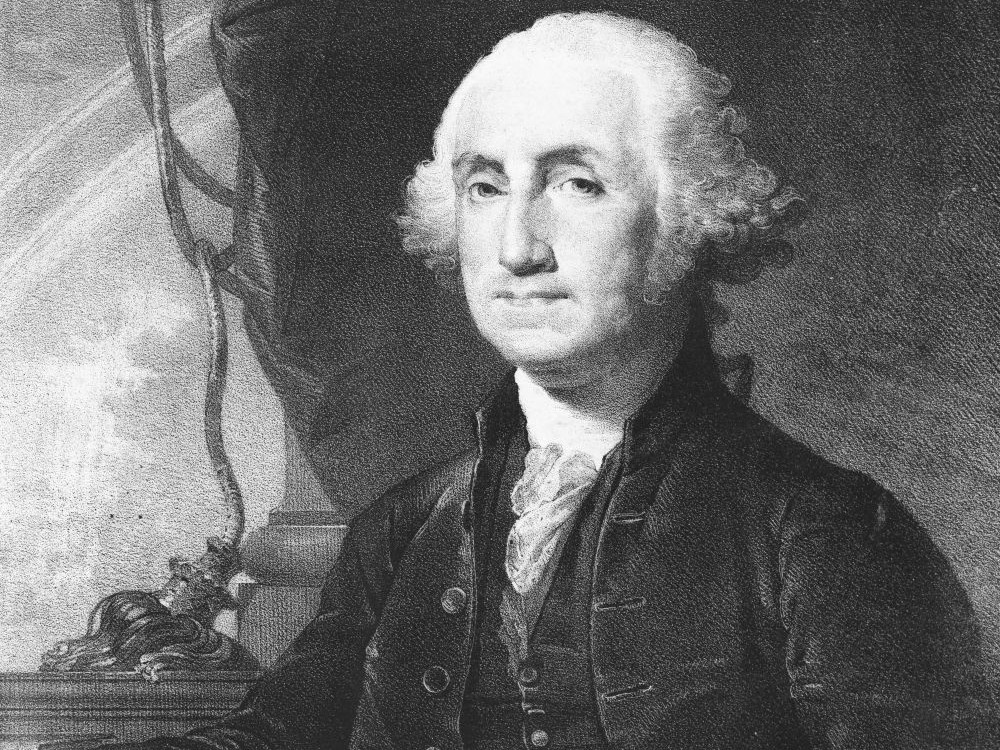
A lithograph from an original series painted by Gilbert Stuart (circa 1828) depicts George Washington, a signatory of the U.S. Declaration of Independence and the country's first president. (Unsplash/Library of Congress)
by Scott Hurd
Join the Conversation
Send your thoughts to Letters to the Editor. Learn more
On the United States' 250th birthday, American Catholics can celebrate the religious freedoms enshrined in the U.S. Constitution and Bill of Rights, and upheld by the church in the teachings of Vatican II.
But while they've long benefitted from religious freedom, American Catholics haven't always enjoyed religious tolerance. This is evident to anyone who visits our nation's capital and sees that the iconic Washington Monument was built with different shades of stone.
In 1854, Pope Pius IX donated a marble block from an ancient Roman temple as a gift for the monument's construction. It bore the inscription "A Roma Americae," Latin for "From Rome to America."
This incensed members of the anti-Catholic "Know-Nothing" political party. One dark night, nine of them raided the construction site, tied up the watchman at gunpoint, smashed the stone with hammers, and tossed the broken pieces into the muddy waters of the Potomac River.
Construction stopped shortly thereafter. When it recommenced in 1876, stone from a different quarry — with a slightly different shade of white — was used, resulting in a permanent and visible reminder of the religious intolerance Catholics have faced in U.S. history.
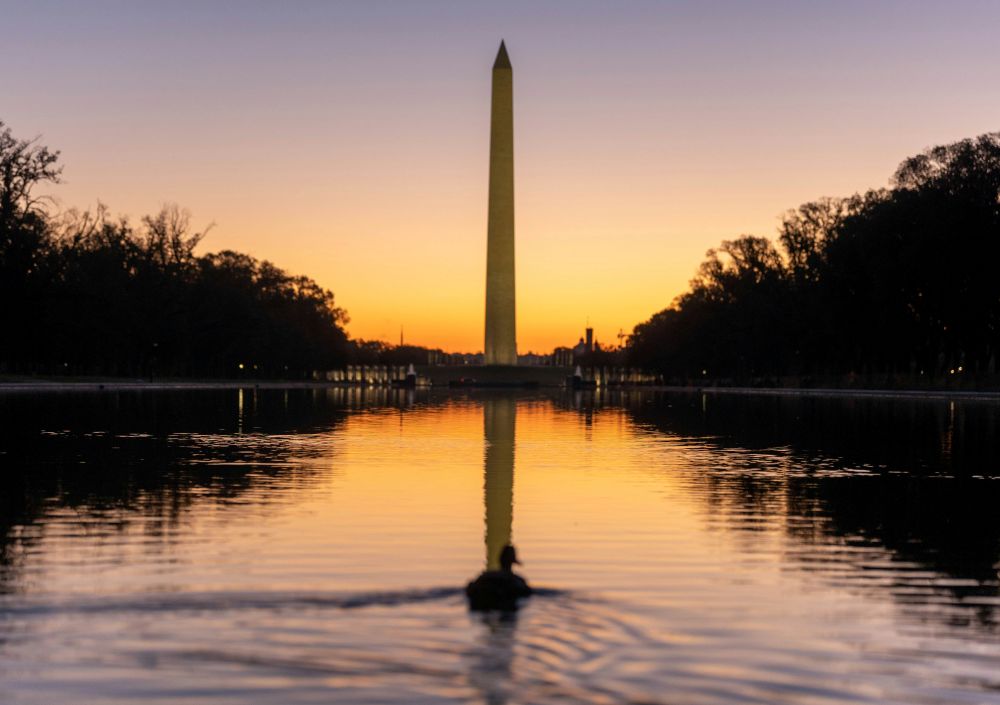
In 1854, Pope Pius IX donated a marble block from an ancient Roman temple as a gift for the Washington Monument's construction. (Unsplash/Harrison Mitchell)
Ironically, the man to whom this monument is dedicated — George Washington — was quite tolerant of Catholics and their religion. That was uncharacteristic for an Anglican churchwarden and Freemason in Virginia where, during the colonial era, the celebration of Mass was illegal. In fact, some accounts say that Washington ultimately became Catholic himself.
While commanding the Continental Army in 1775, Washington forbade his soldiers from burning the pope in effigy as was popular on Guy Fawkes Day ("Pope's Night") — a practice he condemned as "ridiculous and childish." Washington concluded: "(I)nsulting their religion is so monstrous as not to be suffered or excused."
One Catholic aide-de-camp during the war, Lt. Col. John Fitzgerald, became a close friend and business partner. During a St. Patrick's Day celebration at Fitzgerald's home in 1788, the two discussed the establishment of the first Catholic parish in Alexandria, Virginia. Washington would later make a sizable contribution to purchase land for St. Mary's Church, which now is a minor basilica.
Washington also donated funds for the construction of Catholic churches in Baltimore and Philadelphia. On Oct. 9, 1774, while a delegate to the First Continental Congress, he and another future president, John Adams, visited Philadelphia's St. Mary's Church. Washington would later attend a Mass there during the 1787 Constitutional Convention.
As president, Washington collaborated with an Irish Catholic architect, James Hoban, who won a contest to design the White House and worked under Washington's supervision during construction. Hoban became a Catholic leader in the new District of Columbia, helping establish a parish and providing funding for what became Georgetown University, as his son Henry was a Jesuit.
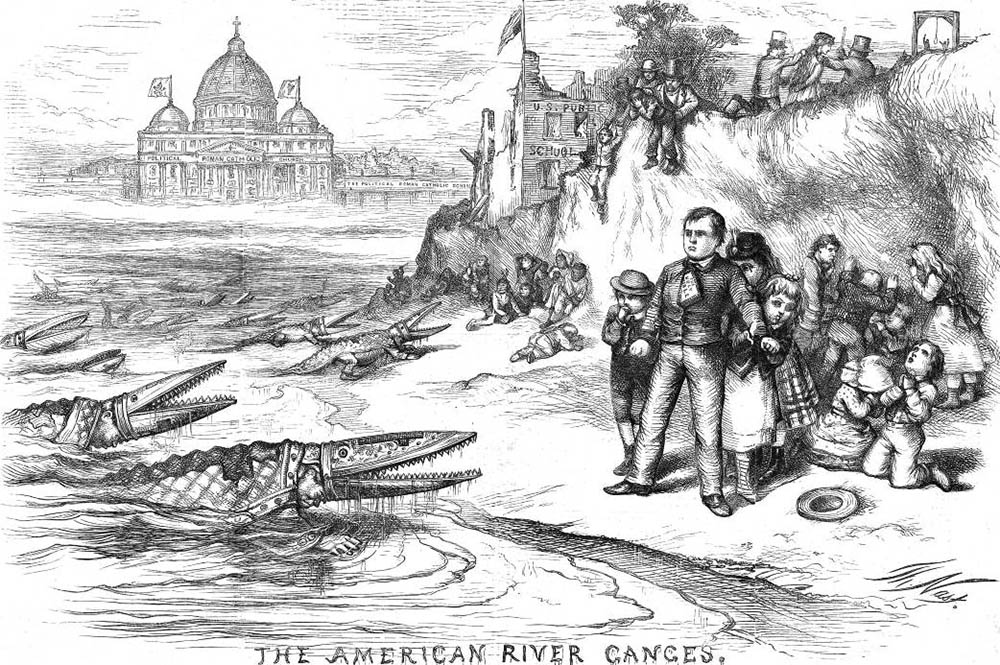
An 1870 political cartoon by Thomas Nast depicts Catholic bishops as crocodiles threatening America’s public school system. (Wikimedia Commons)
Also involved in funding Georgetown's establishment was Charles Carroll, the only Catholic to sign the Declaration of Independence. While serving on the Board of War during the revolution, Carroll was a staunch supporter of Washington's leadership as commanding general, and defended his service against critics who wished to remove him.
But it was in his correspondence with Charles' cousin, John Carroll, that Washington as a newly-elected president firmly expressed his commitment to religious freedom for Catholics in the fledgling nation.
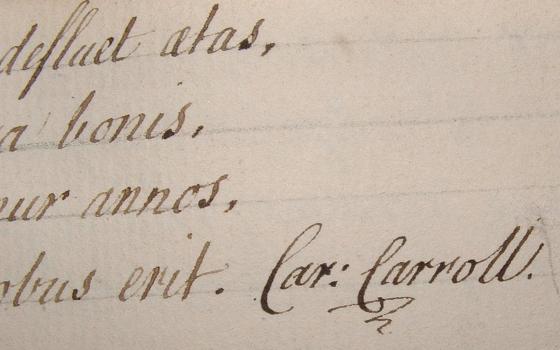
In 1790, after his selection as the first bishop in the U.S., John Carroll wrote a letter to Washington, praising his "respect for religion" and expressing Catholic hopes for "equal rights of citizenship," especially in those individual states that still restricted it.
Responding that same month, Washington assured Carroll and all the nation's Catholics that "those who conduct themselves as worthy members of the Community are equally entitled to the protection of the Civil Government." The following year, as an expression of gratitude, Carroll composed a now-famous prayer for Washington's inauguration.
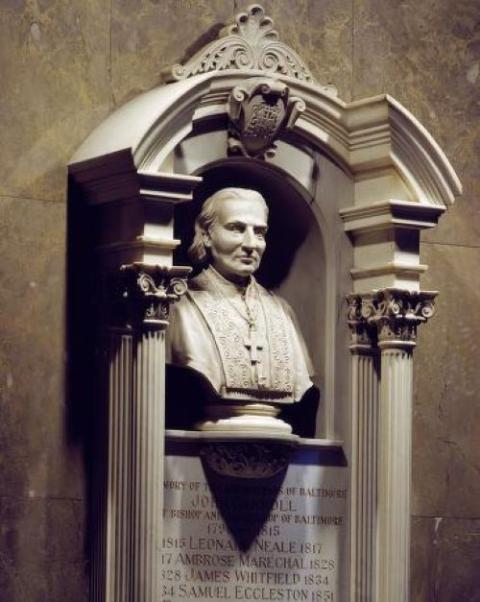
Bishop John Carroll, depicted in a statue at the Baltimore Basilica, Baltimore, Maryland, was a cousin of Charles Carroll, the only Catholic to sign the Declaration of Independence. (Library of Congress/Carol Highsmith)
The prayer asked that the president's "administration may be conducted in righteousness and be eminently useful to your people over whom he presides; by encouraging due respect for virtue and religion; by a faithful execution of the laws in justice and mercy; and by restraining vice and immorality."
After Washington's death in 1799 at age 67, Bishop Carroll eulogized him as America's "best friend." In 1895, Pope Leo XIII wrote of the "well-known friendship" between Washington and Carroll, a friendship later recalled by Pope Pius XII. But did this friendship, and Washington's close collaboration with other prominent Catholics, lead to his conversion?
Possible evidence includes Washington's displaying a portrait of the Blessed Virgin Mary at his Virginia home, Mount Vernon. Also, long after Washington's death, a report surfaced that an enslaved person at Mount Vernon, Juba, claimed that Washington made the sign of the cross before meals.
It's been long suggested, however, that Washington became Catholic on his deathbed. According to the story, he spent four hours with a Jesuit priest before he died, after which enslaved people at Mount Vernon claimed he'd been baptized. This account was allegedly maintained for decades by nearby African American communities, and circulated among local Jesuits as well.
Advertisement
This account may be nothing more than a fable. However, what is incontestable is that Washington firmly believed in religious freedom and tolerance. As president, he expressed hope that the new nation would avoid the "horrors of spiritual tyranny," and wrote that people should be "protected in worshipping the Deity according to their own consciences."
Washington's understanding of religious freedom wasn't restricted to Christians. He assured a Jewish congregation in Rhode Island that the "Government of the United States … gives to bigotry no sanction (and) to persecution no assistance." And he suggested that Muslims would be welcome to work at Mount Vernon.
Washington, in his own way, anticipated Vatican II's teachings on religious freedom, which, as Pope Leo XIV reiterated in his new encyclical, Magnifica Humanitas, "is a fundamental right grounded in human dignity that must be guaranteed by law so as to prevent people from being forced to act against their conscience."
We probably can't honor Washington as our first Catholic president. But on America's 250th birthday, we can certainly celebrate and embrace his commitment to religious freedom — and rejoice that it's shared by the first American pope.