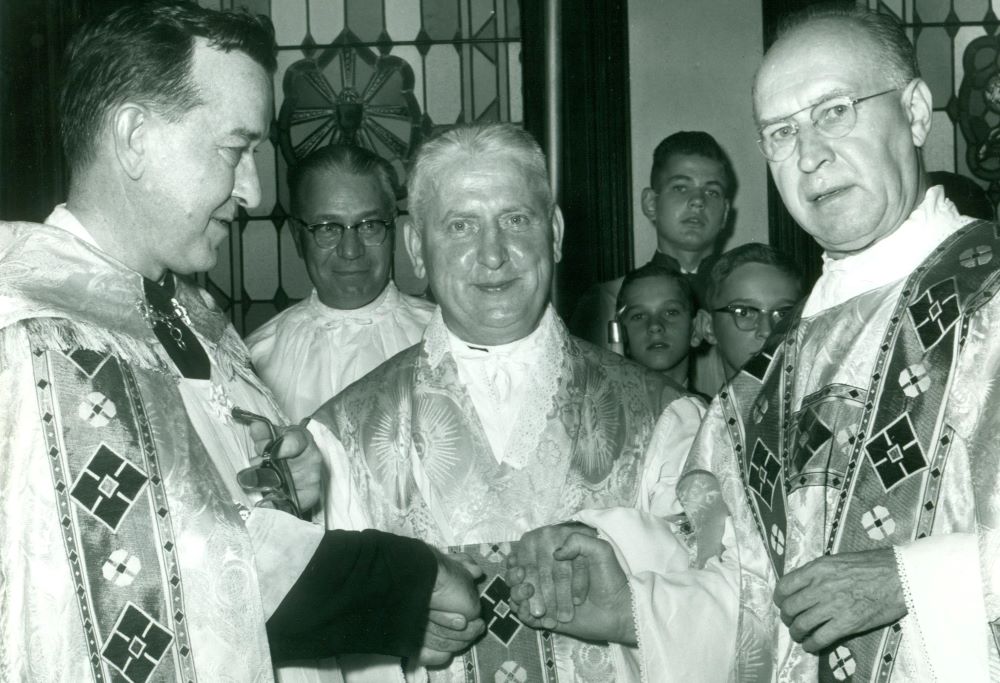
Jesuit Fr. Walter Ciszek, center, is welcomed home at a Mass of Thanksgiving in St. Casimir Catholic Church, Shenandoah, Pennsylvania, following his release from the former Soviet Union, where he was imprisoned and detained for more than 20 years. (Courtesy of Ciszek Society)
The Diocese of Allentown, Pennsylvania, recently announced that the cause for sainthood of Jesuit Fr. Walter Ciszek will not move forward at this time. The April 9 statement was careful and measured. It did not question his faith, his priesthood, or the enduring impact of his life. It simply said that the documentation gathered so far does not support advancing his cause for beatification.
For many Catholics, that news comes as a surprise. Ciszek's life seems to embody heroic holiness. He entered the Soviet Union as a missionary, was arrested, endured years of imprisonment and forced labor, and quietly ministered as a priest in some of the harshest conditions of the 20th century. His spiritual memoir, He Leadeth Me, continues to guide readers toward a deeper trust in God's providence.
If a life like that does not move forward in the canonization process, what does that say about how the church recognizes sainthood?
To answer that question, it is important to understand what the church is actually doing when she declares someone a saint.
Canonization is not simply a recognition that a person lived a good or even admirable life. It is a careful and rigorous judgment that the person lived the virtues — faith, hope, charity, and the moral virtues — in a consistently heroic way, and that this can be clearly demonstrated and safely proposed as a model for the whole church.
This requires more than reputation or even widespread admiration. It requires strong and consistent evidence: witnesses who agree, a life that shows steady virtue over time, and clarity in moments of severe testing. The church must be able to say, with confidence, not only that a person was holy, but that this holiness can be clearly seen and reliably attested.
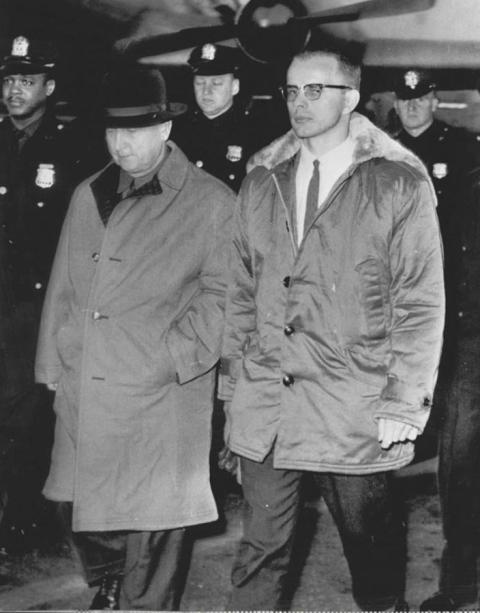
Jesuit Fr. Walter Ciszek, left, and American student Marvin Makinen were returned to the U.S. as part of a prisoner exchange with Russia on Oct. 12, 1963. (Courtesy of Ciszek Society)
A helpful comparison is Maximilian Kolbe, who lived under similar historical conditions and was canonized. Like Ciszek, Kolbe ministered under a totalitarian regime and endured imprisonment. In Kolbe's case, however, there is a striking consistency in how his life is described by those who knew him. His charity, his clarity of purpose and his readiness to give himself completely are attested across many witnesses and circumstances.
That pattern comes to a head in a single, decisive act. In Auschwitz, when a prisoner was selected for execution, Kolbe stepped forward and volunteered to take his place. That act was public, witnessed and unmistakable. It revealed, in one moment, the kind of love he had lived all along. The church can point to it and say: this is what heroic charity looks like, clearly and concretely.
Ciszek's life is no less courageous, but it is marked by a different kind of witness — one that is, in many ways, more hidden.
Much of his priestly ministry took place in secrecy. Many of the most important moments of his life unfolded in isolation or under conditions where reliable documentation is difficult to establish. Even where his holiness is evident, the circumstances in which he lived make it more challenging to assemble the kind of consistent, converging testimony that the church requires for canonization.
This highlights an important point. The church does not canonize based on what seems likely or inspiring. She proceeds with great care, relying on what can be clearly established and demonstrated with moral certainty.
None of this diminishes the real and lasting fruit of Ciszek's life.
The church does not canonize based on what seems likely or inspiring.
His writings have led many to a deeper trust in God, especially in circumstances that resist easy interpretation. He speaks with unusual clarity to those who find that their plans have fallen apart, or that their faith has been tested in ways they did not expect. He shows that holiness is not only found in visible success or dramatic moments, but also in learning to accept God's will as it is actually given.
In that sense, his witness remains deeply valuable — regardless of the status of his cause.
At this point, it is helpful to recall the example of St. Peter. Peter's failure is well known. He denied Christ three times. And yet he is not only a saint, but the first pope.
What follows that failure, however, is just as clear. His restoration is public. His mission is unmistakable. His life thereafter is marked by a steady and visible witness, attested by many and ultimately sealed in martyrdom. The full pattern — failure, repentance, restoration and enduring faith — is clearly seen and widely confirmed.
This brings us back to the heart of the matter.
When the church declares someone a saint, she is not making a judgment about whether God has sanctified that person. That belongs to God alone. Rather, she is making a judgment about what can be proposed to the whole church with clarity and certainty.
Advertisement
Some lives are marked by moments that can be clearly identified, witnessed and universally recognized as heroic. Others unfold in quieter ways, with much of their depth hidden from view or known only in part.
Ciszek's life belongs, in many respects, to that second kind.
And that may be part of what makes his witness so compelling.
He reminds us that holiness is not always found in what is visible or easily measured. It is often found in perseverance, in surrender, and in the quiet acceptance of God's will when it does not match our expectations.
Even if his cause does not move forward, his life continues to bear fruit.
And perhaps that, too, teaches us something essential about sainthood: that while the church must be careful in what she declares publicly, God is never limited in the ways He forms saints — often in places and in ways that remain hidden from view.