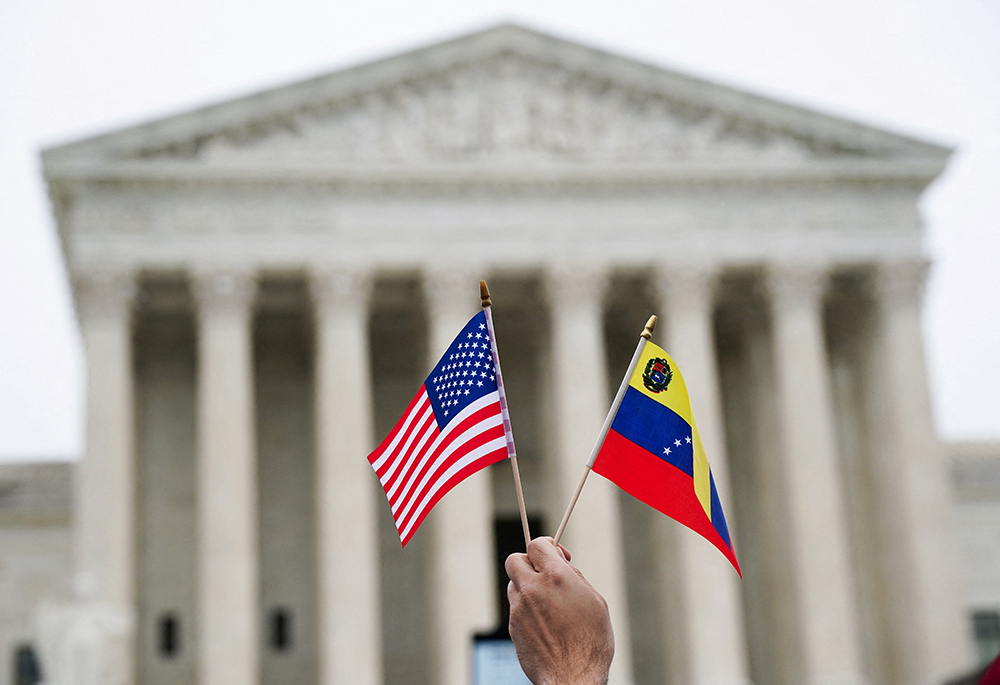
A person holds U.S. and Venezuelan flags as immigrants' rights activists and demonstrators attend a rally outside the U.S. Supreme Court in Washington April 29, 2026, as justices heard arguments on whether the administration of U.S. President Donald Trump can end the temporary protected status of Syrian and Haitian nationals. (OSV News/Reuters/Nathan Howard)

Join the Conversation
Send your thoughts to Letters to the Editor. Learn more
As the Supreme Court considered arguments for and against the Trump administration's efforts to end temporary protected status for Haitians and Syrians, I listened from home, tuned into the court's live audio feed on my old iMac.
It wasn't exactly like sitting in the august chamber amid sculptures of Moses, Confucius and Solon, but it did provide me with real-time access to a debate shaping the fate of close friends among the tens of thousands of people whose temporary protected status, or TPS, is at stake.
Although it heard arguments last week, the court will not issue its opinion until June or July. The justices' questions to attorneys on both sides Wednesday, April 29, suggest the case will be decided on procedural grounds as opposed to an assessment of the safety of those who would be deported if TPS is removed.
If not the safety of human beings facing extraordinary danger in foreign lands, which is the basis upon which TPS was established, what is the case really about?
"The true reason for the termination [of TPS]," argued the attorney representing the Haitian TPS holders, "is the president's racial animus toward non-white immigrants and bare dislike of Haitians in particular."
Attorney Geoffrey Pipoly went on: "The president has disparaged Haitian TPS holders specifically as undesirables from a quote, shithole country. And days after falsely accusing them of, quote, eating the dogs and eating the cats of Americans, he vowed that he would terminate Haiti's TPS. and that is exactly what happened."
Former Homeland Security Secretary Kristi Noem had argued that conditions in Haiti have improved sufficiently since TPS was first granted and that it was safe for Haitians to return. Rejecting that claim, a lower court pointed to the State Department's public warning against any travel to the country due to "kidnapping, crime, terrorist activity, civil unrest, and limited health care."
I wrote about the case a few months ago, and I continue to believe that Noem failed to follow the procedures required by law to end TPS. Whether a Supreme Court leaning so heavily in support of presidential power will agree remains to be seen.
Noem had left no doubt about her personal views of migrants, describing them in a December post on X as "killers, leeches, and entitlement junkies" while referencing the travel ban her department ultimately levied in January of this year against 39 countries.
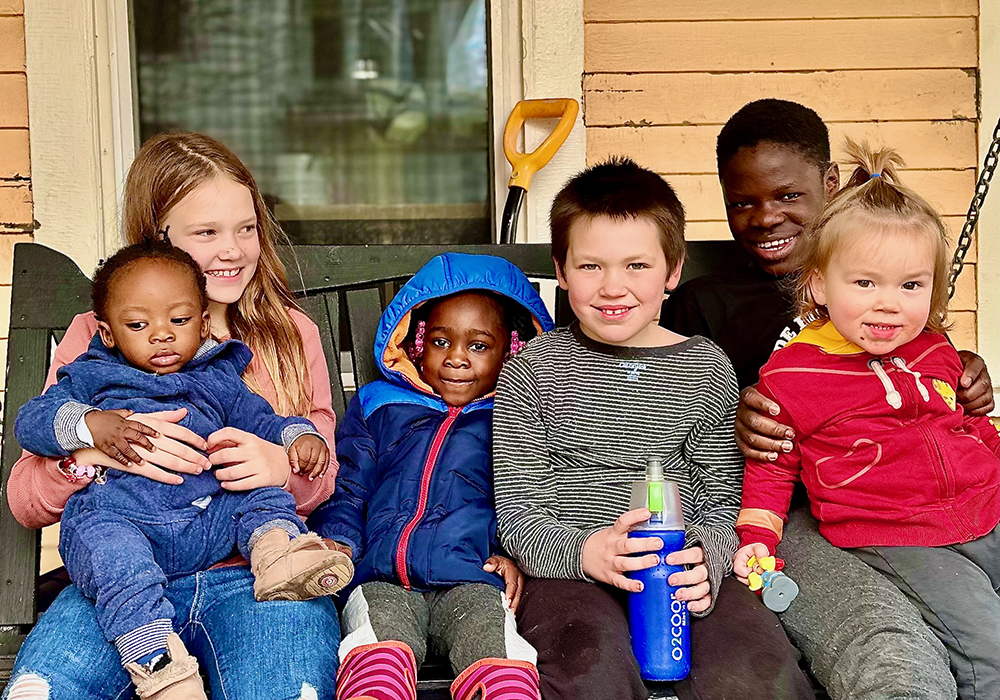
The author's grandchildren are pictured with Haitian family friends. (Courtesy of Bill Mitchell)
I had a different view as I pointed my browser to supremecourt.gov on Wednesday morning. In December 2023, we were introduced to a Haitian family of five that had spent the night sleeping on the floor at Logan Airport in Boston before being transported to a temporary shelter.
Since we have extra space at the two-family home we share with our daughter and family in Boston's West Roxbury neighborhood, we invited the family to stay with us until more permanent arrangements could be made. Our three grandchildren (and our dog, Benny) bonded with the Haitian kids.
After a couple of weeks, various state agencies collaborated to find more permanent lodging for the family. We've remained friends, and we've worked with the Immigration Advocacy Group at the Paulist Center to provide help along the way.
Advertisement
The family entered the country legally and the dad works full time, but they face deportation if TPS is removed. They point to the violence that gangs are inflicting throughout the country and say they'd be unable to support themselves there. The dad taught French before they left but the schools are in chaos, and UNICEF reports that more than one in four Haitian children are not in school.
(To avoid making the family a target, I'm not identifying them by name.)
Their stay in Boston has not been easy, struggling with a new language and scraping for ways to survive financially in one of the country's most expensive cities.
Until the lower court intervened, Trump had attempted to end TPS in February. As the calendar ticked down toward their likely deportation, I checked in with the family to discuss strategies for dealing with ICE should officers show up at their door. I asked them how they were doing.
"We have faith in God," the dad replied. "Everything goes well in the name of Jesus Christ."

The author's grandchild and Haitian family friends are pictured with dog Benny. (Courtesy of Bill Mitchell)
Since Wednesday was his day off, I suggested he listen to the high court proceedings on his smartphone.
"In the USA, there's 350,000 Haitians, maybe more," he texted me after the proceedings concluded. "They work, they pay taxes to the country, they put money in the state treasury."
He questioned the wisdom of "kicking out" people who generate more than $1 billion in annual tax revenue across the country.
I asked him whether the hearing left him feeling fearful or hopeful.
He texted me back: "Honestly, I am not fearful … I am still hopeful."
A version of this column was posted by the author on his Substack account. It is republished here with permission, and has been edited for style and clarity.