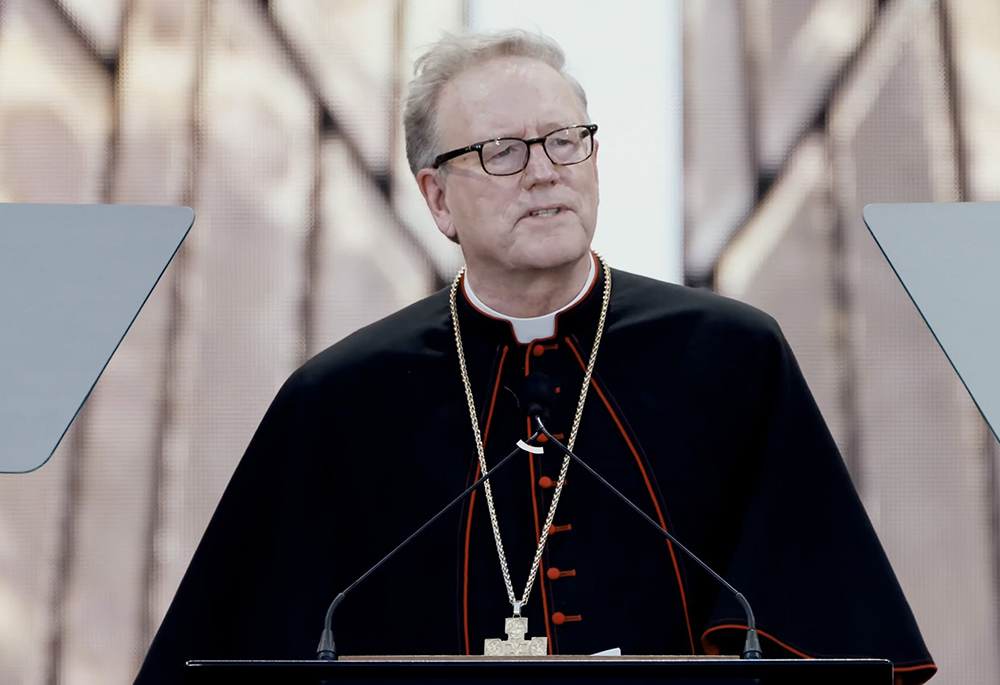
Bishop Robert Barron of Winona-Rochester, Minnesota, a member of the U.S. Religious Liberty Commission, speaks at the Rededicate 250: A National Jubilee of Prayer, Praise & Thanksgiving event at the National Mall in Washington, May 17, 2026. (OSV News screenshot)

Join the Conversation
Send your thoughts to Letters to the Editor. Learn more
Bishop Robert Barron recently participated in the "Rededicate 250" celebration on the National Mall. It was an odd event. Barron took the occasion of his visit to Washington to give interviews, two of which showed signs of intelligent life and signs of ideological co-optation.
"The roots of our country are deeply religious and I would argue the basic principles of the country are inescapably religious and I think we're here to celebrate that," Barron told EWTN News' Colm Flynn. The argument got a bit weird. He noted that in Lincoln's handwritten draft of the Gettysburg Address, the words "under God" did not appear, that Lincoln had written only "that his nation might have a new birth of freedom" and added the phrase "under God" spontaneously when delivering the remarks.
"So, you say, this is just pious decoration. No, no, no," Barron asserted. "I think it represented a deep intuition that Lincoln had that you can't really understand our democracy without it." He said the phrase "under God" was "meant to hold off tyranny." He explained that in the ancient world most political orders deified their rulers, but not Israel which believed all rulers were "under God," subject to divine judgment, "and our founders understood that."
There is a lot to unpack here. First, let's give Barron a bit of credit for acknowledging that a belief in God should prevent any deification of a political ruler, though he might have paused when he said that and offered a knowing look to his audience. We are left wondering if he understood the irony.
Second, it was President Dwight Eisenhower, not Lincoln, who said, "Our form of government has no sense unless it is founded in a deeply felt religious faith, and I don't care what it is." Unlike Lincoln, Eisenhower was not particularly articulate and his expertise was in managing invasions, not navigating complex issues of religion and politics.
Barron's historical sensibilities are rough around the edges. He cites nothing in Lincoln's writings, nor in writings about Lincoln, to suggest his interpretation of the decision to add "under God" was not just a rhetorical flourish. Lincoln certainly was one of the most profound theological thinkers to ever live in the White House but he was also an expert wordsmith.
Advertisement
It is the case that Lincoln and all the founders all believed in some sort of providence, that the world was not devoid of meaning. The Deists among them had the most remote understanding of providence, a belief that God set the world in motion but did not interfere beyond having ordained the laws of physics and nature. At the other end of the spectrum, the one Catholic signer, Charles Carroll, obviously believed God continued to show up in human affairs. The Rev. John Witherspoon was a Protestant minister who was also sympathetic to parts of the Scottish Enlightenment, and he would have been somewhere between the two poles.
The founders were all believers in some sense and they also lived in a place and time in which Christian ethical understandings were in the air they breathed. There was yet no utilitarianism, no existentialism, no libertarianism in the ambient culture. But distinctions between Deists and orthodox Christians were, and are, profound in reckoning human responsibilities and rights, and Barron always seems to lump everyone together. Citations to the founders should acknowledge the founders had many different perspectives and ideas and often clashed profoundly. The "intent of the founders" was rarely univocal and uncomplicated.
Later, discussing the totalitarian regimes of the last century, Barron claims that the first move of tyrants "typically" is to "get rid of religion." Actually, it is usually political opponents and organized labor that are the first to go when a tyrant takes power. As for religion, many tyrants co-opt it, as Franco did in fascist Spain, and others make a truce with the organizations of religion while undermining their wellsprings as Hitler did in Nazi Germany. Only in Soviet Russia was religion first on the chopping block, along with political opponents and aristocrats.
In an interview with The Washington Post's Adam O'Neal, Barron was asked if America is a Christian nation. He explained that if the phrase meant any kind of establishment of religion, the answer is no, but "If they mean there are principles that are derived from the Judeo-Christian biblical tradition that are essential to our democracy, I would say, 'yeah.' "
The claim would be unobjectionable if he acknowledged the role of liberalism in the founding which is, of course, historically inaccurate. Most of the founding fathers were familiar with the writings of John Locke and other Enlightenment thinkers who argued that the government received its legitimacy not from the church nor from any organic natural law, but from the consent of the governed. To fail to even mention liberalism in this context is like trying to cook in a French restaurant with no butter. It can't be done.
The omission is also strange given the fact that Catholicism is the one religion which, like liberalism, proposes a universal ethic. The Torah tells Jews how to organize their own community. The Church of England is, well, the Church of England, not the Church of France or Spain. At the time of the founding, both French and Austrian Catholicism were suffering Gallicanism and Josephism respectively, both of which were attempts by the crown to garner more authority over the local Catholic churches, but those efforts failed. Liberalism insisted that all human beings were endowed by the same rights just as Catholicism insists that all human beings are endowed with the same dignity.
Barron went on to say in the EWTN interview that in our time, some people think that "any mention of religion in a public context is an establishment of religion." Barron added that the phrase "Christian nationalism" is "a slippery term … I don't even know what it means." I agree with him about the slippery quality of the term "Christian nationalism," but the bishop's comments about religious establishments seemed premised on another historical misunderstanding. He said that the founders opposed religious establishments because, under Britain, they had experienced an establishment. Actually, several founders wanted an establishment, only at the state level, not the federal. In Virginia, Patrick Henry lost his struggle to have the Anglican church established in his state, but in New England, religious establishments continued into the mid-19th century.
My frustration with Barron is always the same: He is very smart, capable of discussing complex historical and ideological realities, but he too often reverts to bumper sticker slogans that are false and, worse, unhelpful. He can do better, but doesn't.