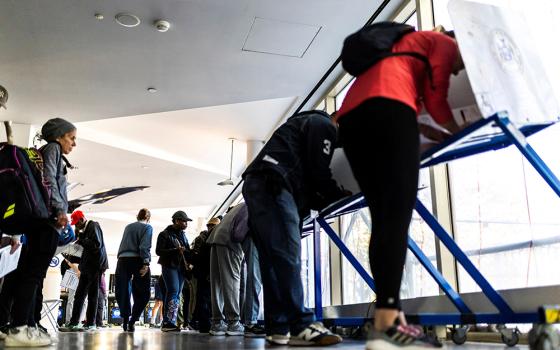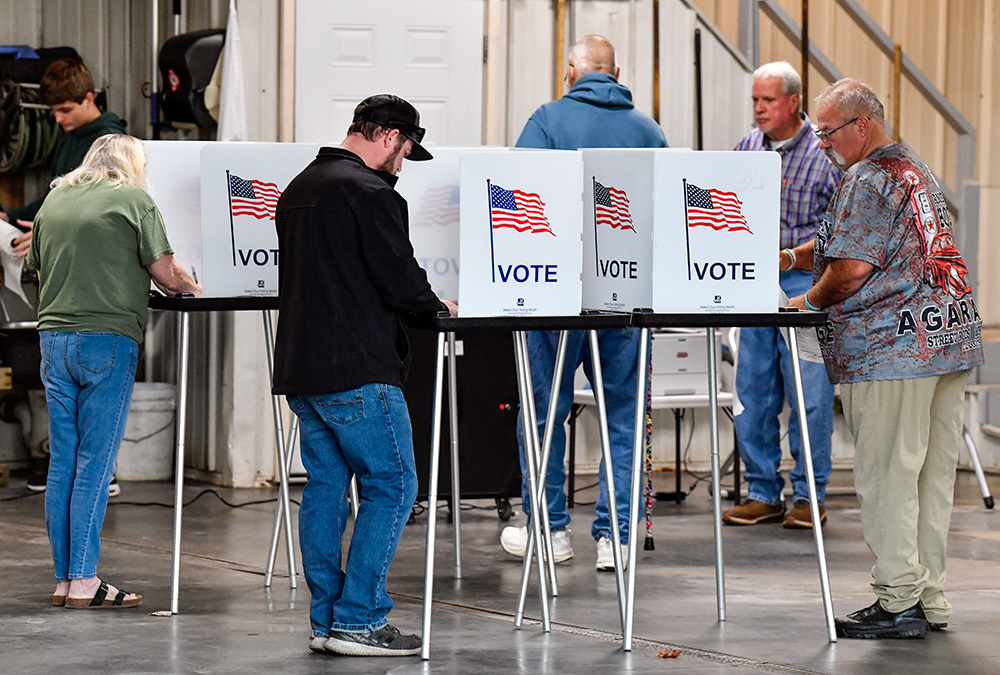
Voters cast their ballots on Election Day at the Bald Knob Fire Station in Frankfort, Ky., Tuesday, Nov. 5, 2024. (AP/Timothy D. Easley)

Join the Conversation
Send your thoughts to Letters to the Editor. Learn more
All year, discussions about the upcoming midterm elections came down to a single question: Will there be a blue wave that carries the Democrats into the majority in the House and, less likely, the Senate?
In the past couple of weeks, speaking with a variety of political operatives and observers, I noticed that the question has morphed into a slightly, but importantly, different one: How big will the blue wave be?
The party that controls the White House almost always loses some seats in the midterm races. In the past hundred years, that rule has only been broken twice. In 1934, two years after Franklin Delano Roosevelt secured the presidency, Democrats increased their majorities in both the House and the Senate. In 2002, two years after George W. Bush won the White House, and a little more than one year after the terrorist attacks of Sept. 11, 2001, the Republicans increased their numbers in both chambers.
That won't happen in 2026. President Donald Trump's sinking poll numbers — Nate Silver has the president 20 points underwater — combined with his ability to dominate the news cycle make it very difficult for GOP candidates to separate themselves from him. What is more, on the key kitchen-table issue of the economy, Trump is almost 30 points underwater with 62.1% disapproving of his handling of the economy compared to only 33.3% who approve. For a man who ran in large part on his business bona fides, these numbers are terrible.
Rural areas are among the hardest hit by both tariffs and rising prices. Farm equipment uses a lot of diesel fuel and AAA reported last week that the nationwide average price of a gallon of diesel is $5.5477. It was around $3 a year ago. Farmers were already operating on slender profit margins. How do they absorb such a steep increase in a basic commodity they can't do without?
Advertisement
Consequently, the Democratic Congressional Campaign Committee recently added some candidates in largely rural districts to its "Red to Blue" program. I got to meet one of those candidates this past week, Zach Dembo, who is running for an open seat in Kentucky's 6th Congressional District. Lexington is the only large city in the district. Dembo's family were farmers for six generations until his parents went to college. He served as a Navy JAG and later in the Civil Rights Division at the Department of Justice until it became clear that the Trump administration was interested in terminating civil rights, not defending them.
Dembo is bright and articulate, but that is not enough to win a seat in Congress. KY-6 voted for Trump by 15 points in 2024 but in 2023, Democratic Gov. Andy Beshear won the district by 20 points. Last month, the Cook Political Report shifted its rating of KY-6 from "Solid Republican" to "Likely Republican" based on polling showing the race close and Dembo's outpacing his GOP opponent, Ralph Alvarado, in fundraising. Independents and even Republicans increasingly want someone in Congress whose first loyalty is to them, not to the cult of Trump. I suspect Dembo is on his way to Congress.
Interestingly, some of the districts on the Democratic Congressional Campaign Committee's "Red to Blue" list have significant Catholic populations. "Catholics, and former Catholics who are still culturally attuned to Catholic identity, are outsized populations in many of the most critical districts," says Stephen Schneck, founder of Catholics for the Future. "In Pennsylvania, for example, PA-7 around Allentown and PA-8 around Scranton have large Catholic and formerly Catholic populations that might be persuaded or mobilized by the right kind of appeals."
Full disclosure: I worked for Schneck years ago when he was the director of the Catholic University of America's Institute for Policy Research and Catholic Studies.
Schneck said that his new organization is also targeting Catholics and former Catholics in some Midwest districts that are in play, such as Iowa's 1st Congressional District, the boundaries of which track more or less with those of the Catholic Diocese of Davenport, and Wisconsin's 3rd District, centered on La Crosse.
"These four seats are currently held by Republican incumbents. So, the Catholic vote could be the difference. I'm convinced that the right messaging appeals to Catholic identity while raising concrete policy concerns like the cuts to Medicaid that impact seniors," he told me.
Winning the House is important, but taking the Senate is even more important, given the upper chamber's role in confirming judicial nominees and some executive branch officials. We'll look at the state of the Senate in my next column.