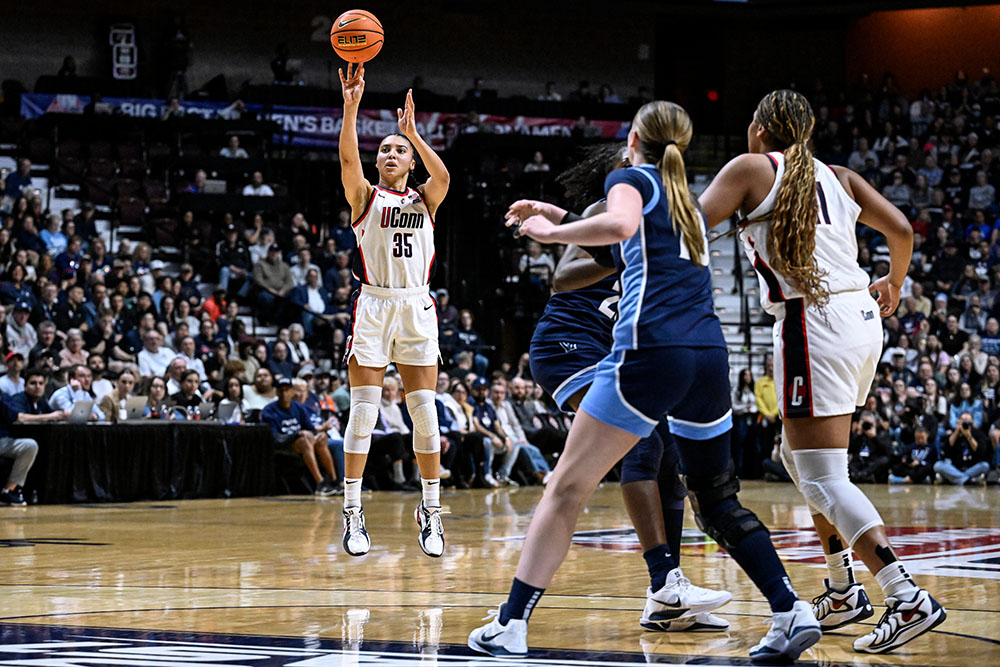
UConn guard Azzi Fudd shoots during the first half of an NCAA college basketball game against Villanova in the finals of the Big East tournament March 9, 2026, in Uncasville, Conn. (AP/Jessica Hill)

Join the Conversation
Send your thoughts to Letters to the Editor. Learn more
It's March Madness. The Big East and other conference tournaments are finishing the finals in women's basketball and beginning in the men's. After that, the NCAA tournament will garner most of the attention of the sports world for three consecutive weekends.
At a time when the world holds its breath, fearful that the various wars around the globe might trigger yet greater conflagrations, watching an uneven economy on the whole and profoundly unjust in the particular, and mourning the loss of many of the norms of our democracy that now lie in tatters, we need the break that March Madness provides.
I have often wondered about our human fascination with sports. We just finished the Winter Olympics in Milan and Cortina, Italy, and I watched every night. These young people are so talented, they compete so fiercely and under such pressure, and yet they demonstrated good sportsmanship throughout. Of course, to be the best in the world — or to be a top-tier college basketball player — you have to lead something of an unbalanced life. You have to be driven, and driven obsessively, to seek perfection. You do not get to indulge some of the pleasures others indulge. Do they have time to daydream?
Competition seems an indelible mark of humanity, and far better it be directed into sporting rivalries than to military ones. Still, it is odd that the Olympics have shed none of the nationalistic overtones with which they began in the heyday of European romanticism, which was closely linked to nationalism. The modern Olympics were begun in 1896. Germany and Italy had only recently become nations, with many blessings and curses for their peoples and the world that flowed therefrom. Brahms was dying but Strauss was still writing waltzes. The anti-liberal impulses of the age were pronounced. And so when the Olympics began, athletes competed for their countries, marched into a ceremony behind their national flag, and anthems celebrated the winners. In 1936, Adolf Hitler hosted the Olympics in Berlin, introduced the torch relay, and tried to turn the whole enterprise into a demonstration of German ethnic and racial superiority. An athlete from Ohio named Jesse Owens gave the lie to Hitler's propaganda.
Advertisement
More than any other sport, college basketball highlights the singular achievement of a social policy that was once controversial, Title IX. That was the law that required colleges and universities to start spending as much on women's sports as they do on men's. In the early aughts, the University of Connecticut women won several years in a row, but then there emerged first half a dozen, then a dozen, now 20 or more schools that could win on any given night. Women's college athletics have opened up new horizons for hundreds of thousands of young women, and that is a very good thing.
Of course, living about 20 minutes from Storrs, Connecticut, I would like to see the UConn Huskies win both the men's and women's championships this year. The women are likely to do so; the men need to bring their A game. In 2004, UConn won both, and again in 2014. They are the only school to do so. That is why they call Storrs the "College Basketball Capital of the World."
In the next few weeks, some of the rivalries among schools will appear over the top, some of the fans might cause a ruckus, a coach or two will be ejected. But a point guard will steal the show with a clutch shot, or a power forward will grab a rebound that seals the victory. Some previously unheralded team will do better than expected and be dubbed this year's "Cinderella." And, in the end, one team wins it all but there are no losers. The kids who participated in these sports will return to their lives with important lessons about teamwork, hard work, practice and dedication.
The rest of us will get a much-needed break, not entirely of course, from the horrors and tragedies of the world. The next generation will give us a bit of hope. And the games will be very, very exciting.
You are reading a selection from Michael Sean Winters' weekly newsletter. To get the full edition — including the "In the News" link roundup — delivered 24 hours before it appears online, sign up here!