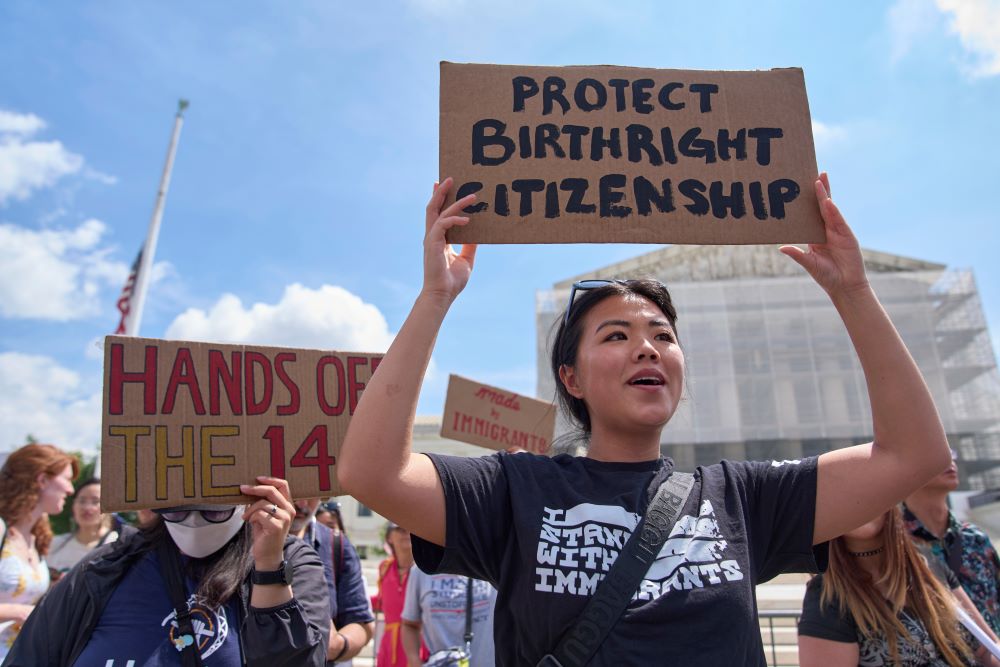
Hannah Liu, 26, of Washington, holds up a sign in support of birthright citizenship, May 15, 2025, outside the Supreme Court in Washington, D.C. (AP/Jacquelyn Martin)

Join the Conversation
Send your thoughts to Letters to the Editor. Learn more
The U.S. Supreme Court again finds itself cast as the last bulwark between President Donald Trump's ideological fetishes and the rule of law. The court will hear arguments this week in the case Trump v. Barbara, which challenges the president's efforts to end birthright citizenship.
This case, like the tariff case, Learning Resources, Inc. v. Trump, should put to rest the idea that the court is in Trump's pocket. As I have noted before, it may be unfortunate that Chief Justice John Roberts has been a fan of the unitary executive theory for years, and has brought the other conservatives on the court along with him, causing them to side with the president on a host of cases. We can disagree with their decision, but it is hard to see how it amounts to caving to Trump when they held these legal theories back in the 1980s.
Questions about the Roberts' court were raised even before Trump began his second term. After the 2022 Dobbs' decision overturning Roe v. Wade, some people claimed the court was illegitimate, for example here by a law professor and here by a U.S. senator. Of course, many on the right consider Roe to be a sign of the court's illegitimacy when it was rendered back in 1973. These critics of the court's decisions do not like the outcome. Legitimacy is made of sterner stuff.
The issue of birthright citizenship seems clear enough. The plain language of the 14th Amendment reads: "All persons born or naturalized in the United States, and subject to the jurisdiction thereof, are citizens of the United States and of the State wherein they reside." There are no qualifying phrases. It does not say "persons born to U.S. citizens" nor does it require domicile. Although the focus of the amendment was ending slavery, the drafters of the amendment, and the citizens who ratified it, certainly were aware that immigration was changing the shape of America. The "Know Nothing" anti-Catholic party had been formed precisely to restrict citizenship to migrants, but none of their proposals made it into the text of the amendment.
The plain meaning of the text matters to the court's conservative majority who describe themselves as textualists. They shun looking into constitutional penumbras. They deny a right that is implied, not clearly articulated, the status of a constitutional right. We may think that they are a little too fixated on the actual text of a given statute or constitutional provision, but in this case, it makes any effort to side with the president virtually impossible.
Advertisement
Writing at Slate Smita Ghosh pointed to an 1844 decision by a New York state court, Lynch v. Clarke, "In the 1844 case, Judge Lewis Sandford held that Julia Lynch, the child of Irish parents who was born during their 'temporary sojourn' in New York, was a U.S. citizen," Ghosh explains. The case involved an inheritance left by Julia Lynch's uncle and, at that time, noncitizens were prevented from inheriting property. Julia had been born in the U.S. while her parents were visiting the country.
The lawyers for her uncle Bernard, who claimed the entire inheritance, argued that:
Julia was not a citizen because her parents were only temporary visitors to the United States and lacked a permanent "residence or domicile" there. In Bernard's telling, citizenship was not the product of "mere accidental birth," but rather the "political condition" of the parents. He conceded that Julia would be an American citizen under English legal principles, under which everyone "born in her dominions" was a "subject," but he argued that the colonists, when declaring independence from British tyranny, had also liberated themselves from the common-law rule of birthright citizenship.
This is the essence of the Trump administration's argument today. But, in 1844, the court dismissed those arguments and ruled that Julia was a citizen by reason of her birth.
At this moment in our nation's history, with the president running roughshod over a host of democratic norms, it is important that enough Americans acknowledge the legitimacy of the court so that it can function as a bulwark against authoritarianism and protect the Constitution. On account of the clear text of the 14th Amendment, and the ruling in Lynch v. Clarke, it is hard to see how the court will rule in the president's favor. Let's hope the attacks on the court's legitimacy do not convince the president to ignore the court's ruling. That would be a true constitutional crisis.