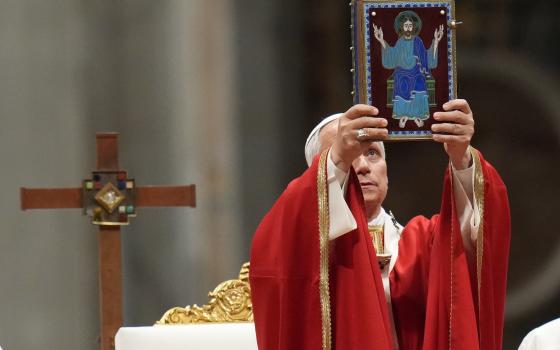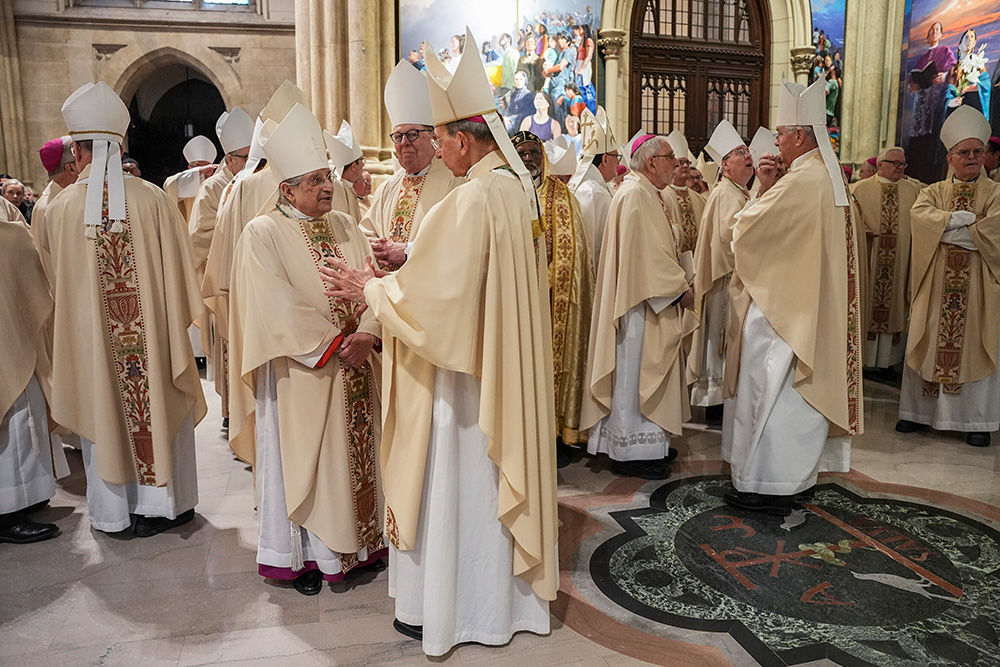
Bishops talk as they gather for the procession during the Installation Mass for New York Archbishop Ronald Hicks at St. Patrick's Cathedral in the Manhattan borough of New York on Feb. 6, 2026. (Pool Reuters via AP/Angelina Katsanis)

by Rebecca Bratten Weiss
Join the Conversation
Send your thoughts to Letters to the Editor. Learn more
The U.S. bishops are finally criticizing the Trump administration. They've been speaking out against the administration's attacks on immigrants and bellicose foreign interventions. They even filed an amicus brief demanding that the Supreme Court strike down Donald Trump's executive order eradicating birthright citizenship. Now, as the United States' war against Iran escalates, Archbishop Paul Coakley, president of the U.S. Conference of Catholic Bishops, has asked Catholics to pray that leaders "seek dialogue over destruction, and pursue the common good over the tragedy of war."
The bishops' criticism of Trump's policies is welcome and necessary. But it's also years too late. If they had listened to the many Catholics who raised the alarm about Trump early on, we might have avoided our current disastrous national trajectory. This belated pastoral response to the MAGA movement reveals a failure of leadership and prudential judgment. It's also a failure of synodality.
No, the bishops cannot endorse candidates without risking their tax-exempt status. But they've found ways in the past to make their preferences known. Some, like Bishop Robert Barron of Winona-Rochester, Minnesota, and Cardinal Raymond Burke, have made no secret of their admiration for Trump and the MAGA movement. A few, like Bishop John Stowe of Lexington, Kentucky, have been stalwart shepherds, standing with the vulnerable and denouncing oppression. Cardinals Blase Cupich, Robert McElroy and Joseph Tobin have sharply criticized Trump's foreign policy, but without naming him.
But most of the U.S. bishops have continued to repeat the same mantras about voting that they uttered for decades, insisting on abortion as the "preeminent" issue. In so doing, they have stealthily but clearly steered Catholic voters toward Republicans. Even Pope Francis overlooked the danger that the MAGA movement could pose when he equated Trump with Kamala Harris in the lead up to the 2024 election.
It's hard to take seriously the bishops' claims to moral leadership when they failed to note the danger Trump and the MAGA movement pose for the common good.
This comparison, in the climate of the past few years, is ludicrous. The Republican Party has veered toward the extreme right. The Trump administration has turned the power of the state against its own citizens, carried out extrajudicial killings, stripped the poor of desperately needed aid, depleted our publicly funded resources and removed environmental protections. Now it is waging an illegal war while disregarding all humanitarian guardrails.
Against this backdrop, the bishops' mantras about abortion, recycled from 30 years ago, seem out of touch to the point of being robotic.
Many of us have written extensively on the nuances of abortion policy. We've dug into the history of abortion politics, looked at global data, and pointed over and over to the reality that absolutist abortion bans do not work to sustain human dignity and the common good.
We've also written repeatedly on the grave dangers of the MAGA movement, with its disdain for human rights and rejection of the idea that all have equal dignity. The bishops do not appear to have listened to us at all.
It's hard to take seriously the bishops' claims to moral leadership when, even with the vast wealth of resources from the Catholic tradition at their disposal, they failed to note the danger Trump and the MAGA movement pose for the common good. And it's hard to take seriously their dedication to synodality when they failed to hear the strident cries of warning uttered by so many.
Advertisement
Synodality was a hallmark of Francis' papacy. He insisted on it as essential to the church's identity and mission, reiterating that a synodal church is a listening church. His oft-quoted assertion that good shepherds should "smell of the sheep" encapsulated his belief that pastors should not be authoritarian top-down rulers but should walk with and among the people.
So why didn't the bishops listen to us when we spoke out about Trump? Where were the shepherds?
A listening church needs to listen not only at special sessions and not only to select interlocutors. Synodality needs to be habitual and organic. It must be woven into the fabric of church governance as well as the methodologies of the magisterium. And it must entail listening to the most vulnerable — especially when they raise the alarm about threats that will affect them most closely.
It's often said that the church moves at a glacial pace because it thinks in terms of centuries. Conservative Catholics view this as a good thing. And indeed, there is a place for moving slowly. But thinking in terms of centuries is not commendable when it means showing up too late for the "least of these." If the church is truly guided by the Spirit, shouldn't it be on the vanguard of justice? After all, this is not the first time church leadership has lagged behind lay Catholics and secular persons. Look at the delay in acknowledging women's rights or opposing slavery.
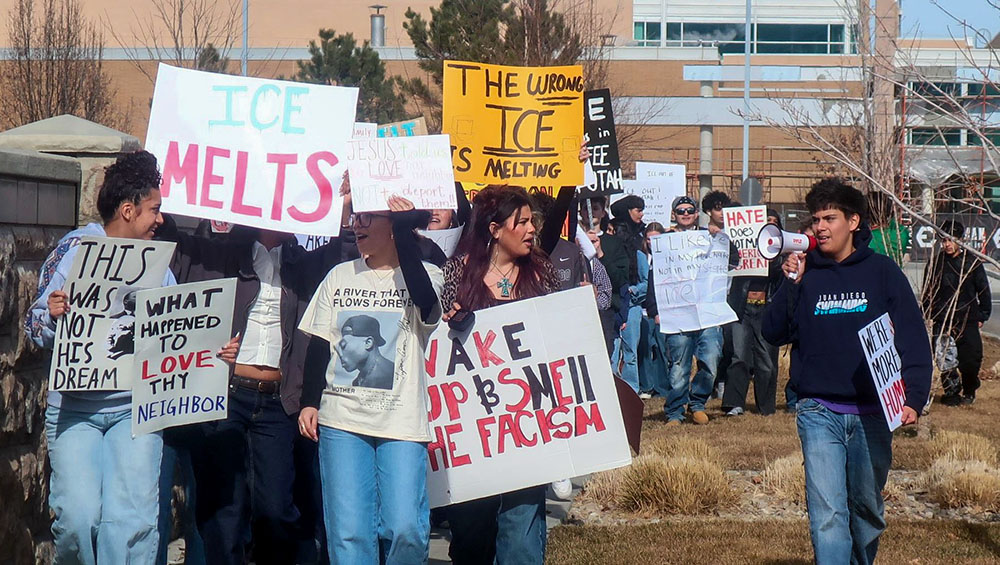
Students at Juan Diego Catholic High School in Draper, Utah, conduct a walkout in support of the immigrant community and to protest against U.S. Immigration and Customs Enforcement and the U.S. Department of Homeland Security just after noon on Feb. 3, 2026. (OSV News/Intermountain Catholic/Linda Petersen)
It could even be argued that the U.S. bishops, with a few courageous exceptions, helped create this current threat to peace and justice. Now that they are speaking up, it feels less like moral leadership and more like a belated and ineffectual bandage on a wound they helped create.
Maybe the church moves so slowly not because of the slow, deliberate work of the Spirit, but because of the slow, deliberate work of men to block the Spirit.
If the church in the U.S. had truly practiced synodality, if its leaders had acted like pastors instead of princes, the bishops would have been united in opposing Trump and the MAGA movement's policies from the very beginning. They've made it clear for years that they can influence politics without directly endorsing people.
It's difficult to gauge how much the U.S. bishops' emphasis on abortion has shaped American politics in the contemporary world, but their influence is not negligible. This makes it even harder to forget the bishops' conference's long silence on the dangers of Trump's far-right, xenophobic and militaristic policies.
If the church's leaders couldn't see through the truth of who Trump is, they could have at least listened to those of us who did.