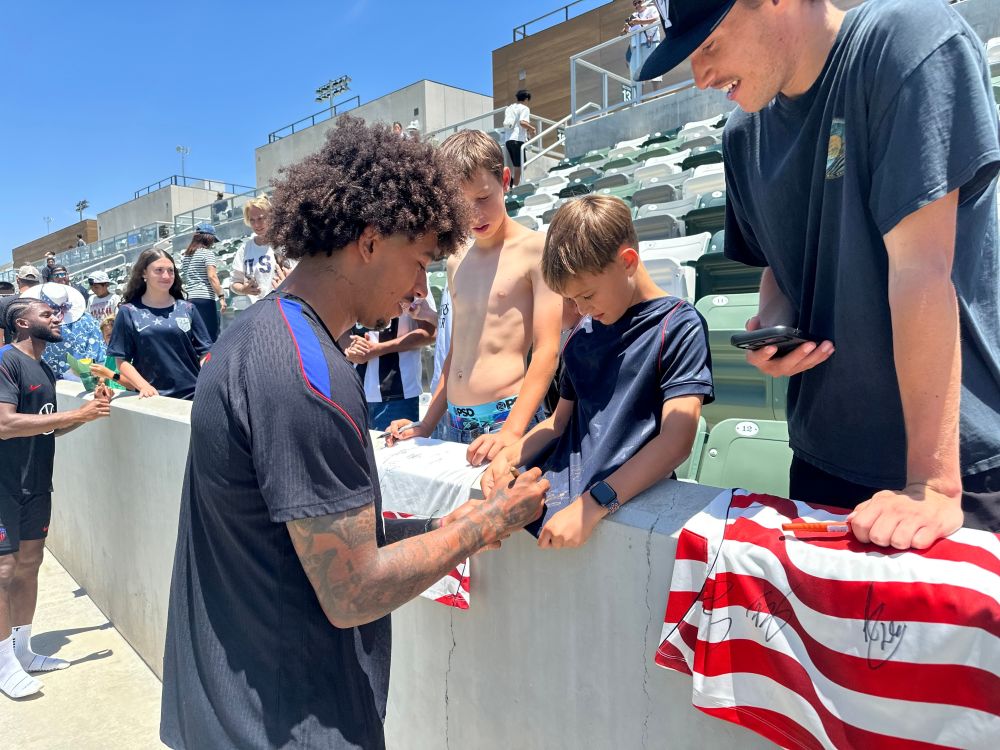
United States defender Chris Richards, front left, gives autographs to fans after the national team's first practice at its World Cup soccer tournament training base in Irvine, Calif., June 8, 2026. The international tournament begins July 11. (AP/Greg Beacham)
When the 2026 FIFA World Cup begins today (June 11), it will be the largest in the tournament's history and the first time three nations — the United States, Canada and Mexico — will jointly host. Millions will travel across borders. Billions will tune in. Cities will have spent years preparing. Entire communities will welcome visitors from around the globe.
Most conversations about the World Cup focus on what happens on the field. Who will win? Can Argentina defend its title? Will a new star emerge? As a Brazilian, I would be lying if I said I have not spent some time wondering whether Brazil can finally win a sixth World Cup.
Yet over the past several months, I have found myself thinking less about the matches and more about the cultural moment itself, perhaps influenced by Pope Leo XIV's Magnifica Humanitas. Much of the attention surrounding the papal encyclical has centered on artificial intelligence and technology, but what stayed with me was a much broader question: What kind of society are we building together, and what does it mean to keep human dignity at the center of that work?
Leo writes, "I therefore wish to add my own voice to this living tradition." Catholic social teaching has always tried to read the signs of the times and reflect on them in light of the Gospel. Inspired by that tradition, I would like to add my own voice as the world prepares for the World Cup.
Nations are rarely as simple as the stories we tell about them. Beneath political debates and media narratives are real people, real communities and real hopes for the future. That's one reason why the World Cup is so special: It forces encounter. People who would otherwise never meet will share trains, restaurants, streets, stadiums, victories, disappointments and stories.
Catholic social reaching does not ask us simply whether the World Cup tournament succeeds, it asks us to look more carefully at what success means.
The "Compendium of the Social Doctrine of the Church" offers several principles that help us think about encounter, the essence of our human life together, among them the dignity of the human person, the pursuit of the common good and participation. How might we hold these three principles up to host countries Mexico, Canada and the U.S.?
Human dignity in Mexico
It's difficult to think about modern Mexico without themes of migration, borders, opportunity and belonging. For many, Mexico has become tied to debates about immigration policy, security and national identity — debates that real people can disappear inside. Before long, human beings become categories: legal or illegal, documented or not. One of the most important contributions of Catholic social teaching is its insistence that we begin somewhere else. Before someone is a migrant, a foreigner or a citizen, they are a person created in the image of God.
The World Cup has a way of interrupting our categorizations. We see families traveling together, traditions being celebrated, cultures shared and stories told. The people we too often discuss in the abstract become visible again. In a world increasingly tempted to sort human beings into competing groups, that reminder matters.
Common good in the US
The U.S. continues to wrestle with questions of belonging and national identity, even as we prepare to welcome not only close allies and neighboring countries but also nations with whom we have profound disagreements, economic rivalries, diplomatic tensions and, in some cases, active conflicts. For a few weeks, supporters from every corner of the globe will enter the same stadiums, walk the same streets and participate in the same event. This does not solve political disagreements or erase ideological differences. But it does create a space where people are invited to see one another differently.
The irony is difficult to ignore: The same country actively debating who should cross its borders will spend the summer welcoming people from around the globe. Perhaps that is why the common good feels so relevant. It pushes us beyond questions of individual preference and asks what kind of society we are trying to build together, and whether we can imagine a future where our flourishing is connected even when our politics, cultures and histories differ.
Participation in Canada
Who gets to participate in shaping the life of a community?
Canada is often described through the language of diversity and multiculturalism, but beneath conversations about immigration, housing and Indigenous reconciliation lies a deeper question about belonging. Participation is about more than being present, or even included. It is about having a voice. It is about contributing to the future of a society and being recognized as a stakeholder in its success.
The World Cup offers a small but powerful image of this reality. Volunteers, local communities, business owners, supporters and visitors all become part of something larger than themselves. The tournament succeeds not simply because athletes show up, but because entire communities participate in making it possible.
Advertisement
After the final whistle
Of course, major sporting events are never as simple as their promotional campaigns suggest. World Cups and Olympic Games have long promised economic growth, infrastructure improvements, tourism and international visibility to their host cities. Sometimes those promises become reality; sometimes they do not. History is filled with examples of host cities left with underused facilities, unexpected costs and communities questioning whether the benefits justified the investment. Other cities point to lasting improvements and opportunities that might never have emerged otherwise.
The 2026 World Cup will likely contain some of both realities. Amid the questions already emerging about ticket prices, immigration enforcement and cost-benefit ratios, everyday people still have to live their lives in these host cities. It is easy to focus on the matches, the visitors and the excitement of the tournament, but someone still has to get to the hospital for their shift, open their restaurant, commute across the city or pick up their children from school.
The success of an event cannot be measured only by attendance numbers, tourism revenue or television audiences. It must also take into account the people who continue living and working in these communities long after the visitors have gone home. Catholic social teaching does not ask us simply whether the tournament succeeds, it asks us to look more carefully at what success means. Who benefits from these investments? Who feels welcome? Who participates? Who bears the burdens?
Reflecting on these questions has made me less interested in who wins the tournament and more interested in what comes afterward. The final whistle will eventually blow. A champion will be crowned. The crowds will go home. What will remain?
If Pope Leo is right to ask what kind of humanity we are forming and what kind of society we are building, then the 2026 World Cup's greatest legacy may not be found in a trophy cabinet, a stadium or a record book, but in what we choose to carry forward after the final whistle.