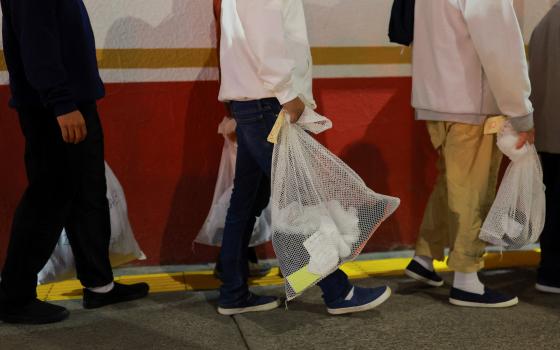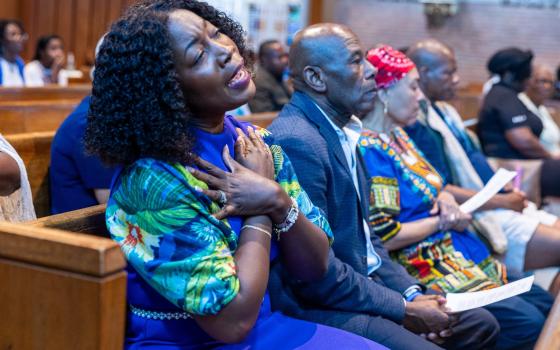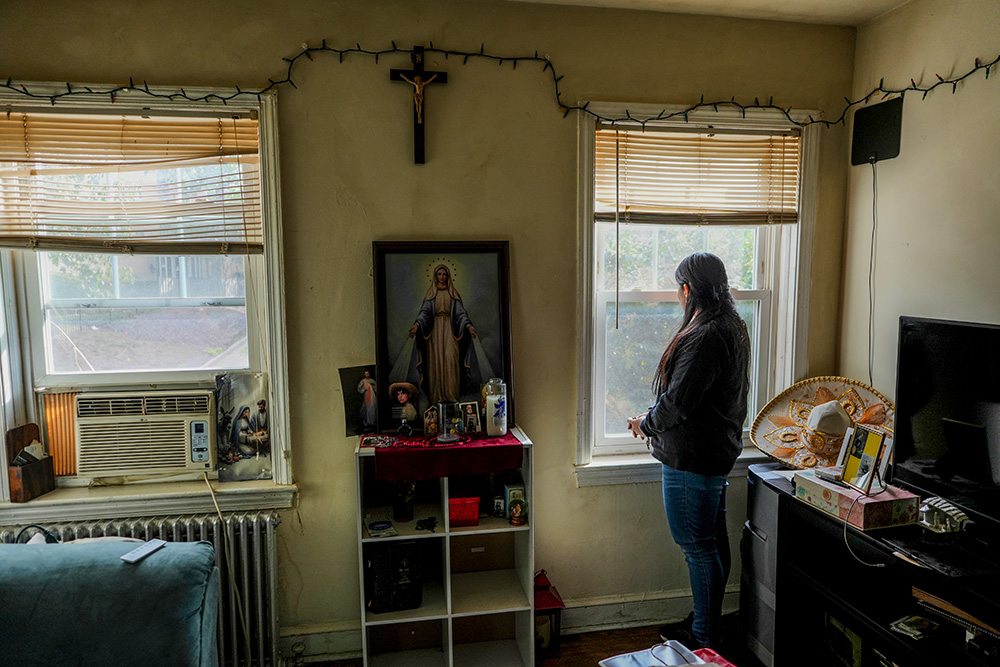
A parishioner of the Shrine of the Sacred Heart whose husband was detained by immigration agents looks out her home's window in Washington, D.C., Oct. 10, 2025. (AP/Luis Andres Henao)

by Yolanda Chávez
Join the Conversation
Send your thoughts to Letters to the Editor. Learn more
Once, after a parish gathering with migrant women, I sat next to a mother who had just received difficult news about her son. He had been detained earlier that week. The room had grown quiet as people slowly began to leave. She remained seated, her hands folded in her lap.
Every few minutes she whispered the same words under her breath:
"Dios mío, cuídalo."
"My God, take care of him."
She was not praying long prayers or speaking in theological language. Her words were short, almost fragile, like someone holding onto the thinnest thread of hope. Yet as I listened, I realized that what I was witnessing was not a weak form of prayer. It was one of the most powerful prayers I had ever heard.
The deepest prayer in the world rarely happens in churches or retreat centers. Rather, it happens in kitchens, hospital waiting rooms, detention centers; quiet moments of worry, when people speak to God with only a few words. These are the prayers that rise between breaths.
Prayer, at its most essential, is not a performance of faith but a gesture of trust. A few words whispered in the midst of fear can carry the weight of an entire life.
Prayer is simply what happens when the human heart speaks to God in the middle of ordinary life.
In the Gospels, many of the prayers Jesus hears are brief and urgent. A blind man cries out from the roadside, "Jesus, Son of David, have mercy on me." A desperate father pleads, "Lord, help my unbelief." From the cross, another voice requests simply, "Remember me when you come into your kingdom." These prayers are not polished or carefully constructed. They rise from the raw edge of human need. They are survival prayers.
The Christian tradition has long known that prayer does not always require many words. In fact, Scripture often connects prayer with breath itself. In the biblical languages, the word for Spirit — ruah in Hebrew, pneuma in Greek — also means breath or wind. The Spirit is the breath of God moving through creation, the quiet life that sustains everything that lives.
To pray, then, is nothing more than allowing that breath to carry a few words toward God.
This is why some of the most ancient forms of Christian prayer are brief phrases repeated gently with the rhythm of breathing: "Lord Jesus Christ, have mercy on me." "Come, Holy Spirit." "Into your hands." These prayers are simple enough to be carried throughout the day, whispered while walking, working, waiting or worrying. They remind us that prayer does not always require special conditions. Prayer is simply what happens when the human heart speaks to God in the middle of ordinary life.
Advertisement
In the communities I have accompanied over the years, I have heard many of these small prayers. A mother blessing her children before they leave the house. A woman whispering, "Lord, give me strength," while waiting for difficult news. Someone murmuring a quiet "Thank you, God" at the end of a long day.
Among migrant communities, these prayers often become even more essential. They are whispered while waiting for news from home, while crossing borders and while beginning again in unfamiliar places. They are short prayers carried in pockets and repeated in moments of uncertainty, like small lights people refuse to let go of.
In such moments, prayer does not appear as spiritual achievement. It appears as trust: sometimes fragile, sometimes stubborn, but deeply real.
These prayers rarely appear in books about spirituality. They are too brief, too ordinary, too woven into the fragile rhythms of daily life. Yet they carry a depth that formal words sometimes cannot reach. They rise not from certainty, but from relationship, from the quiet confidence that someone is listening.
They may be simple prayers, but they hold the weight of real life.
The smallest prayers are often the most honest ones. They are not meant to impress, only to reach the heart of God, one breath at a time.