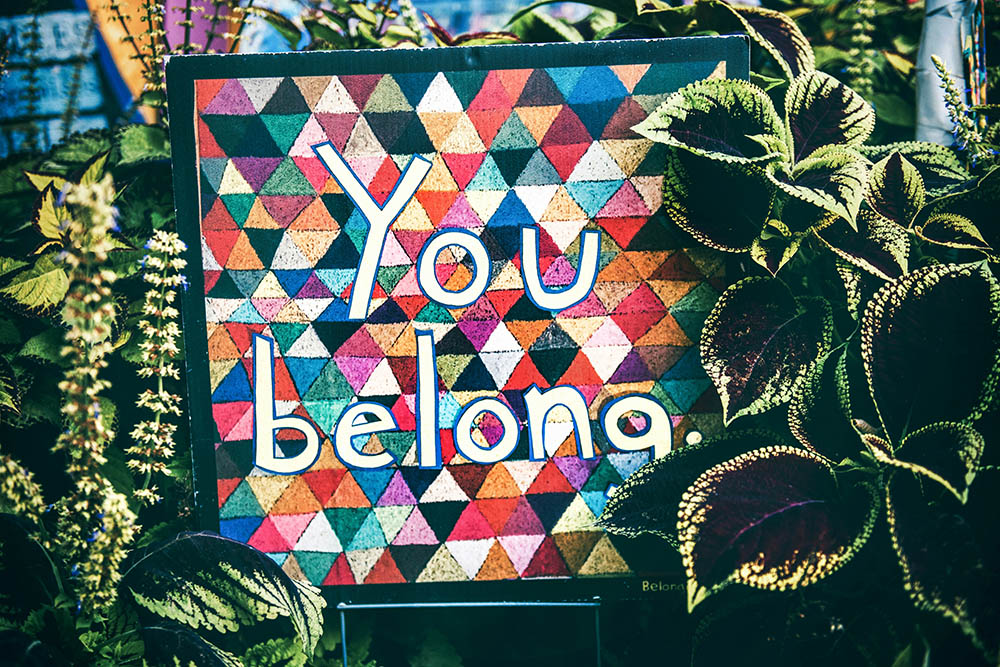
(Unsplash/Tim Mossholder)

by Yolanda Chávez
Join the Conversation
Send your thoughts to Letters to the Editor. Learn more
There is a line in the Book of Ruth that I keep returning to.
"Where you go, I will go.
Where you live, I will live.
Your people shall be my people,
and your God my God." (Ruth 1:16)
At first glance, it sounds like a simple promise between two women walking together on a dusty road. But the more I sit with it, the more I realize how quietly radical those words are.
In most of the world, belonging is defined by things we inherit. We belong through blood, language and birthplace. Our identities are anchored to land, family names and histories that stretch behind us like roots in the soil of memory. We rarely question this kind of belonging because it seems natural, almost inevitable.
But Ruth speaks these words after all of that has been broken.
Her husband has died. The life she imagined has collapsed. Naomi, her mother-in-law, is returning to Bethlehem, a land that is not Ruth's home and a people who are not her own. Nothing obligates Ruth to go with her. In fact, Naomi urges her to stay behind, to return to her own people and rebuild her life among those who share her language and customs.
Yet Ruth does something unexpected, something quietly radical.
She chooses to walk into a future where nothing is guaranteed. She steps into a different kind of belonging, one that does not grow out of territory or lineage but from relationship.
"Your people shall be my people."
It is one of the most beautiful declarations in Scripture, and it reveals something many migrants understand deeply: Belonging is not always inherited. Sometimes it is chosen. Sometimes it is forged in the fragile space between loss and hope.
Advertisement
For people who live between countries and languages, belonging often becomes something that must be rebuilt from the ground up. It rarely arrives ready-made; instead, it grows slowly through gestures that might appear small but carry enormous meaning. A shared meal after Mass. A phone call from someone who notices you have not been at church. Someone asking how your children are adjusting to their new school. These moments weave threads of connection where once there was distance.
I have witnessed this kind of belonging many times in migrant communities among women who arrived in the United States unsure of their future. I have witnessed them slowly begin organizing prayer groups in living rooms. A rosary, coffee in chipped mugs, children running through the hallway. Week after week, they returned to sit together, to share stories of work, worry and hope.
Over time, something unexpected happens.
The living room became a place where tears could fall without embarrassment. Someone whose husband had been detained by immigration authorities found other women ready to accompany her through sleepless nights. A newly arrived family found people willing to help translate school forms or guide them through unfamiliar systems. Little by little, a community took shape.
Like Ruth and Naomi, these women were rebuilding life through fidelity to one another.
Migration often breaks the structures that once gave stability to our lives. People leave behind extended families, familiar streets, languages that feel like home in the mouth. Even faith communities — which once held memories of baptisms, weddings and funerals — may suddenly be far away.
In that moment, the question becomes spiritual: Where does belonging live now?
At its best, the church becomes a place where that question can begin to find an answer. Not because the church eliminates the pain of displacement, but because it reminds us that Christian identity does not depend on geography.
In fact, faith has always been shaped by people on the move.
People who once believed they no longer had a place slowly discover that community can be rebuilt through gestures of loyalty, hospitality and care. Strangers become companions.
Abraham left his homeland without knowing where the road would lead. The people of Israel crossed the desert in search of a promise they could not yet see. Even the Holy Family fled violence and became refugees in Egypt before returning to begin again.
The story of salvation has never been a story of stability. It is a story of God accompanying people whose lives unfold between departure and arrival.
Perhaps this is why Ruth's words continue to resonate across centuries. In the middle of uncertainty, she does not speak about territory or inheritance. She speaks about relationship: "Your people shall be my people."
Those words do not erase the vulnerability of migration. Ruth still walks into an unknown land. Naomi still carries the grief of everything she has lost. But the promise between them creates a new possibility: belonging that grows out of mutual commitment rather than shared ancestry.
In many migrant communities today, that same quiet miracle continues to unfold.
People who once believed they no longer had a place slowly discover that community can be rebuilt through gestures of loyalty, hospitality and care. Strangers become companions. Prayer circles become extended families. Churches become spaces where names, stories and hopes are remembered.
None of this erases the reality of borders or the pain of displacement. But it reveals something deeper about the life of faith.
Belonging, in the end, is not only something we inherit from the past. Belonging is something we create together as we walk the road of faith.
And in those fragile yet faithful acts — sharing bread, holding one another's stories, refusing to let someone walk alone — God continues to gather a people from those who once believed they no longer belonged anywhere.