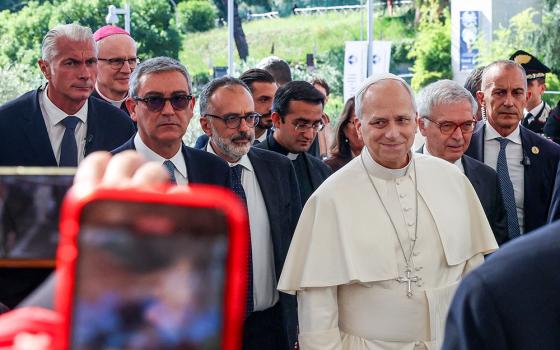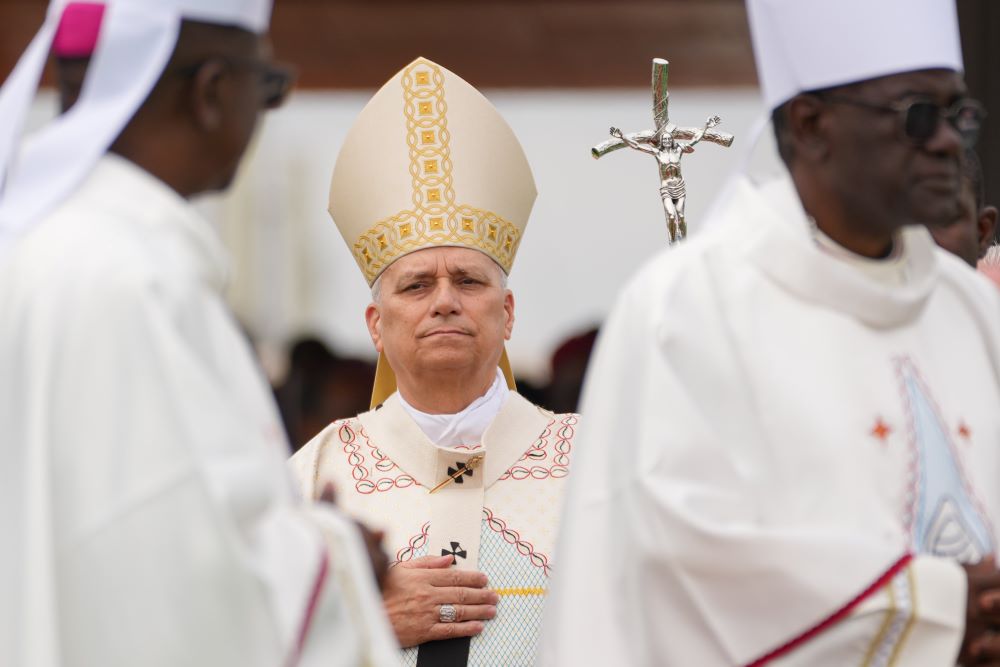
Pope Leo XIV walks in a procession during Mass at Yaoundé-Ville Air Base in Yaoundé, Cameroon, April 18, 2026. (CNS/Lola Gomez)

Join the Conversation
Send your thoughts to Letters to the Editor. Learn more
After Bishop Robert Prevost was whisked to Rome from his diocese in Chiclayo, he admitted he would have preferred to continue his ministry in northern Peru rather than assume one of the most powerful posts in the Vatican bureaucracy.
Now, almost one year into his pontificate, it shows that Pope Leo XIV was itching to return to the Global South after spending most of the last year largely confined to Rome for 2025 Jubilee events.
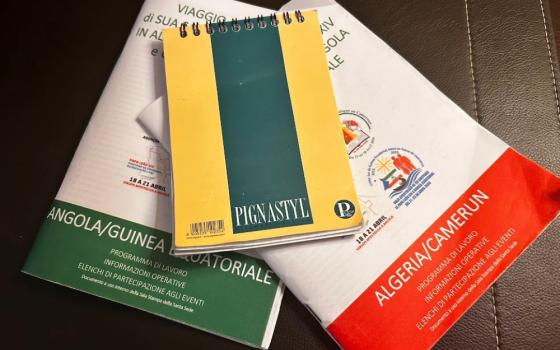
Beginning his 11-day, four-nation tour of Africa, he told journalists en route to Algeria April 13 that he wanted to visit the continent for his first apostolic journey, and that the trip was already being discussed in the first month following his election. Although Leo wanted to get back to his missionary roots after two years as a senior cardinal in Rome, standing invitations for papal visits to Turkey and Monaco put that prospect on the back burner.
Yet it was in sub-Saharan Africa, a vibrant mission territory with large but poverty-stricken Catholic communities — not unlike the pope's former mission in Peru — that Leo seems to have come into his own.
'Faith does not separate the spiritual from the social. Indeed, it gives Christians the strength to interact with the world, responding to the needs of others, especially the weakest.'
—Pope Leo XIV
Throughout his three days in Cameroon, Leo has started to shed the soft-spoken reputation he had garnered in Rome, raising his voice with a newfound fervor to decry the corruption and violence plaguing much of the African continent in messages that have rippled worldwide.
It was fitting, therefore, that Leo chose Cameroon as his first stop in sub-Saharan Africa. The Central African nation is referred to as "Africa in miniature" due to its cultural and linguistic diversity, and set the stage for his messages of social justice to resonate across the continent.
Leaving for Angola April 18 he told journalists that Cameroon is in many ways "the heart of Africa" which, despite its great opportunity, also suffers from "an unequal distribution of wealth" seen across African nations.
The Algeria leg, which began the trip and where Leo paid homage to his spiritual father St. Augustine, set the theological base for the rest of his journey. In Cameroon, the pope pivoted his focus toward the concrete challenges of the communities he encountered.
That may render the entire trip itself a "Leo in miniature" which reflects his own life's trajectory of cultivating deep roots forged in Augustinian spirituality before being thrust into a missionary context to advocate for the world's poor.
The pope's speeches in Cameroon clearly show that he understood his visit there as a platform to speak to all of Africa, where 20% of the world's Catholics live.
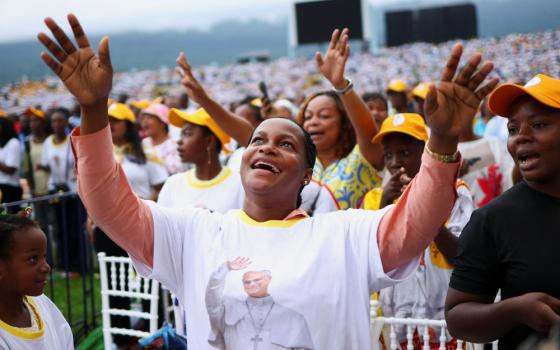
In French-speaking Douala, for example, Leo pivoted to English midway through his homily to encourage the youth of Africa to be "protagonists of the future" and to "reject every form of abuse or violence, which deceives by promising easy gains but hardens the heart and makes it insensitive." His audience was larger than the 120,000 who attended the Mass.
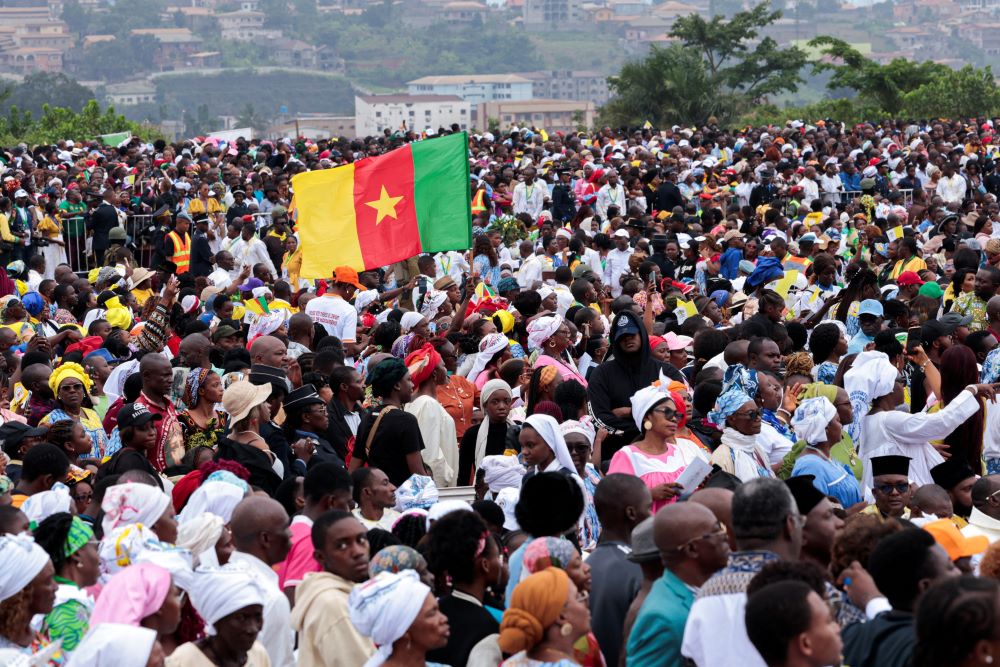
A Cameroonian flag flies as the faithful gather for a holy Mass led by Pope Leo XIV at Yaoundé-Ville air base in Yaoundé, Cameroon, April 18, 2026. (OSV News/Reuters/Luc Gnago)
With Africa as his pulpit, Leo also directed pointed messages to the world writ large, which he said is "being ravaged by a handful of tyrants" at a meeting for peace in Cameroon's northwest, a region marred by internal strife since 2017.
Those words were interpreted in some media reports as a rebuke of President Donald Trump, who issued a stream of invective toward Leo on social media the evening before he departed for his trip, but the pope later made a point of quashing that interpretation.
Still, Leo lofted harsh words toward the external forces which exploit Africa, even if not directed at any one particular person.
In Cameroon, where the government and the church has been deeply impacted by drastic cuts in USAID funding, Leo condemned without naming any particular nation how "billions of dollars are spent on killing and devastation, yet the resources needed for healing, education and restoration are nowhere to be found."
He also condemned how those "who rob your land of its resources generally invest much of the profit in weapons, thus perpetuating an endless cycle of destabilization and death."
Likewise, at the Catholic University of Central Africa in Yaoundé, which caters to students from across the region, Leo dedicated an ample part of his comments to the wide-reaching concern over the use of artificial intelligence. He warned of "embedded biases and forms of power that shape our perception of reality," highlighting the dangers of new technology via the threats they pose to eroding human relationships.
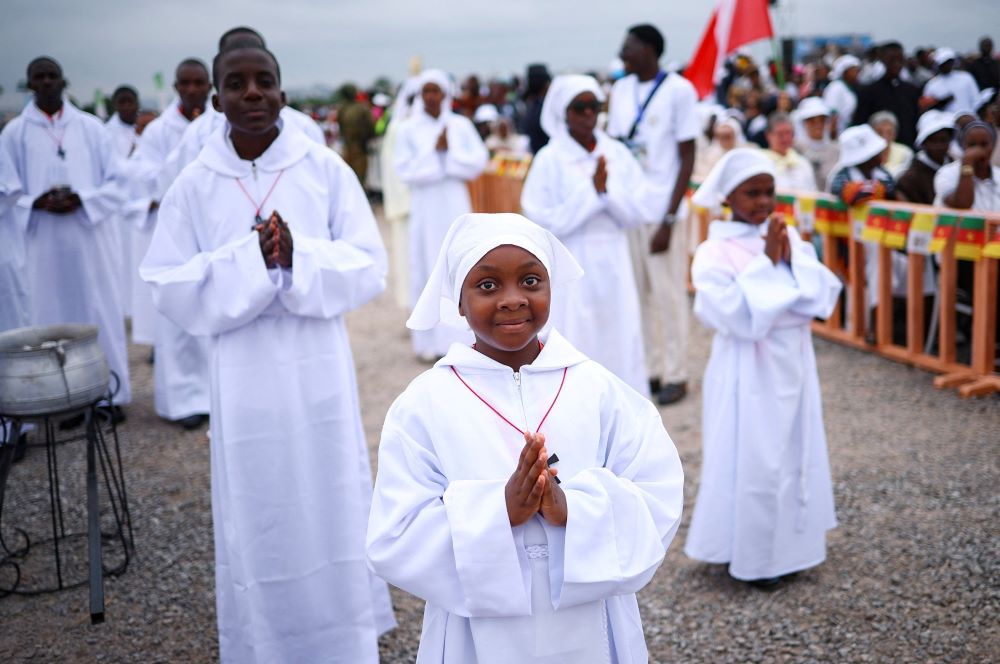
People wait for the beginning of a holy Mass by Pope Leo XIV at Yaoundé-Ville air base in Yaoundé, Cameroon, April 18, 2026. (OSV News/Reuters/Guglielmo Mangiapane)
Throughout his speeches in Cameroon, Leo consistently drew from the core of Catholic teaching to issue sharp critiques of the continent's most urgent social crises, doing so with a vigor he had yet to fully display in Rome.
The pope himself summed up that principle in his final Mass in Cameroon in the capital Yaoundé: "Faith does not separate the spiritual from the social."
"Indeed, it gives Christians the strength to interact with the world, responding to the needs of others, especially the weakest," he said.
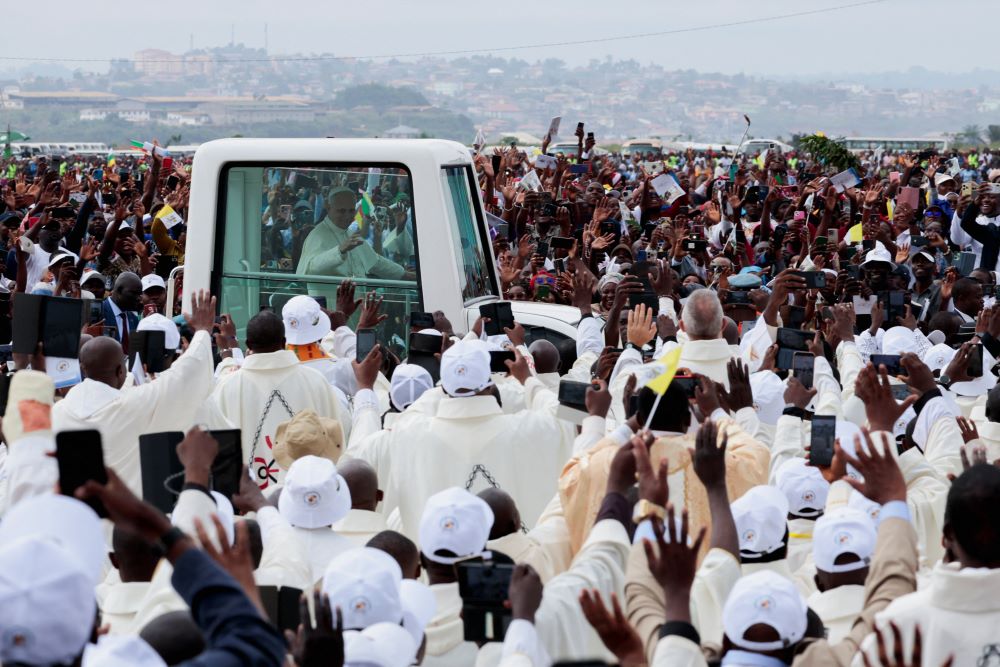
Pope Leo XIV greets faithful from the Popemobile on the day he celebrates Mass at Yaoundé-Ville air base in Yaoundé, Cameroon, April 18, 2026. (OSV News/Reuters/Luc Gnago)
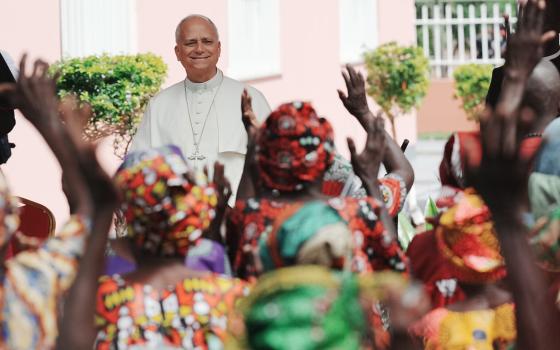
In front of mass crowds and intimate gatherings alike, often accented with xylophone music and joyful dancing, Leo shook off the sometimes stilted speaking cadence he carries with him in Rome and spoke forcefully (in French), often buoyed by cheers when discussing the promise of Africa's future.
Leo's lengthy trip to Africa, launched within the first year of his pontificate, shows just how close the successor of St. Peter intends to position himself to a region considered to be the future of the church.
For his first big trip, "he did not choose America, he did not choose other European countries," said Donatien Nsom Menye, who attended the papal Mass with his family in the Cameroonian capital. "It shows that we have a place in his heart and that we have a place among the Christians of the world."
The National Catholic Reporter's Rome Bureau is made possible in part by the generosity of Joan and Bob McGrath.
Advertisement