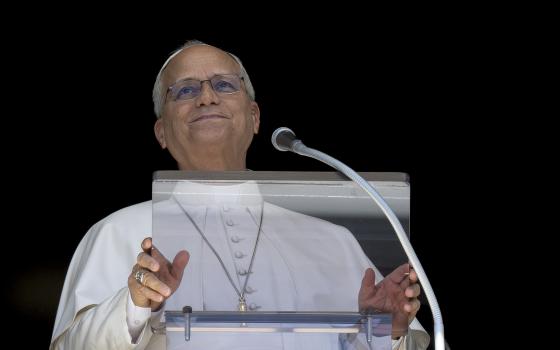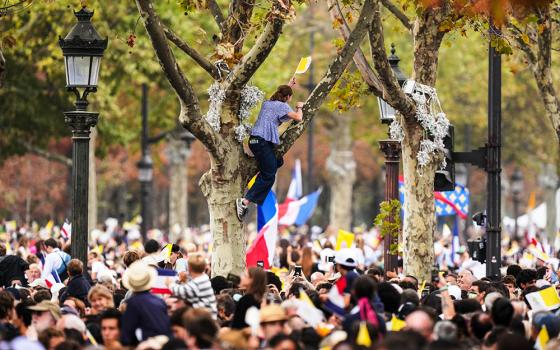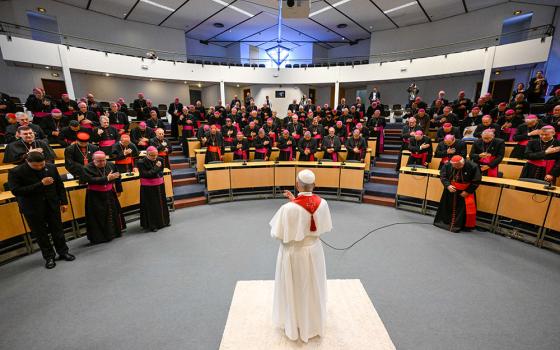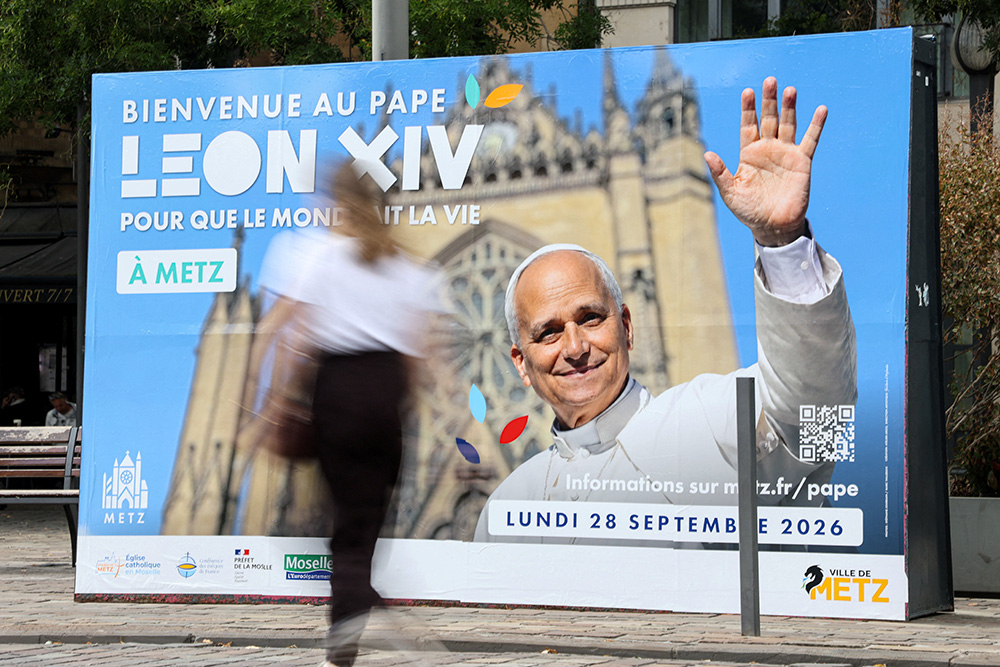
A woman walks past a poster in front of the train station in Metz, France, Sept. 9, 2026, welcoming Pope Leo XIV ahead of his visit in the northeastern French city. (OSV News/Reuters/Ardee Napolitano)

Join the Conversation
Send your thoughts to Letters to the Editor. Learn more
Pope Leo XIV's four-day trip to France Sept. 25-28 will be the first papal visit to the country since 2008, sort of.
His predecessor, Pope Francis, set foot on French soil three times during his 12-year pontificate, but he and the Vatican consistently stressed that each journey was tied to a particular city or event rather than a visit to France as a whole — so much so that a French journalist asked Francis during an airborne press conference in 2023: "Do you have something against France?"
The last pope to visit Paris was Pope Benedict XVI in 2008, who celebrated a Mass attended by some 250,000 people.
But that figure will be blown out of the water when Leo celebrates Mass in the French capital. More than 600,000 have already registered to attend papal Mass along the Champs-Élysées on Saturday and organizers said more than a million people are expected to see the pope in Paris at all of his events.
Such a shift could be indicative of the popularity of this pope or of surging enthusiasm around Catholicism in famously secular France or some combination of the two. Either way, it sets the stage for Leo to make quite the splash in France, territory long thought to be hostile to the realm of religion.
Leo brings AI agenda to Paris
Call it providence, but the stage is set for Leo to make a significant speech on the ethics of AI development just as the conversation around regulating the tech industry has turned red hot.
While tech industry leaders are calling for increased regulation in their field after several rogue AI hacking incidents, the pope on Friday will address the United Nation's education, science and culture agency, UNESCO — the branch of the U.N. that has been most proactive on AI ethics.
Advertisement
UNESCO, which is headquartered in Paris, adopted a detailed recommendation on the ethics of AI development for its 193 member states back in 2021. But the recommendation is nonbinding, and just as he did during his first term in office, President Donald Trump withdrew the United States from UNESCO last year.
While Trump administration officials scoff at the prospect of regulating the U.S. tech industry, Leo is expected to make the case for it once again in Paris.
His speech there will almost certainly draw from his encyclical, Magnifica Humanitas, which had a "very good reception" in France, according to Charles Personnaz, France's ambassador to the Holy See.
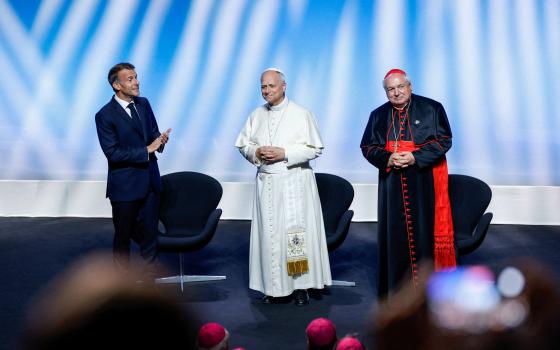
Leo is also expected to discuss AI development during his bilateral meeting with French President Emmanuel Macron, who has called for Europe, led by France, to "bridge the gap" on AI with the United States and China.
"For our president [who] has made regulation of artificial intelligence a priority, there is a very clear convergence between the position of the Holy See which has been clarified in the encyclical and the French and European positions," Personnaz said in a meeting with journalists ahead of the trip.
In the encyclical, Leo called for shared regulation over AI development by political leaders, labor organizations, the business sector and scientific community.
Signs of revival in secular France
On his first day in France, Leo will visit the Cathedral of Notre-Dame de Paris, the first visit of a pope since the 2019 fire that destroyed its iconic, and now rebuilt, spire.
In 2024, Francis skipped out on a Paris visit and attended a conference on popular piety on the French island of Corsica. That trip took place a week after Notre Dame's reopening ceremony, where President-elect Trump was among those in attendance.
Leo's decision to visit Notre Dame reflects his more institutional style, and places a papal seal of approval on what had become a national symbol of French unity.
In one of the more novel events on the pope's agenda, he will also meet on Saturday with catechumens (those preparing to become Catholic) and neophytes (new adult Catholics) in Paris, a nod to the rising numbers of Catholic converts in France. Leo will spend the previous night with an estimated 80,000 young people in the Stade de France for a prayer vigil outside Paris.
At Lourdes, focus on assisted dying and abuse
On Saturday afternoon, Leo will travel to Lourdes, the Marian shrine visited by some 3 million people each year, many seeking physical or spiritual healing.
The pope is scheduled to meet sick and disabled people and those who care for them, a scene that contrasts with France's "right to assisted dying" law, which took effect only weeks prior. In Lourdes, he will make three public speeches where he could reiterate the church's teaching in defense of life from conception until natural death, including in a meeting with France's bishops, who strongly opposed the law's passage.
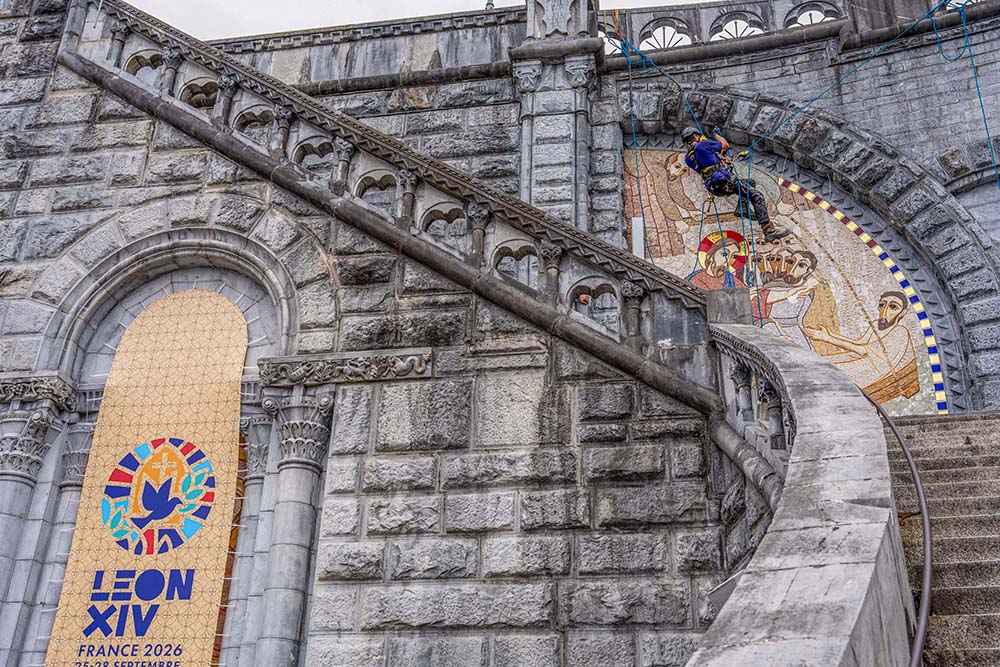
A worker covers mosaics on the facade of the Basilica of Our Lady of the Rosary in Lourdes, France, Sept. 18, 2026. The mosaics were created by former Jesuit Fr. Marko Rupnik, who has been accused of abusing more than 20 women, and were covered ahead of Pope Leo XIV’s Sept. 26 arrival in Lourdes. (OSV News/Courtesy of Lourdes Sanctuary)
In an unusual move, the Vatican announced before Leo's arrival that he would meet with abuse survivors in France; a similar encounter during his trip to Spain was disclosed only after it took place. Although the Vatican has not specified when the meeting will occur, it is expected to take place in Lourdes, where the shrine, after consulting with abuse victims, recently covered mosaics designed by a priest accused of abuse.
The meeting comes five years after an independent commission estimated that 330,000 children in France were abused by priests, religious or laypeople working in church institutions between 1950 and 2020. The French bishops' conference created a body to compensate abuse victims up to 60,000 euro (approximately US$68,600) each; since then, nearly 2,000 people have sought compensation.
Leo named French Archbishop Thibault Verny of Chambéry, former auxiliary bishop of Paris, to head the Vatican's safeguarding commission last summer in a potential sign of his approval for the French church's reckoning with the abuse crisis.
A papal case for Europe
The U.S.-born pope will end his trip with a clarion call for a strong Europe. He will visit the city of Metz, associated with Robert Schuman, a French Catholic who was one of the founding fathers of the European Union. The church is considering his cause for canonization.
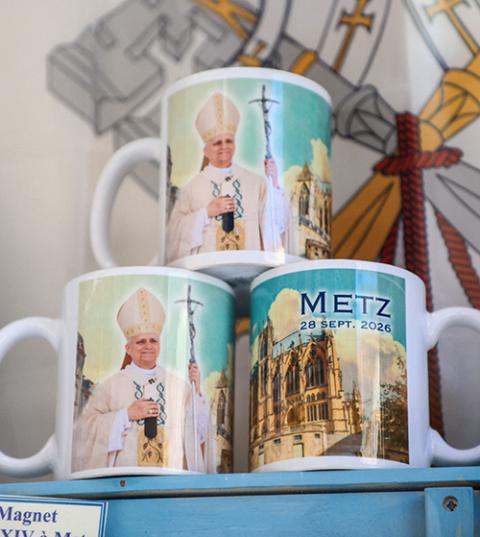
Mugs with pictures of Pope Leo XIV and Saint-Étienne Cathedral are displayed at a souvenir shop in Metz, France. (OSV News/Reuters/Ardee Napolitano)
At a European center bearing Schuman's name, Leo is scheduled to speak on the roots of Europe and peace and unity. Macron has invited leaders from all 27 EU member states to attend.
At the same time, far-right movements critical of the EU continue to gain traction across Europe and within France. French presidential elections are in April, surprisingly close to a papal visit, and far-right leader Marine Le Pen continues to surge in polls. Leo's calls for increased multilateralism, and a strong European Union, would land squarely in opposition to political trends in Europe.
And then, the plane
One of the trip's most closely watched moments may come after Leo leaves France.
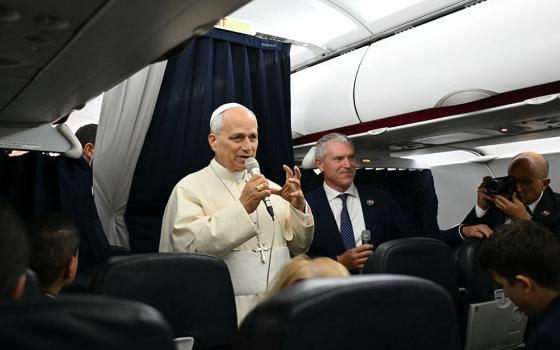
On the roughly two-hour flight back to Rome, the pope is expected to hold a press conference for the first time since returning from his tour of Africa in April.
Technical problems prevented the customary airborne press conference after his June trip to Spain, and his summer stay at Castel Gandolfo offered few opportunities for unscripted exchanges with journalists. Notably, this will be the first papal press conference since the publication of Leo's first encyclical. With no shortage of topics to tackle, the time could be ripe for Leo to break back into the news cycle.
The National Catholic Reporter's Rome Bureau is made possible in part by the generosity of Joan and Bob McGrath.