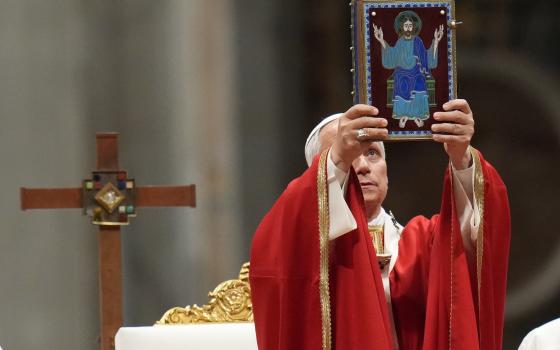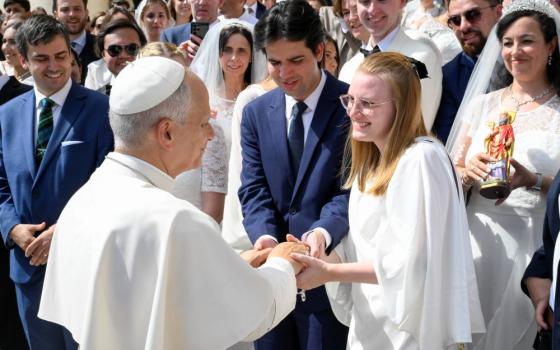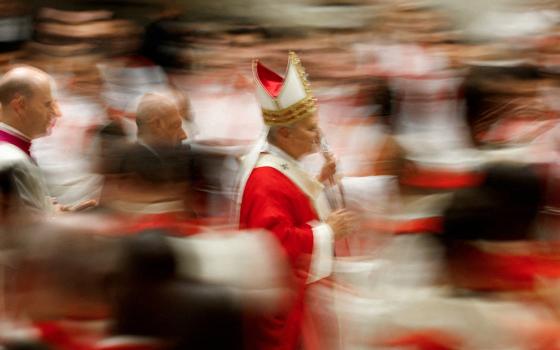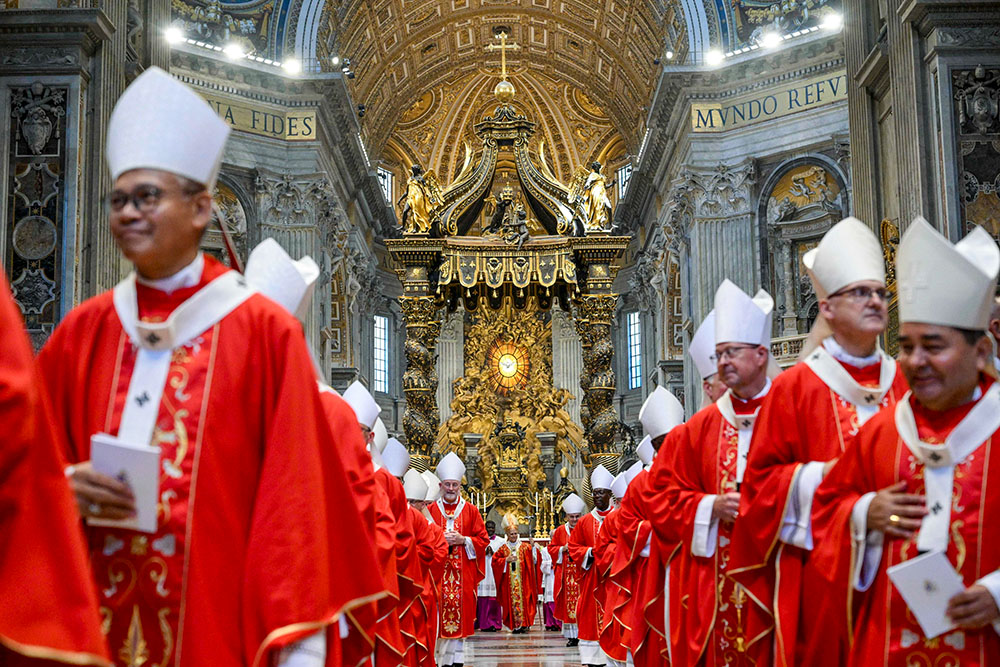
Prelates process after Pope Leo XIV celebrated Mass with the blessing and imposition of the pallium on new metropolitan archbishops on the feast of Sts. Peter and Paul in St. Peter's Basilica at the Vatican June 29, 2026. (OSV News/Vatican Media/Simone Risoluti)

Join the Conversation
Send your thoughts to Letters to the Editor. Learn more
Before placing the white woolen bands symbolizing authority around the shoulders of 35 new metropolitan archbishops, Pope Leo XIV urged the church's pastors to become "builders of unity" and to foster communion within the church.
Communion, Leo said in his homily at Mass for the feast of Sts. Peter and Paul, "is not built by clinging rigidly to one's own position, but by seeking, in all hearts, points of encounter in the truth, in whose light alone each person becomes a means of growth for another."
The U.S.-born pope's message uttered in St. Peter's Basilica held special resonance for the U.S. archbishops who received a pallium from him June 29 — Archbishops Ronald Hicks of New York, James Golka of Denver, James Checchio of New Orleans and Mark Rivituso of Mobile, Alabama.
"It seems like our American culture has become more uncivil," Golka told NCR following the Mass in Rome. "For people to be able to be with someone they disagree with, it seems like that's not possible anymore. In the church, that's always been possible. Unity has got to be an earmark of the church."
The archbishop noted that the widespread incivility in U.S. society has crept into the church as well, a trend that he said has been exacerbated by social media and by some Catholic online commentators.
Advertisement
"There are also people who call themselves Catholic YouTubers who are just trying to make money, and it's dividing us," he said, pointing to the coverage of meetings of the U.S. Conference of Catholic Bishops as an example. "When we're together, there's a spirit of working-togetherness," he said. "And the media might pick one or two bishops that seem at odds with each other and then highlight that."
Against that polarizing backdrop, Leo, who has repeatedly returned to the theme of unity throughout his pontificate, "can stand in the middle of the church and talk to all ends," the archbishop said.
"He's just measured and calm and peaceful and a bridge-builder," he said. "I think we have potential to be able to heal and unify people and the church."
Golka, who is three months into his tenure in an archdiocese that developed a reputation for cultivating and exporting a more conservative vision of Catholicism under his two immediate predecessors, Archbishops Charles Chaput and Samuel Aquila, said that while some would describe the Denver Archdiocese as conservative, he sees it as "robustly Catholic."
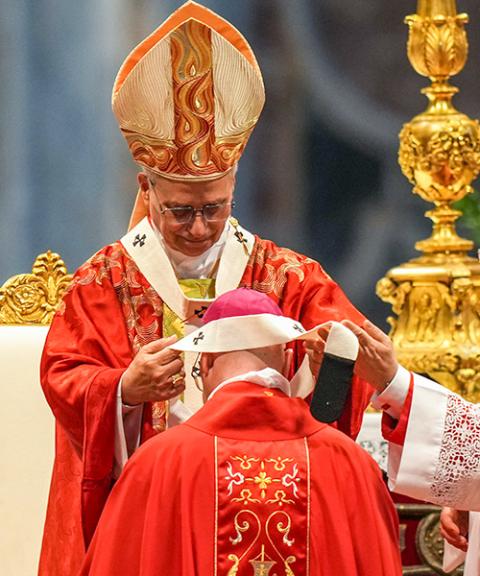
Archbishop James Golka of Denver receives his pallium from Pope Leo XIV during Mass in St. Peter’s Basilica at the Vatican June 29, 2026. (CNS/Lola Gomez)
"I think I'm inheriting a diocese that is intentionally Catholic, and people are ready for mission," he said.
Golka, speaking calmly and deliberately, also said he wants the archdiocese to continue on the synodal path — the Catholic Church's effort to become a more listening and participatory body, which has drawn criticism from some conservatives who see it as a threat to clerical authority.
Referencing his time as bishop of Colorado Springs, Golka said the diocese there decided to focus the synod's three-year implementation phase on the themes of humility, unity and charity.
"I love that because it's neither left-leaning nor right-leaning," he said. "You can't call one conservative or liberal. It's who we are."
Golka acknowledged that the word "synod" itself has become fraught in some Catholic circles, but said that the church is called to push ahead on implementing the synodal path.
"I know that word 'synod' isn't the best word in some ways in some circles because people kind of discount that," he said. "And I don't want to discount letting the Spirit guide us."
"We need to be experts at listening to the Spirit," he added. "And that's what I really want all Catholics to do, especially those who are on my team."
Checchio, archbishop of New Orleans since February, told NCR that Leo's call to unity was "a perfect message for us" as new archbishops.
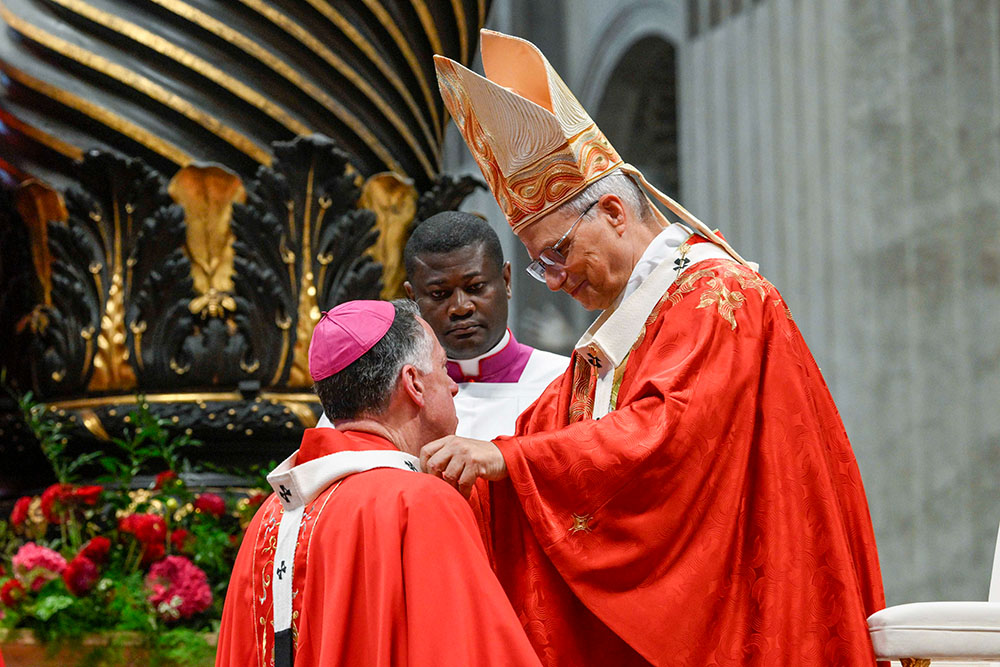
Pope Leo XIV presents the pallium to New Orleans Archbishop James Checchio in St. Peter's Basilica at the Vatican June 29, 2026. (OSV News/Vatican Media/Simone Risoluti)
With Leo as pope, Checchio said, "it's beautiful that what we have now for our universal church is that regular reminder" of the need for communion. "And I think that we as shepherds have to call our people to the same thing."
Synodality, he said, "is part of that; it's timely for us [bishops], too."
The archbishop also pushed back on an interpretation that synodality means putting church teaching up for grabs.
Synodality "is just part of who we are and what we do," he said. "It's not like we're saying: 'Let's figure out our doctrine by putting it up for a vote.' "
Despite "so much division, in our country and in our church," Checchio said Leo "certainly is bringing us unity among the bishops, too."
"I think of an American as pope — a man that understands us, knows us, has relatives there, knows what challenges are going on in our culture and in our church in the States," Checchio said. "And that's a huge help."
The National Catholic Reporter's Rome Bureau is made possible in part by the generosity of Joan and Bob McGrath.