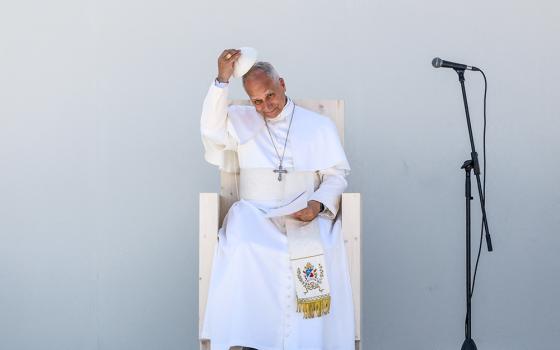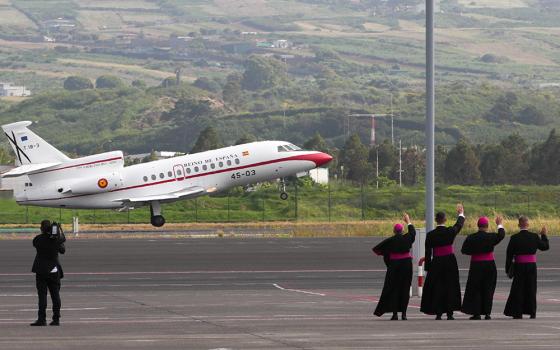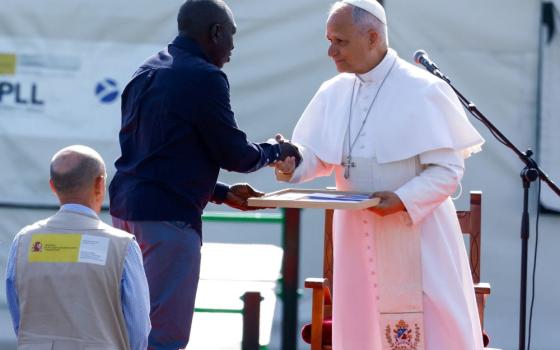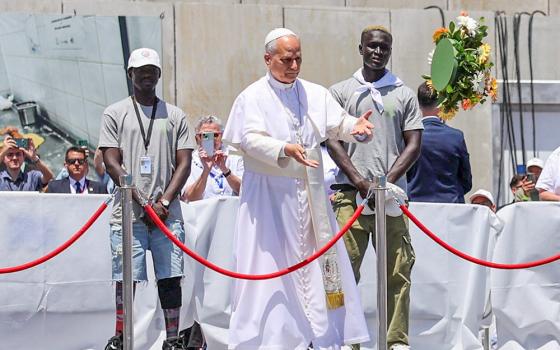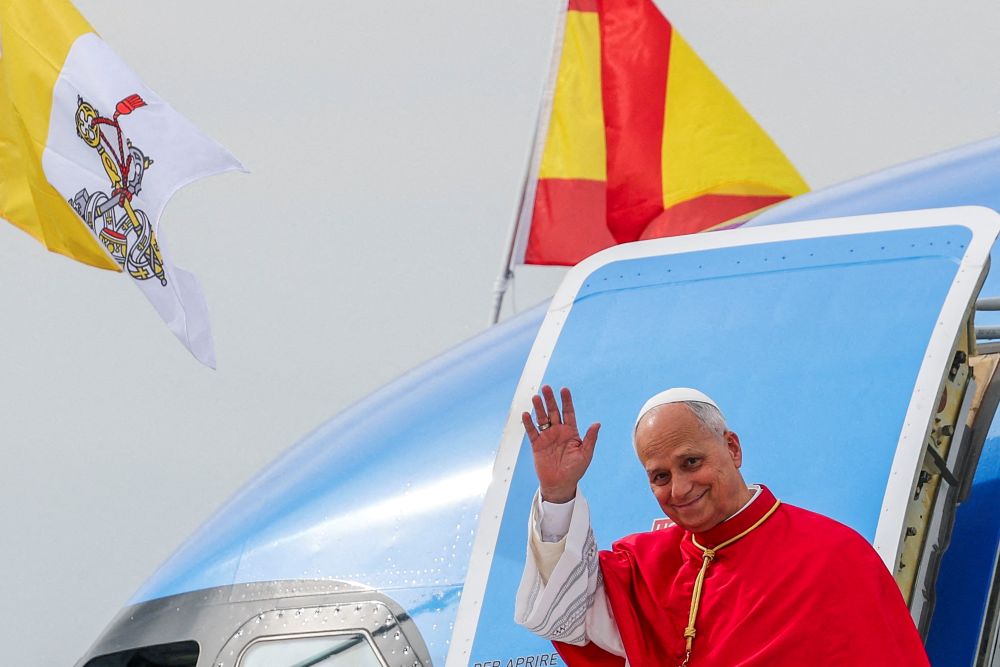
Pope Leo XIV disembarks the papal plane as he arrives at Adolfo Suarez Madrid-Barajas International Airport in Madrid June 6, 2026, to begin his apostolic journey. Leo's June 6-12 visit is the first papal visit to the country since Pope Benedict XVI traveled to Madrid for World Youth Day in 2011. (OSV News/Reuters/Violeta Santos Moura)

Join the Conversation
Send your thoughts to Letters to the Editor. Learn more
After 15 years, a pope has returned to Spain, today one of Europe's most polarized nations.
Here, Pope Leo XIV, who has made peace and unity the refrains of his 13-month pontificate, warned against exploiting division for political gain and pushed for increased multilateralism on the world stage.
"Today, the temptation to gain popularity by fanning the flames of polarization seems to have grown rather than diminished, and human dignity continues to be violated," he told some 200 people in the Spanish Royal Palace on June 6, among them government leaders, diplomats, and members from the Spanish church hierarchy. "This is why we need culture, interiority and free quality education; we need transcendence."
Though not directed toward any particular group, the audience reflected Spain's divided politics: Prime Minister Pedro Sanchez, a socialist, sat in the front row for the pope's speech, while Santiago Abascal, the leader of Spain's far-right Vox party, sat a few rows behind him.
Abascal, a Catholic who has made anti-immigrant sentiment a cornerstone of his political messaging, has been publicly supportive of the pope's visit while also warning against what Leo may say about migration. His party holds about 10% of the seats in Spain's parliament and has maintained a significant, increasing influence in several regional governments, at times pulling Spain's center-right party toward its views as it competes for voters.
'The temptation to gain popularity by fanning the flames of polarization seems to have grown rather than diminished, and human dignity continues to be violated.
—Pope Leo XIV
Ahead of the pope's visit, Abascal said that if any religious leader, including the pope, "tells us that we have to accept a process of mass migration and the advancement of Islam in our society, we are going to say, 'no.' "
He also insinuated that Spain's bishops were working with migrants in order to receive government funds to then be funneled into the church, a claim rejected by a senior Vatican official working on migration.
Leo's seven-day trip through Spain will end in the Canary Islands, his first visit as pope to a major migration hub. The islands, a destination for migrants sailing toward Europe from the shores of North Africa, sit along one of Europe's deadliest migration routes, and Leo is expected to highlight the plight of migrants there.
In his speech in the lavish Hall of Columns in the Spanish Royal Palace, where Spain signed the accords to join the precursor to the European Union, Leo recalled Islam's long presence in Spain and said that, beyond moments of confrontation, there had also been an effort to "create a space for contact, conversation and dialogue on the meaning of truth among Christians, Muslims and Jews."
The pope, who speaks Spanish fluently after spending more than two decades as a missionary and bishop in Peru, urged Spain's leaders to "set aside the divisive and polarizing narratives" of their past and present by overcoming "sterile simplifications through the fruitful appreciation of complexity."
At the end of the pope's speech, Abascal joined the crowd in standing to applaud.
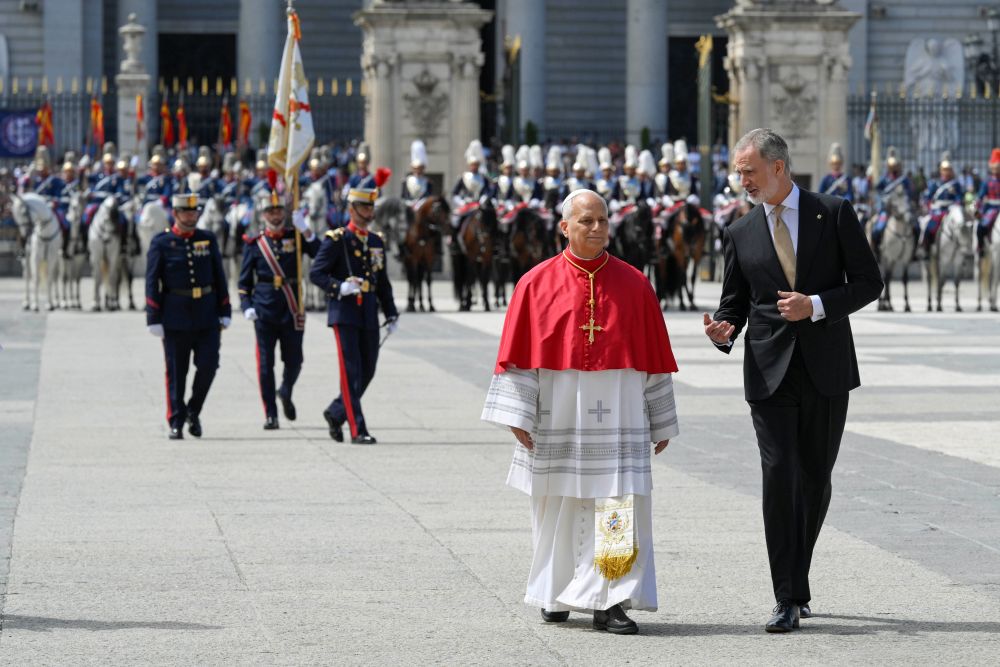
Spain's King Felipe VI walks with Pope Leo XIV as the pontiff arrives at the Royal Palace in Madrid June 6, 2026, as he begins his apostolic journey. (OSV News/Vatican Media/Elisabetta Trevisan)
Leo was welcomed to Spain in royal style. King Felipe VI and Queen Letizia received him at the airport, and he was greeted at the royal palace with a cannon salute. The bells of the massive Cathedral of St. Mary the Royal of the Almudena, which faces the palace, pealed loudly as Leo arrived and departed, a reminder of Spain's historic ties to the Catholic Church.
In addition to the entourage that typically accompanies Leo on his international trips, the pope was joined by Spanish Cardinals José Cobo Cano of Madrid and Ángel Fernández Artime, pro-prefect of the Dicastery for Institutes of Consecrated Life and Societies of Apostolic Life, as well as Augustinian Bishop Luis Marín de San Martín, the newly appointed papal almoner.
King Felipe, speaking before the pope, recognized the church's contributions to Spanish society, "without which our history and our culture cannot be understood." But he also noted the legacy of clerical sex abuse that has scarred Spanish society.
"There cannot be a greater contrast between that and the pain caused by the abuse cases that are not and cannot be representative of the immense ecclesial community," the king said. "Your clarity and firmness, which I would also like to recognize, are essential to the process of healing and repairing the inflicted damage: It is for victims, for the faithful, for the church and for society as a whole."
The Spanish church signed an agreement with the government in January, following several reports documenting thousands of cases of clerical abuse, by which abuse victims can submit cases to Spain's national ombudsman, who will determine reparations to be paid by the church. Leo is also expected to meet with victims of clerical sex abuse in Spain.
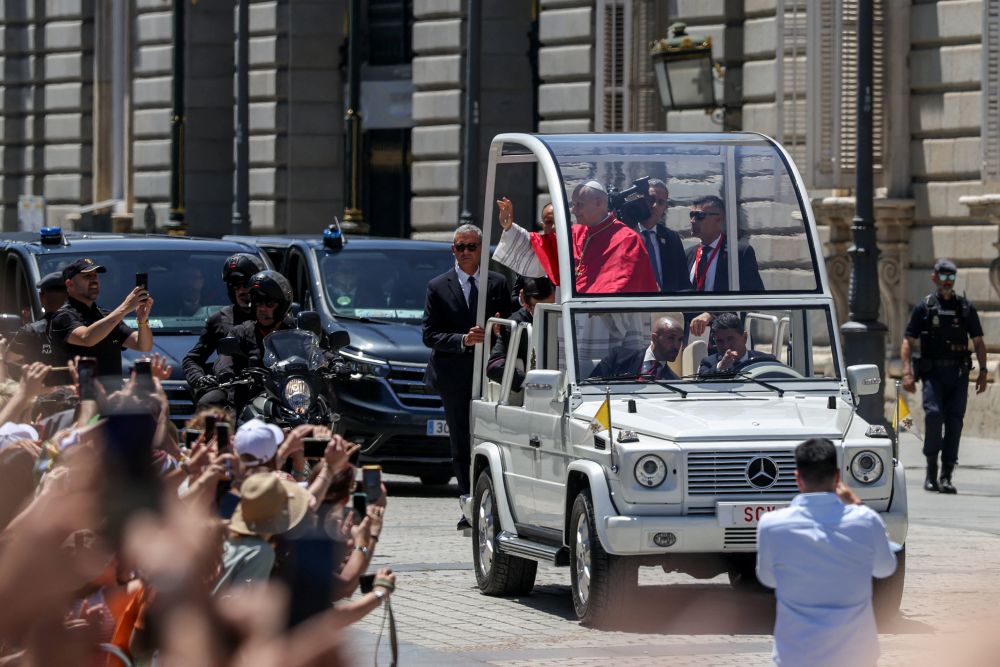
Pope Leo XIV waves to the faithful from the popemobile during his apostolic journey, in Madrid, June 6, 2026. His visit to Spain runs June 6-12. (OSV News/Reuters/Alejandro Martinez)
En route from Rome, the pope said that while his visit to Spain was intended to meet the Catholic faithful in Spain, it was also to meet with the whole of Spanish society and beyond, "because the church has a message for everyone," he said, citing his encyclical letter, Magnifica Humanitas, on safeguarding the human person in the age of AI, published May 25.
In his address to government leaders, Leo said how "new technologies have created an artificial environment where our fundamental choices are put to the test, prejudices are magnified, critical thinking is weakened and dominating interests spread death wishes."
After meeting with Spanish government leaders, Leo thanked the country for "its faithful adherence to international law and multilateralism, which is reflected in an active commitment to peace and solidarity among peoples."
Spain's fragile socialist-led government has emerged as one of the most fierce critics in Europe of the U.S.-led war effort in Iran and has repeatedly advocated for multilateralism on the international stage.
Advertisement
"At the same time, I encourage you to cultivate as well dialogue and civic friendship within your own country, to take into account the perspectives of the poor and the young when envisioning the future, to harmonize the claims for autonomy and unity, and to advance the cause of unity in Europe — not in opposition to other powers, but as a gift to the entire human family," the pope said.
Polarization is expected to be a major theme during Leo's three days in Madrid, when it will take center stage during his historic address to Spain's parliament on June 8, the first time a pope addresses Spain's Congress of Deputies.
He will also meet with young people in the Spanish capital, though he joked with reporters on the papal plane that he may face stiff competition in drawing people to his prayer vigil: Puerto Rican musical sensation Bad Bunny is also performing in Madrid.
“If they are confronted with the question: Do they want to see Bad Bunny or do they want to see the pope, I think many will go to see Bad Bunny. But I think there will also be a few there to see the pope, and that says something."
The National Catholic Reporter's Rome Bureau is made possible in part by the generosity of Joan and Bob McGrath.