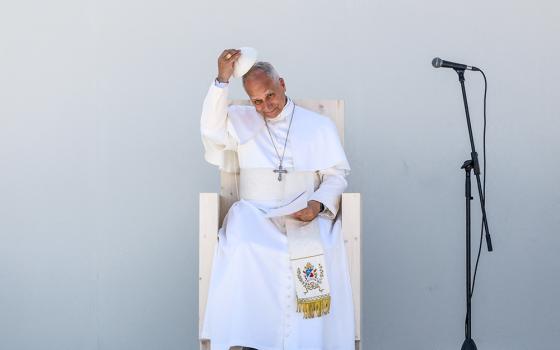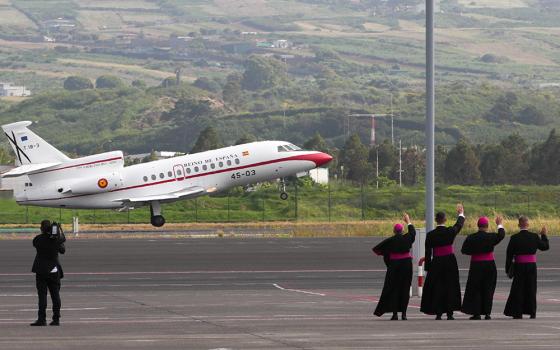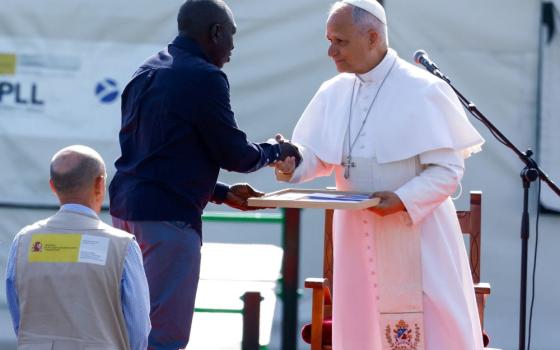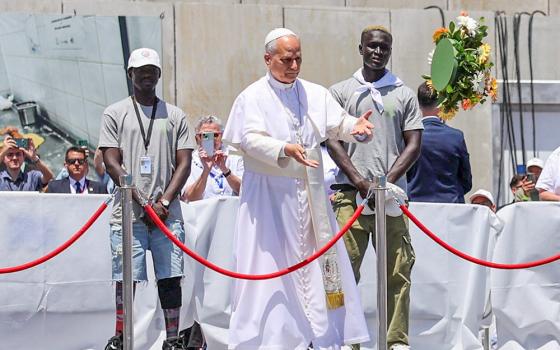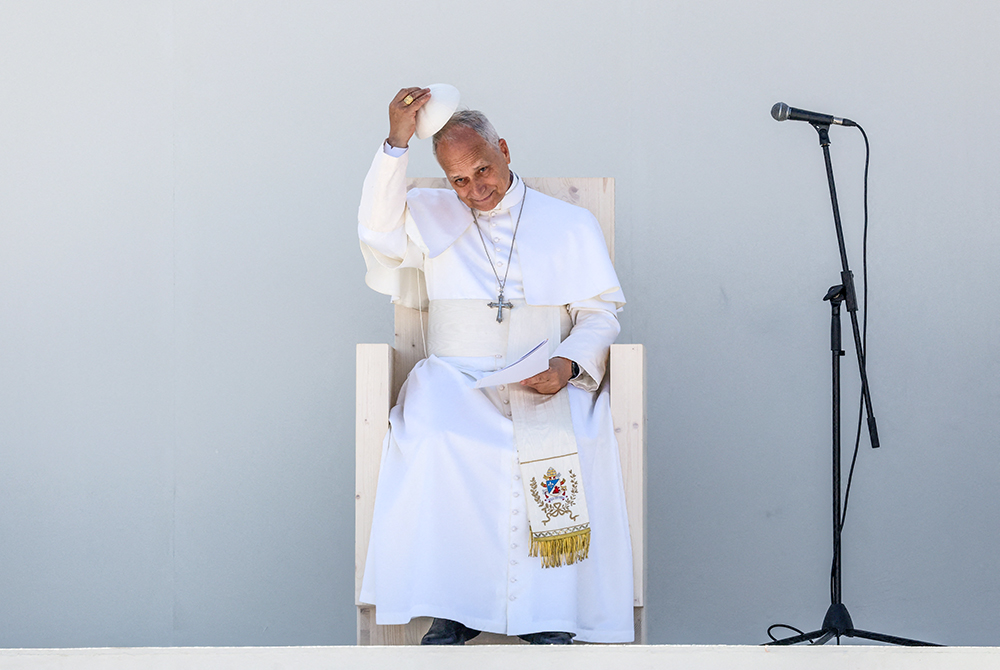
Pope Leo XIV puts on his zuchetto at the Plaza del Cristo de La Laguna, Tenerife, Canary Islands, Spain, June 12, 2026. (OSV News/Reuters/Yara Nardi)

Join the Conversation
Send your thoughts to Letters to the Editor. Learn more
Pope Leo XIV's trip to Spain was stunning. I was traveling much of the week and was able to read the texts of his homilies and talks, but when I got home and went to YouTube and watched the enthusiastic welcome he received, it was remarkable. The history of Catholicism in Spain is profound and complex, with many shadows, especially in the 20th century. All was swept away. It seemed like all of Spain turned out to welcome the Holy Father and he was pitch perfect in his messages.
The question for us is: What did we learn about Pope Leo last week? What didn't we know, or thought was likely, and is now confirmed?
First, he is not dismissive toward traditional, popular piety but respects it. This was evident at Mass on the feast of Corpus Christi, where Leo drew 1.2 million people to the Plaza de Cibeles in Madrid June 7, and then participated in a eucharistic procession.
In his homily at Mass, he recognized the faith at the heart of this popular devotion.
"Even today, they [eucharistic processions] still express and manifest the spiritual sentiments of this country through the beauty and elegance of the floral carpets, the altars erected in the streets, the carefully crafted monstrances and stands, the hymns and the liturgical vestments," the pope said. "This is not an exhibition, a remnant of folklore or a simple display of beauty. It is a profession of faith in the presence of the risen Lord, who is alive and continues to walk among us, who becomes bread to satiate our hunger for life, and visits the recesses of our hearts and history, even those shrouded in darkness."
As we encounter younger Catholics who are drawn to devotions like a eucharistic procession, who like the monstrances and the fancy vestments, let's not pooh-pooh it but, instead, like Leo acknowledge it as a profession of faith, not as a show. And, like the pope, let's encourage all to link their piety to the church's mission: "The Christ who processes through the streets in the monstrance is the same one who identifies with the poor, the downtrodden, those who are alone and forsaken."
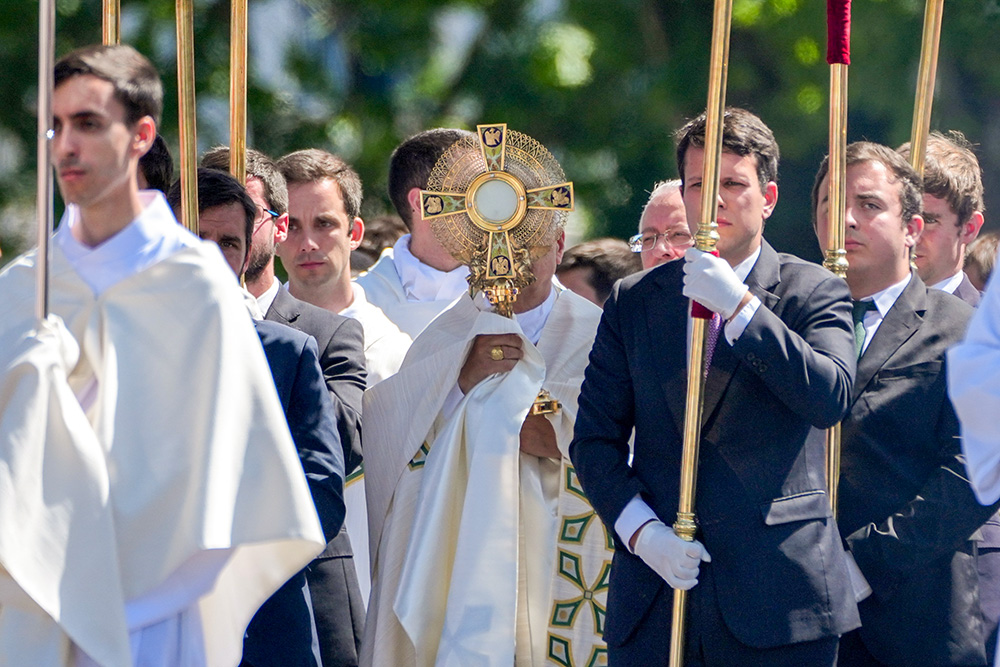
Pope Leo XIV takes part in the Corpus Christi procession at the Plaza de Cibeles in Madrid June 7. (CNS/Lola Gomez)
Pope Francis at times liked to poke the bear of traditional devotions. And, a good Jesuit, he was not much a liturgist. (Nor was St. John Paul II.) Leo may be more like Pope Benedict XVI in his respect for certain ecclesial traditions, certainly mimicking him in his own choice of vestments.
At the Spanish parliament on June 8, Leo echoed Benedict's words in Berlin in 2011 at the German parliament. Before speaking about any particular issue, or their relative moral weight in the Catholic perspective, Leo used the same frame for understanding the essential insight the church brings to politics as Benedict articulated:
Every truly just society is built upon the recognition of the inviolable dignity of the human person. Such dignity precedes any concession by the State and cannot be subordinated to shifting social consensus or the whims of the majority at any given moment (cf. Benedict XVI, Address to the German Federal Parliament, 22 September 2011). It belongs to every human being by the very fact of their existence, and for this reason, it must guide every positive legal system. The Christian faith proclaims it on the basis of Revelation; human reason can recognize it as a requirement inscribed in the truth of man (cf. ibid).
This is why we Catholics cannot set aside our concern for the unborn or the migrant. We see these concerns as linked, indeed as the same concern for human dignity in two different situations. This sets us at odds with the political movements of our time. Not just in the U.S. but throughout the West, wanting to protect the unborn and the undocumented makes one a stranger in the political land and Christians in both parties do not welcome this kind of stranger. The pope insisted we never abandon the one for the other.
N.B. be sure to watch the video of the pope's speech to the parliament: The ovation at the end lasts for seven minutes!
The third thing that became clear during this pastoral visit was how profoundly Leo shares Francis' concern that the plight of migrants is the quintessential issue of our time, exposing all the moral cancers of our time. In the final stop of his trip, the island of Gran Canaria, the pope replayed one of the most powerful images from Francis' first trip to Lampedusa in 2013, throwing a wreath of flowers into the waters where migrants perish.
Advertisement
Like Francis, Leo makes sure he does not merely assign a passive role to migrants. At his June 12 meeting with migrants, he said, "I also invite you to share the treasures of your humanity, of your dreams and of your culture, which you have brought to these islands, and to be open to receiving what is offered to you. We must live this exchange responsibly, considering the future generations to whom we wish to bequeath the heritage of a civilization of love." Migrants are not merely objects of pity and charity.
Yet, Leo is clear that the church has an obligation to the migrants, to stand by and stand up for them at a time when so many political and cultural actors want to turn them into scapegoats. Indeed, Leo links the work for caring for migrants with the church's own self-understanding. In a beautiful passage of his address to groups that work with migrants, the Holy Father said:
In the efforts to integrate these brothers and sisters of ours — as in every work of charity — the Church learns to read in the concrete lives of those who suffer in body or spirit a living sign that points to the holy Gospels. It becomes legible through touch and closeness when we feel the wounds of others. Like Thomas before the glorious body of the Risen One, the Church too learns that viewed through the lens of faith, wounds can become a place of recognition. Where human suffering is touched with love, Christ confirms to us that he is present in the hungry, the thirsty, the naked, the sick, the imprisoned and the stranger (cf. Mt 25:35-40).
Charity is never a one-way street. It is dialogical, and the dialogue is not only between one human heart to another, but a dialogue that invites the Holy Spirit, who always leads the church to deeper understandings of her mission in any given sociocultural context.
Leo is not Francis, and he is not Benedict nor John Paul II. Just as there was always more continuity between Benedict and Francis than some critics wanted to acknowledge, Leo draws from all his immediate predecessors, as well as from the teachings of the 1962-65 Second Vatican Council, the church fathers and, of course, from the Scriptures.
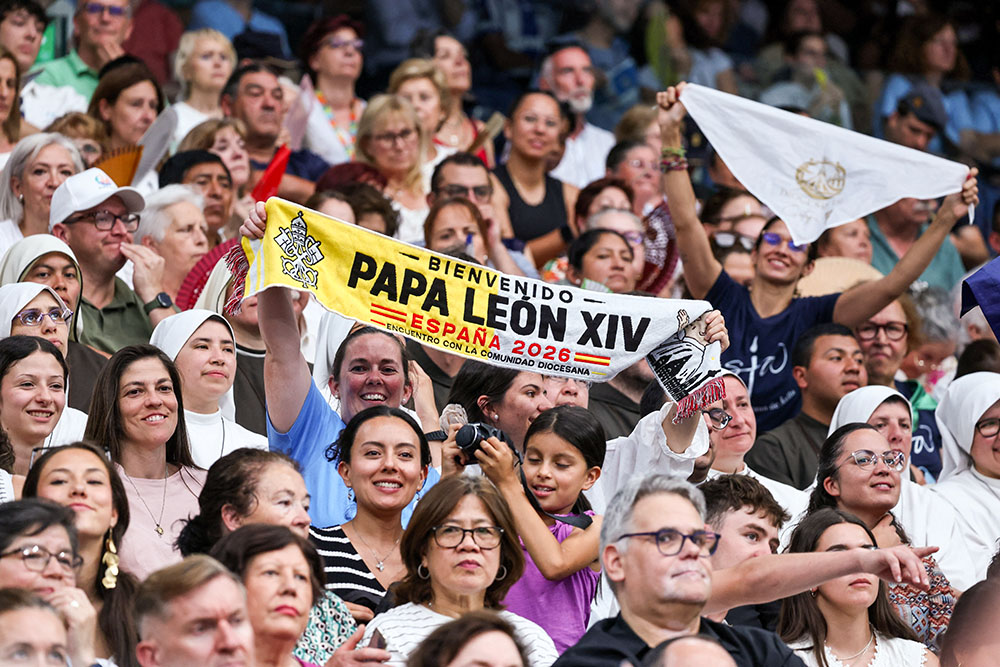
Pilgrims hold a banner as they wait for Pope Leo XIV to arrive for a meeting with the diocesan community at the Santiago Bernabeu Stadium in Madrid June 8, 2026, during his June 6-12 apostolic journey to Spain. (OSV News/Reuters/Yara Nardi)
Leo, however, represents a different generation from that of his predecessors and his ease in the role of pope might be rooted in that fact. In a sense, all previous post-conciliar popes were figuring out how to define the papal office in terms of the ecclesiology of Vatican II. St. Paul VI got the ball rolling, surrendering the papal crown and making foreign trips a part of a pope's routine, for example, but also declining to issue any more encyclicals after the difficult reception of Humanae Vitae. John Paul II had no such reticence and prodigiously issued encyclicals on a range of topics, displaying a more muscular sense of the papal office. He injected steroids into the papal trip agenda, visiting 129 countries in his long reign. Benedict traveled less, and he issued fewer teaching documents, but the ones he did issue were profound and, in a sense, more radical than anything before or since. Francis shook up the church's hierarchy, and crafted a reform agenda that really brought Vatican II into the 21st century.
Leo is his own man, comfortable in his own skin, and he draws easily from the models of his predecessors even while imprinting his own style. What stood out for me in Spain was the almost impish way he gives the 6-7 hand motion, a meme that was heretofore unique to young people. It has no meaning, Christian or otherwise. It is simply a way of connecting with the young.
There is a lightness in Leo's touch that is new, that we did not see in his predecessors. It humanizes him, which humanizes the church. That, too, contains a lesson for this time of technological change: Whatever artificial intelligence can do, it can never replace the essential human mediation of God's word. The Word became flesh 2,000 years ago in the hills and villages of Israel, and the church is always called to become the Word's flesh to every generation. Leo showed in Spain that he is really, really good at it.