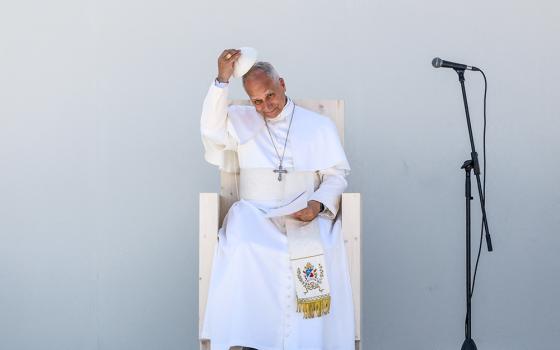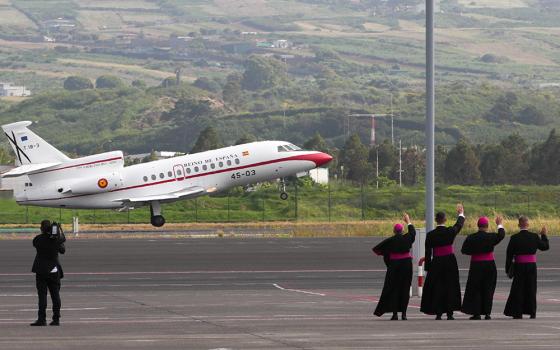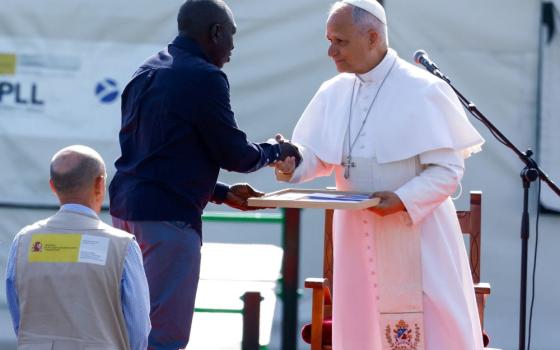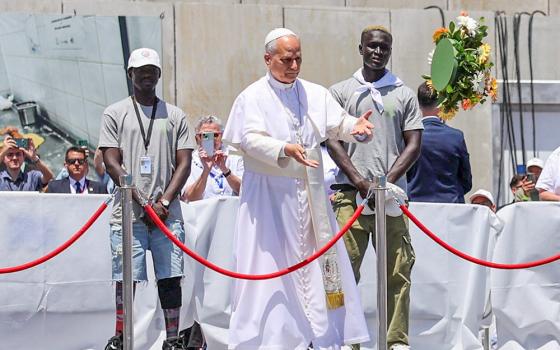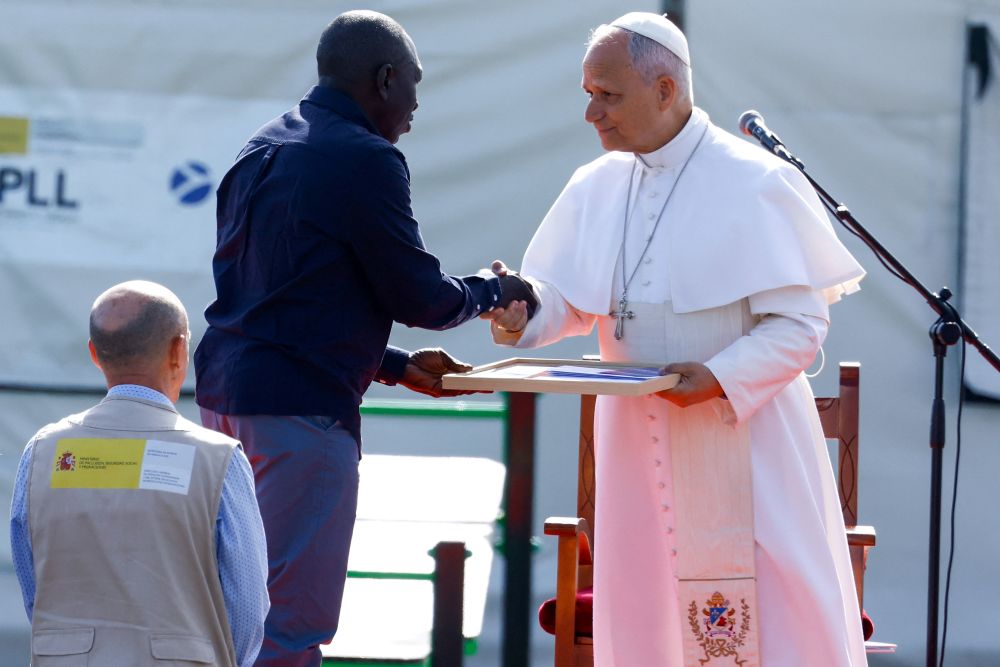
Pope Leo XIV receives a photo collage from Senegalese migrant Theodor Faye at the "Las Raices" migrant center in Tenerife, Canary Islands, Spain, June 12, 2026. (OSV News/Borja Suarez)

Join the Conversation
Send your thoughts to Letters to the Editor. Learn more
On his last day in Spain, Pope Leo issued a stern call for repentance from those who traffic in the lives of migrants and said the Christian conscience cannot remain indifferent to the plight of migrants.
"To those who take advantage of people's desperation, to those who organize death routes, traffic in human beings, withhold documents, exploit workers, threaten women, deceive families and turn the suffering of others into a business: Stop, repent," the pope said Friday (June 12) from the Spanish island of Tenerife, a major entry point for migrants seeking to access Europe. "The money wrested from the vulnerability of the poor will bring neither peace, nor honor, nor a future."
The pope's visit to Tenerife closed the final leg of his trip to Spain in which he spent two days traveling through the Canary Islands, a long-held dream of Pope Francis.
After hearing testimonies from migrants, Leo took aim at the traffickers who smuggle migrants into Europe, often exploiting them and subjecting them to violence.
Nearly half of migrants who arrived in Spain showed signs of having been trafficked, according to 2019 data from the International Organization for Migration, and the United Nations estimates that 200,000 to 400,000 Central American migrants are smuggled through Mexico into the United States each year.
Meeting with organizations that assist in integrating migrants on the island, Leo said "a Christian conscience cannot remain indifferent in the face of these graveyards of the sea, to the victims of shipwrecks and the lack of aid."
"Every life lost on these routes is a failure for the human family," he said.
Yet the pope also made a specific request for Catholics engaged in assisting migrants: "that integration not be reduced to a social undertaking."
Migrants, he said, "must find a community capable of offering paths to knowing Jesus Christ through the witness of life and word, while always respecting the conscience and freedom of each person."
"A church that welcomes is also a church that proclaims, offering Christ without imposing him and which, at the same time, receives the Gospel from the hands of the poor," he continued.
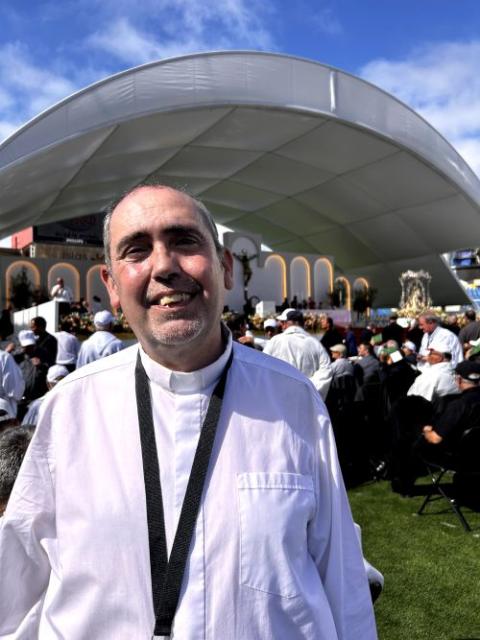
Fr. Víctor Domínguez González, the diocesan delegate for migration of the Canarias Diocese, poses for a photo at papal Mass in the Stadium of Gran Canaria in Las Palmas de Gran Canaria, Spain, June 11, 2026. (NCR photo/Justin McLellan
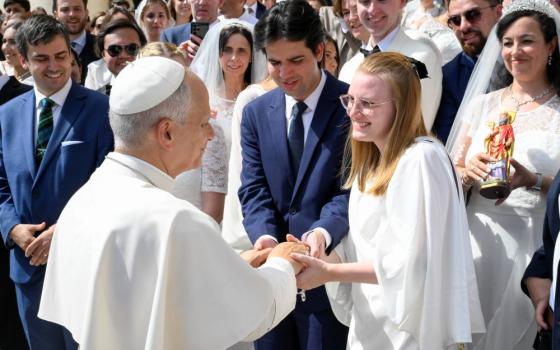
After meeting with some 600 migrants, the pope toured a migrant center and took ample time to greet volunteers and migrants present. In one instance, he held a baby who began playing with the chains that support his pectoral cross.
Both days the pope spent across two distinct islands featured prominent meetings centered on the topic of migration and closed with a large-scale Mass.
On June 11, he celebrated papal Mass with some 50,000 people at the soccer stadium of Las Palmas de Gran Canaria.
There, Fr. Víctor Domínguez González, diocesan delegate for migration of the Canarias Diocese, told National Catholic Reporter that the pope chose to travel to Spain among the first trips of his pontificate so that the Canary Islands could be the "showcase" of the migrant crisis worldwide.
"We are generally irrelevant on the world stage, and that the pope has chosen to travel here and embrace our reality fills us with joy," he said. "The pope wanted to focus on the peripheries, and here he has made that clear."
In deeply polarized Spain, where debate about migration has invoked the idea of Spain's Christian identity, Domínguez said the pope "denounced those political parties that use and instrumentalize religion; he gave a warning to those ultraconservative political parties who want to use the faith."
From a port that drew global attention in 2020 after migrants were subjected to squalid livid conditions after their arrival there, Leo said June 11 that the Gospel message "pulls us out of our comfortable position as spectators" and challenges indifference to the plight of migrants.
"To Christians he made an appeal, saying that a Christian who only stays on their knees in adoration but does not receive and is indifferent toward his brother and sister, well they are not truly living the faith," he said.
The National Catholic Reporter's Rome Bureau is made possible in part by the generosity of Joan and Bob McGrath.
Advertisement