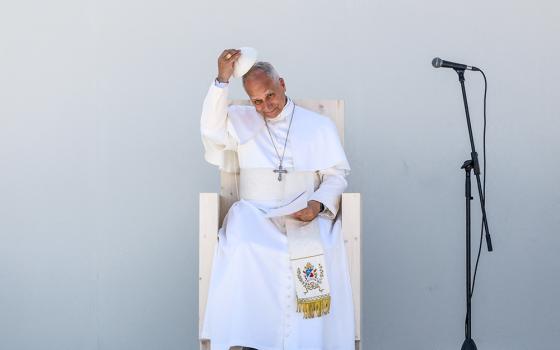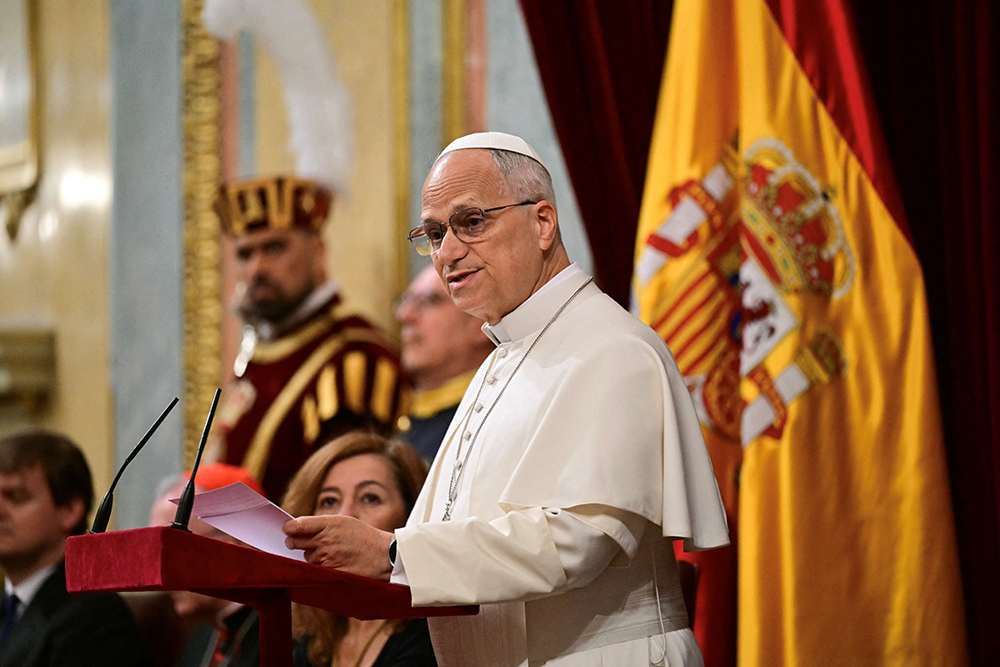
Pope Leo XIV delivers a speech during a joint session of the Spanish Parliament at the Congress of Deputies in Madrid, June 8, 2026, during his June 6-12 apostolic journey to Spain. (OSV News/Stefano Rellandinii, pool via Reuters)

Join the Conversation
Send your thoughts to Letters to the Editor. Learn more
In the first papal address to Spain's parliament, Pope Leo XIV warned Monday of a "profound spiritual and cultural crisis" gripping the world, taking aim at war, rearmament and the decay of international cooperation in one of his most politically charged speeches since becoming pope just over a year ago.
"Every war constitutes, ultimately, a painful defeat of the capacity to negotiate and also of that common human consciousness that recognizes bonds of justice among nations," Leo said in his historic speech June 8, considered the centerpiece of his three-day stay in Madrid. "Weapons may impose a temporary silence; but they can never build a genuine and lasting peace."
In his encyclical letter, Magnifica Humanitas, published May 25, Leo wrote that given the tools available to humanity to promote peace today, the church's teaching on just war is "outdated" but didn't elaborate on the criteria through which a new doctrine on war should be further developed.
Yet in his first speech to a parliamentary body, the pope hardened his anti-war stance before a Spanish government which has emerged as a leading critic of the United States-led war effort in Iran. Leo's comments came only hours after Israel and Iran exchanged missile strikes in a break of their April ceasefire, threatening to plunge the region into a full-scale war.
Before addressing the parliament, Leo met privately with Spanish Prime Minister Pedro Sánchez, who has sharply condemned the United States and Israel's war on Iran and barred the United States from using Spain's military bases in any way that would contribute to the war effort in Iran. In response, President Donald Trump said that the United States would "cut off all trade" with Spain.
Amid the "multiple forms of violence, polarization and reciprocal distrust" prevalent today, Leo said that more than a political aspiration the pursuit of peace is a "moral demand."
"It is therefore a cause for concern that, in various parts of the world, and in Europe as well, rearmament is once again being presented as an almost inevitable response to the fragility of the international situation," Leo said. "True security, however, stems from justice, patient dialogue, respect for international law, and a policy capable of placing the lives of peoples above the interests that profit from war."
Advertisement
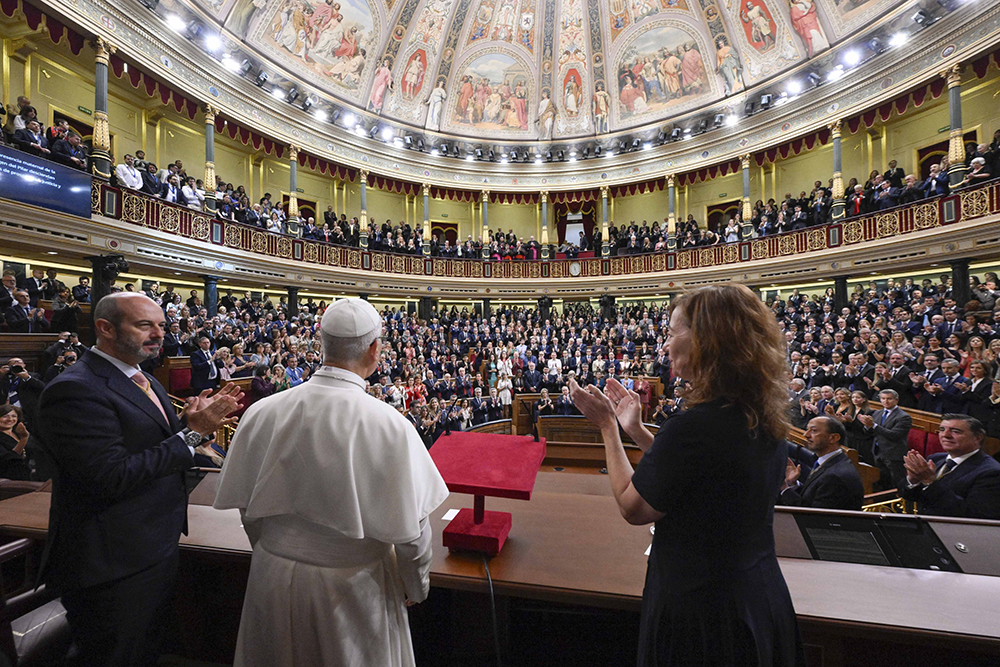
Pope Leo XIV is applauded by Pedro Rollan Ojeda, President of the Senate of Spain, and Francina Armengol, President of the Congress of Deputies of Spain, after the pontiff delivered a speech during a joint session of the Spanish Parliament at the Congress of Deputies in Madrid, June 8, 2026, during his June 6-12 apostolic journey to Spain. (OSV News/Vatican Media/Simone Risoluti)
The pope has repeatedly pushed back on the decline of multilateralism, and in Madrid, where the socialist government has advocated for increased international cooperation, he said the international community is called to "rediscover the indispensable value of dialogue" and develop "the sincere will to prioritize peace over the use of force."
But Spain's progressive government has also legalized euthanasia while it has held power, and has sought to enshrine the right to abortion in the Spanish constitution — two issues which Leo touched on obliquely in his address at parliament.
"The defense of human life is neither a partisan issue nor a confessional interest: it is a goal of civilization," he said. "Every human life must be recognized and safeguarded from conception to its natural end, in every circumstance of its existence."
Though solemn in their reception of the pope's speech, members of parliament stood and applauded the pope for seven straight minutes; four times they cheered "¡Viva el papa!" ("Long live the pope!") while Leo maintained a tight smile and nodded in appreciation.
Both Sánchez and the leader of Spain's far-right Vox party, Santiago Abascal — a Catholic who has been critical of the pope and the Spanish bishops' conference's outreach to migrants — were among the packed hall of parliamentarians standing in applause.
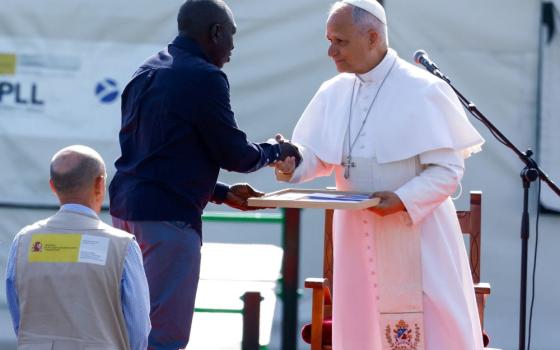
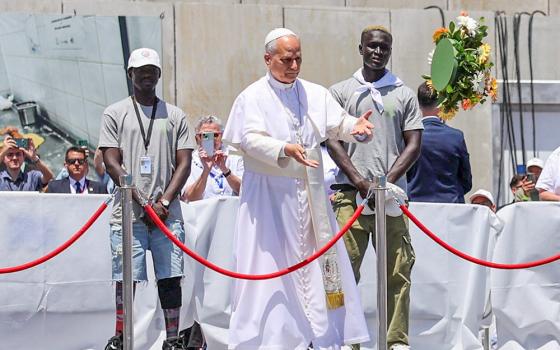
In his speech, the pope said that "the tragic drama of migration also challenges the conscience of nations and the ethical foundation of the international order today." The topic of migration is expected to be front and center during the last leg of his trip through Spain in the Canary Islands, a major destination for migrants sailing to Europe from North Africa.
The leading Spanish daily El País wrote ahead of the pope's trip that the visit was "giving an oxygen tank to Pedro Sánchez" by diverting attention away from the corruption scandals plaguing the prime minister's political party, the Spanish Socialist Workers' Party (PSOE), triggering calls from Spain's far-right party to suspend the pope's visit amid an ongoing investigation.
Addressing Spanish government leaders and foreign diplomats on June 8, Leo called on politicians to overcome the polarization that plagues Spain — one of the most politically polarized countries in Europe.
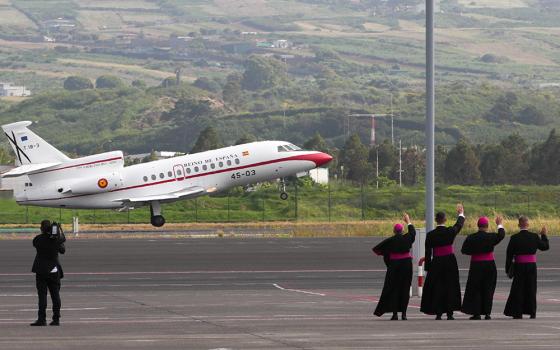
Leo's three-day stay in Madrid, unusually long for a papal visit to a capital city, is expected to be the most politically focused leg of his trip. He will travel Tuesday to Barcelona, where he will celebrate Mass at the Sagrada Familia, before continuing to the Canary Islands, where migration and his role as pastor will take center stage.
The National Catholic Reporter's Rome Bureau is made possible in part by the generosity of Joan and Bob McGrath.