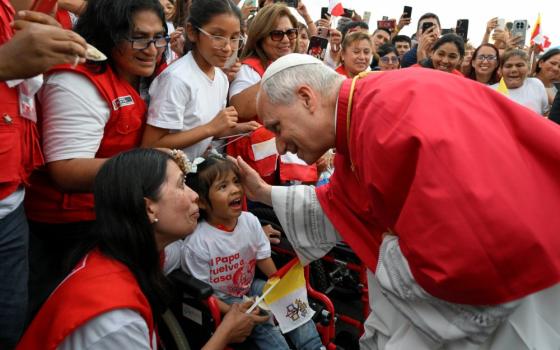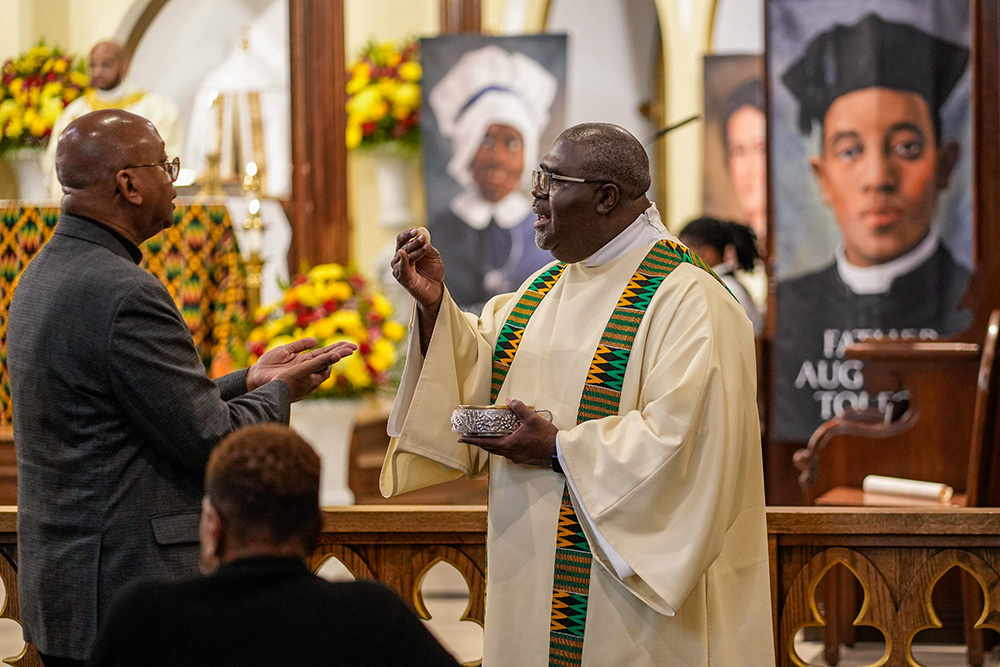
A deacon distributes Communion during Mass at the inaugural New York Black Catholic Congress at Blessed Sacrament Church in New Rochelle, N.Y., Nov. 22, 2025. (OSV News/Gregory A. Shemitz)

by Daryl Grigsby
Join the Conversation
Send your thoughts to Letters to the Editor. Learn more
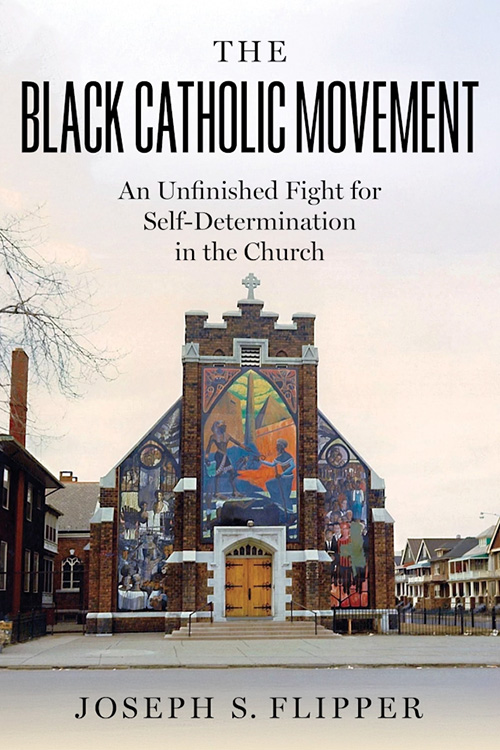
November is Black Catholic History month. In the ongoing struggle of Black Catholics to fully express their faith, mission and gifts in the church, one persistent barrier exists: the reluctance, and even opposition, of whites to make room for Black Catholic empowerment. Because of this, Joseph Flipper's new book, The Black Catholic Movement: An Unfinished Fight for Self-Determination in the Church, is a must-read for all Catholics, not only Black ones.
The title itself is notable. Rather than focus on Black Catholics as individuals in white parishes or in primarily Black parishes, Flipper, an associate professor of theology at the University of Notre Dame, surveys the range of Black Catholic engagement with the church as a "movement," positioning African American Catholics as a fully formed entity within the church rather than a diffuse group.
Historical context matters, of course. At the Second Plenary Council of Baltimore held in 1866, U.S. bishops — including some who had been slaveowners — grappled with the issue of missionary work among the formerly enslaved. Unfortunately, their views were shaped more by their society's racism than by the teachings of Jesus Christ; their official conclusion was that Blacks were morally and intellectually deficient. Missions reflected that perspective and, tragically, racial intolerance infected much of the Catholic Church for years to come.
That being said, racism was not uniform among all white Catholics. Flipper makes note of several white priests, some being recent arrivals from France or Belgium, who believed in Black agency and self-determination and acted as courageous advocates for Black inclusion and empowerment.
At the heart of the book are the vision, persistence and courage of Black Catholics over centuries to be included in the church. Some Black Catholics resisted the effort to shunt them into Black parishes and away from white churches, believing that the Catholic Church, with its focus on a universal community, could be the counter to the segregation and exclusion experienced in every other part of their lives. Thus Black Catholics presented a more truly Catholic theology and practice than the majority of the church in America.
Flipper writes, "For African American Catholics, belonging to the 'one true church' lifted them 'above the color line' by making them part of a transnational, multiracial, and universal community."
Alongside the quest for inclusion was a desire for places where their gifts and expressions were accepted and confirmed. Marginalized in parishes and missions, Black Catholics looked outward to create mutual aid societies, schools, sodalities and other forums where they were affirmed, accepted and empowered to service their community.
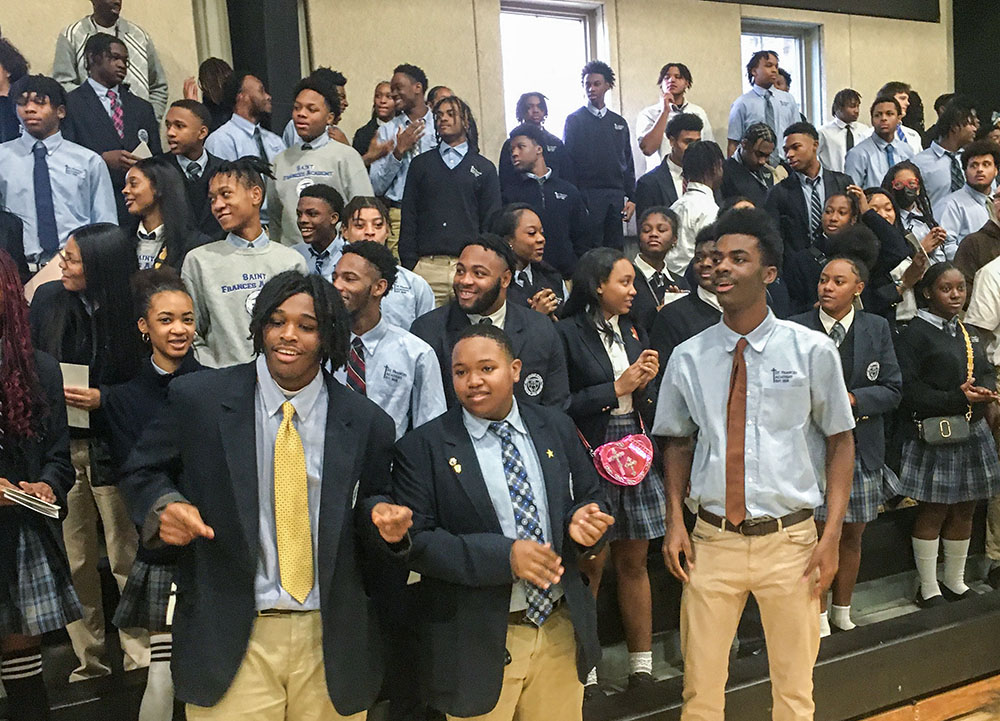
Students sing "Oh Happy Day" at the conclusion of a Jan. 30, 2024, Mass at St. Frances Academy in East Baltimore that honored the school's foundress, Mother Mary Lange, an African American who is a candidate for sainthood. (OSV News/Catholic Review/George P. Matysek Jr.)
The Black Catholic Movement described by Flipper is an ongoing history of meetings, organizations, committees, resolutions and actions of the Black Catholic community to be a vital and accepted part of the church. The First Colored Catholic Congress was formed in 1889, and the Federated Colored Catholics in 1927. Even with all my personal study, I was not aware of the extent to which Black Catholic priests, religious sisters and laypersons held forums, petitioned U.S. bishops and sought papal audience in Rome to advocate for black priests, more schools in their community, and full inclusion in the church.
I was also unaware of the extent to which Black Catholics centered Catholic schools as essential for community building, advancement and evangelization. Every organization, like the Colored Catholic Congress, the Federated Colored Catholics, the National Black Catholic Congress and others, advocated for Black Catholic schools.
Flipper points out that much of the growth of the Black Catholic population in the North between 1940 and 1970 was due to evangelization emanating from Catholic schools in the Black community. An obstacle then, and today, is the continued closure of these schools, often met with unified resistance. In Detroit, Black Catholics nonviolently protested with sit-ins in the chancery and fervent advocacy with the hierarchy.
In the 1960s, the Black Catholic Movement was profoundly influenced by the Civil Rights Movement, Black Power, James Cone's Black Theology and Black Power, and other social developments. Out of that context arose the National Black Catholic Clergy Caucus, the National Black Sisters' Conference, the National Black Lay Catholic Caucus and the National Office of Black Catholics. Each of these formations prayed, discerned, passed resolutions and advocated for practical ways for black Catholics to be represented in the Catholic Church.
Advertisement
Flipper also notes that the Black Catholic Movement read with interest the Second Vatican Council documents regarding the need for unique relevant cultural expressions in liturgy and the importance of the local parish within specific communities. Vatican II was seen as opening the door to their desire for black leadership and liturgical expressions. Ad Gentes (Decree on Missionary Activity of the Church) was particularly quoted for its support of a culturally specific mission.
The movement maintained three specific requests of the U.S. bishops and the Vatican over the years: more Black priests and bishops, a Black ordinariate and an African American rite.
More Black clergy could better understand and pastor the community. A Black ordinariate would have given Black parishes autonomy from their dioceses and placed them under a Black bishop, regardless of their location. (Such ordinariates have been approved for unique communities under canon law, such as for the military, for the Eastern rite, and for parishes coming from the Anglican Communion.)
An African American rite, advocates note, would be consistent with liturgical norms yet reflect the unique cultural expressions of Black Catholics, such as the Zairean rite, and inculturated liturgical adaptations for Aboriginal peoples in Australia and for Indigenous peoples in Chiapas in Mexico.
Sadly, opportunities offered to other groups for an ordinariate or a rite have been continually denied to African Americans, despite remarkable loyalty shown to a church that has neglected their presence. But while many of the visions of the Black Catholic Movement remain unrealized, Flipper reminds us that the movement continues with a persistence that proves it is of the Spirit.
Noted for their critical roles, past and present, in the movement are Fr. Augustus Tolton, Daniel Rudd, Josephite Fr. John Plantevigne, the artist Richmond Barthé, the poet Claude McKay, Martin de Porres Grey, Dominican Sr. Jamie Phelps, Cardinal Wilton Gregory, Nate Tinner-Williams, M. Shawn Copeland, Marianist Br. Joseph Davis, Spiritan Fr. Albert McKnight, Walter Hubbard, Fr. Clarence Rivers, Archbishop James Lyke and many others.
Despite every reason to be discouraged in our day, there nevertheless remains a faithful movement working to make the Catholic Church truly Catholic. Before reading this book, I was proud to be a Black Catholic. After reading, I am honored to be a small part of a historic and ongoing Black Catholic Movement.