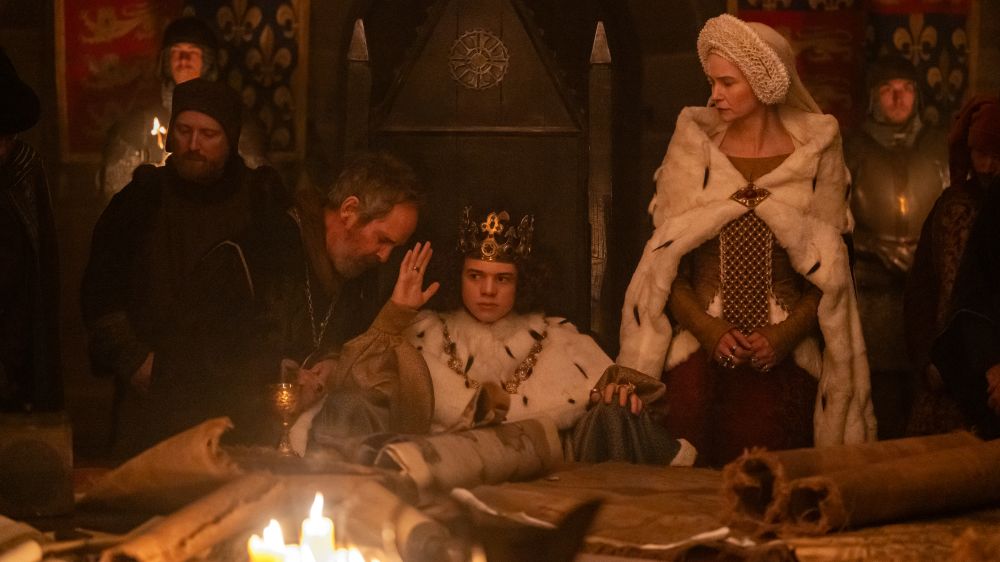
Tom Hollander as Treasurer Hales (left), Woody Norman as King Richard II and Katherine Waterston as The Countess interact in director Paul Greengrass' "The Uprising," which opens in theaters Sept. 10. (Focus Features/Betina La Plante)

by Robbie Wessel Kroeschell
Join the Conversation
Send your thoughts to Letters to the Editor. Learn more
Last week in a Q&A alongside writer-director Paul Greengrass, Andrew Garfield expressed his hopes that billionaires who see his film "The Uprising" are left "scared shitless" by the black mirror it turns on our modern lives.
That black mirror is the rhetorical power of the "eat the rich flick," a film language experiencing a golden age. From the acclaimed works of Bong Joon Ho ("Snowpiercer," "Parasite," "Mickey 17") to the brilliant farces of directors like Boots Riley ("Sorry to Bother You"), Ruben Östland ("Triangle of Sadness") and Rian Johnson ("Knives Out," "Glass Onion") the eat the rich flick provides a flexible, genre-neutral toolset for a director looking to make a populist smash. Greengrass has always brought a journalistic edge to his productions, with an interest in finding real meaning in the gritty details of history, but his choice to adapt the brutal Peasants' Revolt of 1381 may stress the eat the rich flick beyond its breaking point.
"The Uprising," which opens in theaters Sept. 10, is three films in one, and they don't always emulsify into a cohesive whole. First: the anti-authoritarian populist film. Second: the grand historical epic. And third: the naturalistic English peasant suffer-a-thon. Twice in the film our hero, Ploughman (Garfield) — as bluntly named as Christopher Nolan's Protagonist in the film "Tenet" — is left near aphonic when asked to explain the motivations behind his involvement in the revolt, mumbling on the emptiness of his tragic, post-pandemic life. There was a ready-made hero available in Wat Tyler (Cosmo Jarvis), for whom the rebellion is sometimes referred, the picture of the noble cinematic knight that the film attempts to make out of Ploughman. But Ploughman as protagonist is necessary for our eat the rich flick to exist at all.
Advertisement
The politics of "The Uprising" are completely inscrutable, a Rorschach test, as described by Garfield in the aforementioned Q&A. The cruel calculus of realpolitik, high taxes, serfdom, sexual abuse of women, undefended borders, the hypocrisy of the church, and on and on. "The Uprising" is less a political inkblot test and more a buffet of reasons to be frustrated with our unequal society, a list of grievances so long and so comprehensive that it would be astounding to meet someone who didn't agree with at least one. We're left with a muddled message to "rise up, no matter why."
What is mind-boggling about this choice is that it isn't necessary. The eat the rich flick does not have to engage in any specific politic to be compelling. In Bong Joon Ho's 2013 "Snowpiercer," opulence is enough of a sin to warrant retribution by the circumnavigational train's underclass. In Rian Johnson's 2019 "Knives Out," it isn't the Thrombey family's politics that motivate us to root for their downfall, it is their alienation and their greed.
But does "The Uprising" even want us to rise up? As much as the first act of the movie sells rebellion to us, the third act disabuses us of any belief in its efficacy. The exact moment the Peasants' Revolt begins to see the light at the end of the tunnel we are reminded, horribly, that this was a prequel to The Life and Death of King Richard the Second, and just as much a tragedy. Here history finally shatters whatever populist dream "The Uprising" hoped to be, because it was only ever a bleak historical drama recounting the real moment when the boy king became a terrible man through a cynical, shameful act of betrayal.
As messy as the film is, and it is messy, the performances throughout are excellent, with special acknowledgement for Catherine Waterston and Woody Norman as The Countess and King Richard II. Much of the film's drama hinges on the silent, screaming realization that this mother, shackled by the norms of her time, cannot control the monster her son is becoming. In another arresting moment, perhaps the film's emotional peak, Garfield as Ploughman wallows mournfully in the weatherbeaten graves of his long-deceased family and, maybe like us, asks "Why?’
But then comes the coda. A fourth movie emerges from the woods, and it's a superhero film. After a final flurry of violence, after the compounding losses, the barbarous deceptions, Ploughman has King Richard II at his mercy. Instead of taking revenge, or exacting justice, he spares him. Because even if he kills a king, "there will always be another." What possibly can we make of this other than that our enemies are too great for individual action and too monied, too organized for collective action? That these absolutes are so baked into the rhythms of our world that even 650 years later their injustices remain legible? What are we to do in the face of a power so complete?
Does "The Uprising" want us to rise up? "No" the billionaires say, smiling, as they tuck in to sleep.