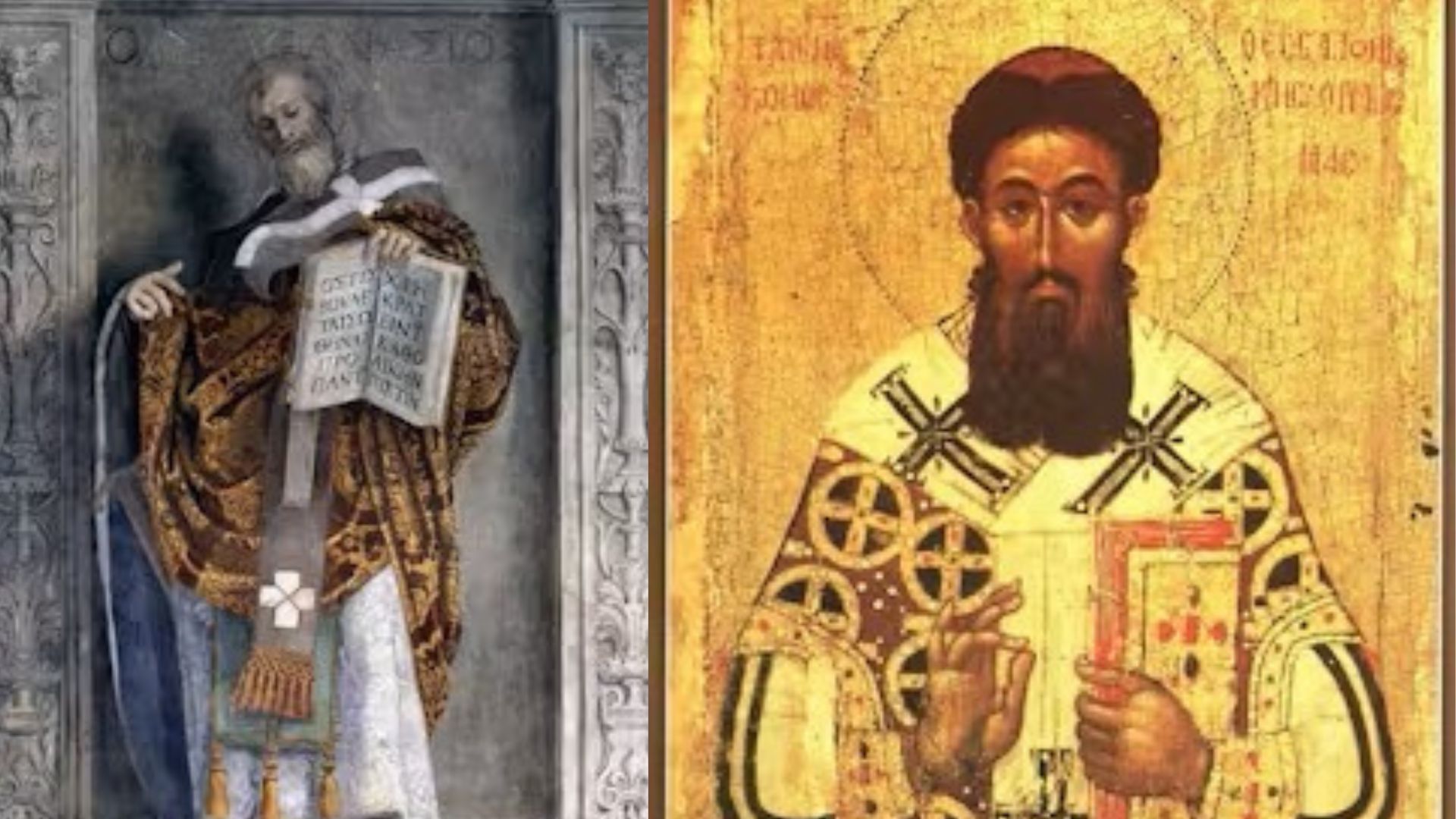
A composite photo shows "Athanasius" by the 17th-century Italian artist Domenichino and an icon of St. Gregory Palamas from the 15th century. (NCR composite photo/RNS/The Web Gallery of Art/Wikimedia Commons/Pushkin State Museum of Fine Arts)

Religion News Service
Join the Conversation
Send your thoughts to Letters to the Editor. Learn more
It begins with the music: a late 1990s rap song. Then someone appears on screen, moving slowly into a pose that can only be called deeply, theatrically serious. Then comes the reveal: The video fades from the person into a medieval painting of a haloed man doing almost the exact same pose.
Videos imitating "church fathers," bishops and theologians who helped shape early Christianity, have been popping up across social media since late 2025. Several have drawn hundreds of thousands of views.
In part, they’re funny because of the incongruity: hoodies, bedrooms and phone cameras, suddenly paired with the solemn authority of saints. But the humor also comes from how current they feel. These paintings may be centuries old, but the visual language is timeless. The raised hand, the open book, the severe gaze – they all communicate power. On TikTok or Instagram, a gesture once used to symbolize doctrine or wisdom starts to look like confidence, coolness, even swagger. The captions say as much: "They had swag fr," one reads.
Church fathers
"Church fathers" were not "founders" in the simple sense, but foundational authorities: figures whose writings later Christians returned to when debating central questions about doctrine, scripture and religious life.
Today’s social media trend uses the term more loosely. In addition to early Christian authors, many of the videos show later saints, monks, bishops and theologians. Online, "church father" becomes shorthand for religious authority itself.
The paintings circulating online range from Eastern Orthodox icons to Western European Renaissance and Baroque paintings. This style of art was meant to inspire awe, surrounding worshippers with a sense of religious authority. The saints’ books, rich vestments and formal poses were visible signs of holiness, symbolizing their learning, discipline and eloquence. Such images did not merely decorate sacred spaces; they taught viewers what closeness to divine truth – saintliness itself – could look like.
Man of books and learning
Several of the videos show Athanasius of Alexandria, a fourth-century bishop and theologian traditionally considered one of the church fathers.
Painted by the Italian painter Domenichino in the 17th century, Athanasius stands in "contrapposto," leaning back with his left shoulder, causing the right side of his body to project outward toward the viewer. The saint is dressed in a rich damask dalmatic – a long, wide-sleeved robe – over a white silk tunic.
Athanasius’ shifting stance and sweeping vestments create drama. They also direct attention to the open book he holds in one hand and points to with the other – a reminder of his place among the great teachers of the church. In religious art, books are not just props. They help the viewer recognize the figure as someone whose words matter.
The Greek text on the page begins with the words "Whoever wishes to be saved": the opening of the Athanasian Creed, a statement of Christian doctrine long associated with Athanasius. In the fourth century, he became famous for defending the idea that Christ was fully divine, a fiercely debated issue at the time.
TikTokers recreating Athanasius’ pose today use a Bible or another thick volume, wielding the book with as much swagger as the saint himself.
They lose the luxurious vestments, trading Athanasius’ sumptuous robes for hoodies and jeans. Yet their captions recognize the force of the look: Church fathers "knew the fit was hard," one video says. The language is modern, but the point is old: Clothing, books and posture make authority visible.
Charged with meaning
Another star in the videos is Gregory Palamas, a 14th-century Byzantine theologian and Orthodox saint – and he presents another type of authority altogether.
Palamas is best known for defending Hesychasm, a mystical tradition in the Orthodox Church that joins repeated prayer with contemplation. He represented holy power grounded not only in learning, but also in spiritual practice.
The painting of Palamas appears still and distant. He is not turning toward the viewer with theatrical movement, but formally facing outward, set against a plain gold background – a sacred figure, held outside ordinary time.
Palamas’ image is an icon. The saint raises his hand in the Orthodox gesture of blessing, with his fingers forming the letters "IC XC," a Greek abbreviation for Jesus Christ.
In sacred art, hands are rarely idle. Christ and the Christ child often hold up their hands to bless the viewer. Mary and John the Baptist draw viewers’ attention to Christ through their gestures and sometimes their gaze. Saints lift their hands in prayer, teaching or intercession.
To some viewers online, Palamas’ raised hand may simply look solemn or strange, charged with an unknown or mysterious meaning. But that gap in knowledge, I’d argue, is part of what makes the "church fathers" trend work. On social media, a hand gesture doesn’t need to be fully explained to feel meaningful: a slow point toward the camera, a hand over the heart, a peace sign.
TikTokers today may be a great distance from the church fathers, but their images still resonate – even, and perhaps especially, on the internet.
Advertisement