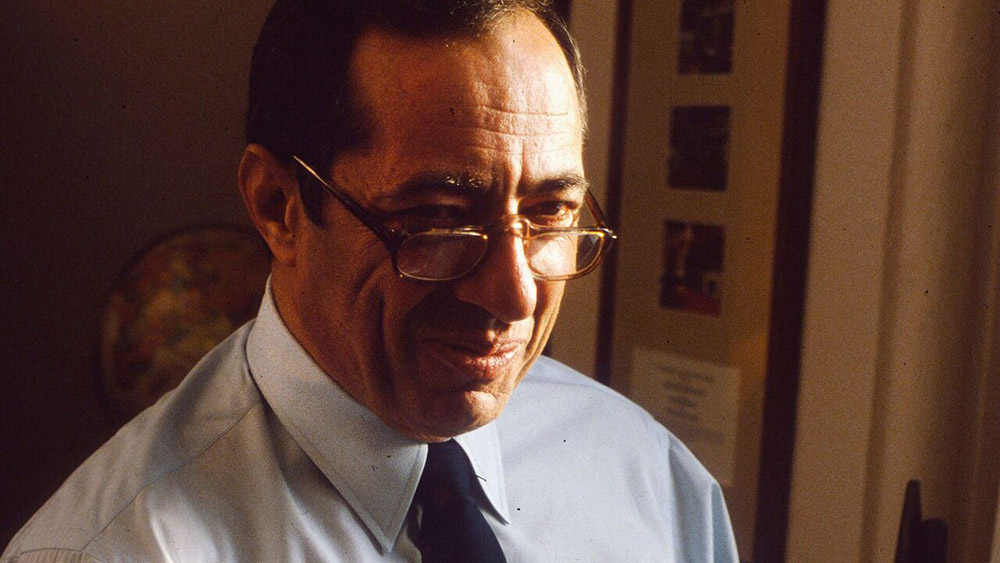
In the upcoming documentary "Mario," the faith and politics of former New York Governor Mario Cuomo are a stark contrast against today's Catholic politicians. (Life Stories)

by Jim McDermott
Join the Conversation
Send your thoughts to Letters to the Editor. Learn more
As our country celebrates its 250th anniversary, we find politics and a certain strand of Catholicism interwoven at its highest levels. The Supreme Court has six Catholic judges and one former Catholic, some of whom have spoken about the importance of religion in the United States in ways that feel unseemly for a justice at best and, at worst, diametrically opposed to the separation of church and state enshrined in the Constitution.
Meanwhile cabinet officials and Vice President JD Vance alike have used Catholicism to justify divisive and at times brutally inhumane decisions of the government. Vance even has a new memoir about his journey to Catholicism titled, of all things, Communion.
More than 40 years ago, New York Gov. Mario Cuomo achieved a similar prominence for his Catholic faith. And yet, as depicted in the forthcoming documentary "Mario," which recently debuted at the Tribeca Film Festival, he approached the balance in a very different way.
Cuomo grew up in Queens, New York, the child of immigrant parents who ran a grocery store. (Cuomo's father had been born in the U.S., but his parents took him back to Italy as a toddler.) After law school, Cuomo took on clients whom he felt were being treated unjustly by developers and government officials.
He hated politicians. "They never came to my neighborhood in South Jamaica," he said. "They were never there for Mama and Papa. They never helped us one bit as far as I could tell." And yet he was talked into running for mayor against Ed Koch in 1977.
He lost, but in the process the experience revealed to Cuomo how much he might be able to help people in government. "I think government has a purpose," he said. "I think the purpose of government is to help those people who have been left out." He became the lieutenant governor of the state of New York, and later governor.
What came to distinguish Cuomo as a governor was his emphasis on compassion and a helping hand.
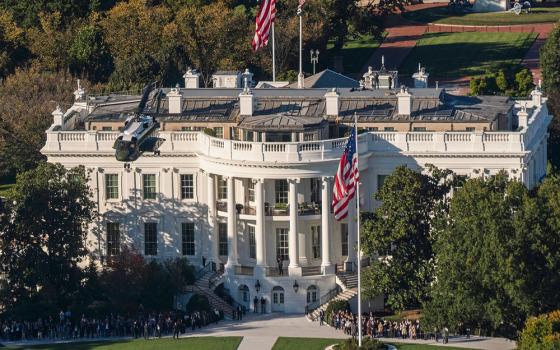
In a clip from an October 1982 White House press briefing, a journalist asks about the "gay plague," at which point other journalists and the White House press team laugh.
"No, it's a pretty serious thing," the journalist goes on. "One in three people who get this have died, and I wonder if the president is aware of it." In reply, Ronald Reagan's press secretary Larry Speakes kids, "Well, I don't have it. Do you?"
After a New York Post column showed a similar lack of concern for AIDS victims, arguing they were responsible for their own sickness, Cuomo said at a press conference, "Then you shouldn't take care of syphilis. You shouldn't take care of anyone who sins. You know who that's going to leave out? All of us."
When his adviser on these issues contracted AIDS himself, Cuomo went to him at his deathbed, held him, and kissed him on the forehead.
Former Speaker of the House Nancy Pelosi, who watched Cuomo similarly reach out to earthquake survivors on a state trip to Italy, said that for Cuomo "our Catholic faith carried a call to action."
Cuomo is perhaps most remembered today for his refusal to involve his faith in his legislative decisions regarding abortion. "I can believe as a Catholic that abortion is wrong," he said. "That doesn't mean in this pluralistic society I must require that you believe it."
Prelates called for his excommunication, and he ended up no longer going to Mass because he didn't want to create a distraction. "That killed him," his son Chris says in the documentary.
But that situation also gave Cuomo the opportunity to talk about the relationship between faith and politics in a deeper way.
Advertisement
"Approval or rejection of legal restrictions on abortion should not be the exclusive litmus test of Catholic loyalty," he said in a 1984 speech at the University of Notre Dame. "Whether abortion is outlawed or not, our work is barely begun, the work of creating a society where the right to life doesn't end at the moment of birth, where an infant isn't helped into a world that doesn't care if it's fed properly and housed decently, educated adequately; where the blind or retarded child isn't condemned to exist, rather than empowered to live."
It's the same kind of language that would be embraced by Chicago Cardinal Joseph Bernardin, and later by Pope Francis.
The Trump administration's Catholics tend to proceed from a notion of "church triumphant," Christianity as the cornerstone of our civilization.
In "Mario," we're shown a very different starting point. Rather than the religion of the victors, Catholicism was for Cuomo the faith of the underdogs, the people like his parents and their immigrant neighbors who found themselves ignored or oppressed by society. His Jesus is the one who has meals with social outcasts and challenges those who believe they are without sin.
Cuomo's Catholicism didn't imbue him with a sense of triumph. It made him feel like he always needed to do more to help. In his private journal, he wrote, "Every day, a thousand lost opportunities. Every day, closer to the end. If only everything we did, we did in light of that, how differently we'd act. I'm pained by so many hurts, so many mistakes, so many missed opportunities. It's a hard game. But the game is lost only when we stop trying."
In his speech at Notre Dame, he imagined Catholic Americans as "a people in the world transforming it, a light to this nation."
But the light we have to offer as Catholic Americans, he said, is not about taking opponents down or justifying any government's policies. Rather, it means "appealing to the best in our people, and not the worst; persuading, not coercing; leading people to truth by love; and still all the while respecting and enjoying our unique pluralistic democracy."
It's a vision of what is possible and what is required worth remembering.