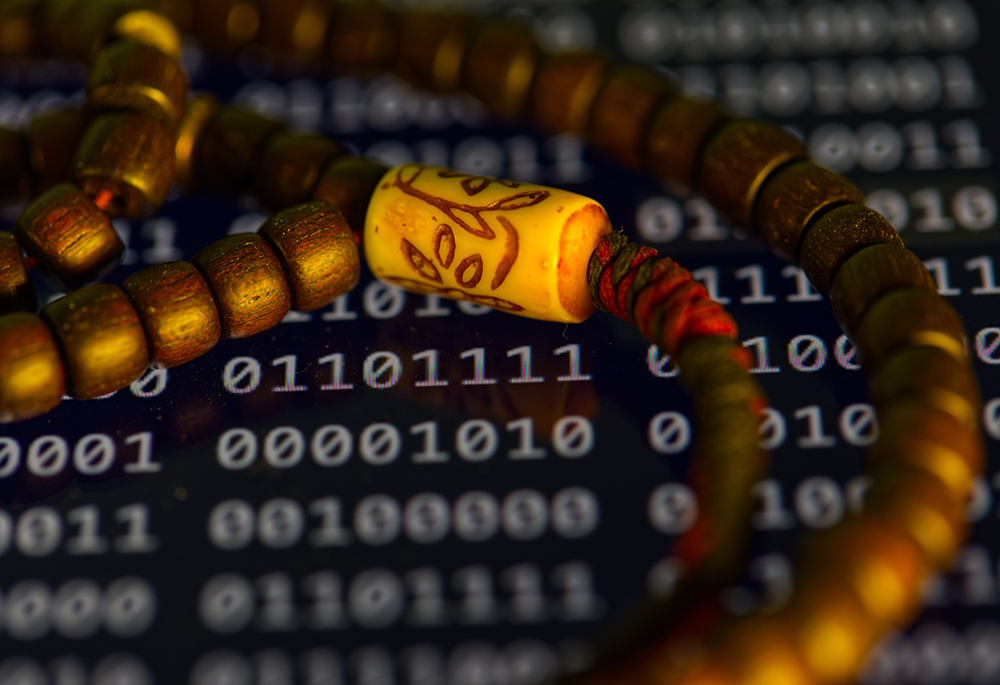
Prayer beads are photographed over a screen displaying binary code in Phoenix, Friday May 8, 2026. (AP photo/Dario Lopez-Mills)
by Brian Fraga
Staff Reporter
Join the Conversation
Send your thoughts to Letters to the Editor. Learn more
At Georgetown University, students this fall semester could register for "Foundations of AI," a course designed to prepare them to integrate artificial intelligence "into their personal, academic, and professional workflows."
Georgetown also offers an undergraduate certificate in artificial intelligence as well as an online master's degree program in AI management that combines topics from computer science, business strategy and ethics.
"We need to be cautious users of [AI programs], but they do have value," said Robert Groves, a senior advisor to the university president who is helping to lead the university's campus-wide AI Initiative.
In an interview with National Catholic Reporter, Groves, who served as Georgetown's interim president from November 2024 through June 2026, described the university's engagement with artificial intelligence, which he said prompted the computer science department to redesign its major.
"This is a moment where humans have created a new technology, and we're right at the beginning of this," Groves said. "It's moving very, very rapidly. AI can do things of great value to enhance human dignity, but it can also be destructive of human dignity. The question for us is how we navigate this moment."
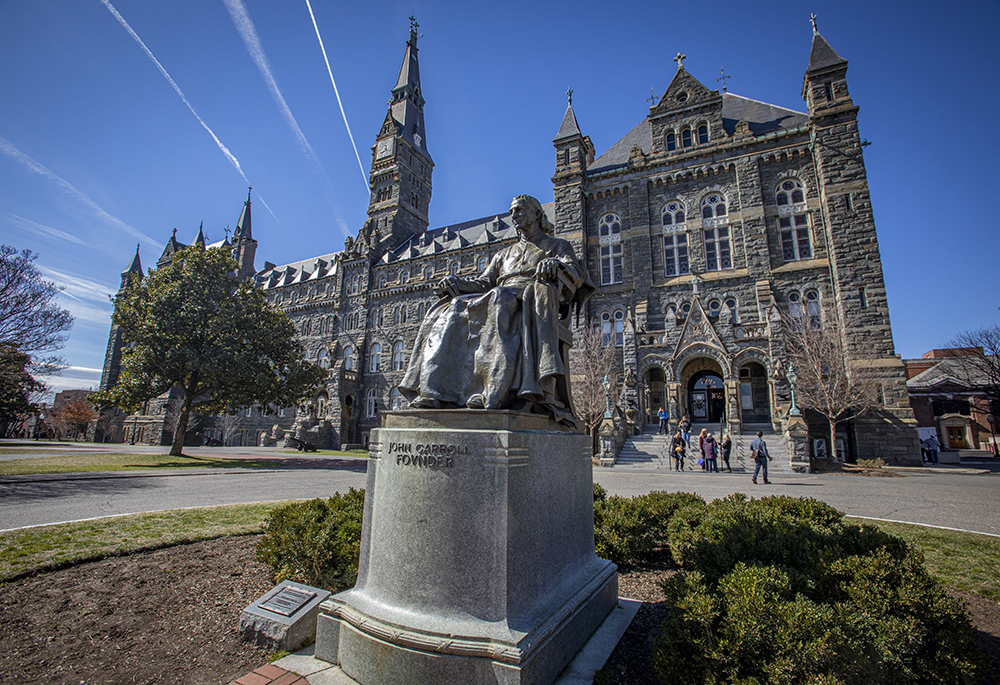
A statue of Baltimore Archbishop John Carroll, the first Catholic bishop in the United States and founder of Georgetown University, is seen on the Jesuit-run school's Washington campus in 2022. (OSV News/Chaz Muth)
Other Catholic colleges and universities are navigating similar challenges as the rapidly developing field of artificial intelligence raises questions and concerns about what the powerful technology means for the future, especially for the job market that students will soon be facing.
Rather than eschewing the technology, a growing number of Catholic higher education institutions in recent years have introduced new academic majors and programs in artificial intelligence that combine technical training with ethics.
In 2025, the Catholic University of America launched undergraduate and graduate degree programs in artificial intelligence through the School of Engineering, with specialized tracks like AI in healthcare, robotics, ethical AI design and large language models. The university also established an interdisciplinary institute for artificial intelligence and emerging technologies led by Taylor Black, director of AI & Venture Ecosystems in the Office of the Chief Technology Officer at Microsoft.
Other Catholic colleges and universities have followed suit.
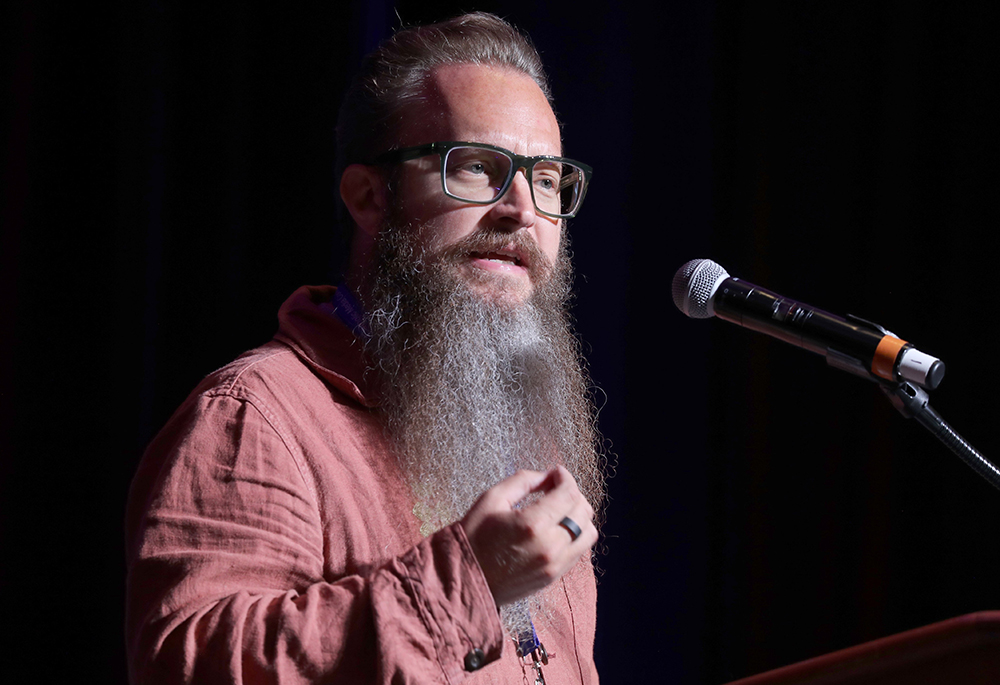
Keynote speaker Taylor Black, director of AI & Venture Ecosystems in the Office of the Chief Technology Officer at Microsoft, speaks during a June 17, 2026, session of the Catholic Media Conference in Atlantic City, New Jersey. (OSV News/Bob Roller)
Beginning this fall, Aquinas College in Michigan introduced a new major in artificial intelligence literacy. The major is intended to broaden students' understanding of AI, uncovering "its practical applications" as well as "its environmental impacts and ethical usage."
St. Norbert College in Wisconsin also added an applied artificial intelligence major alongside new paths in business analytics and data science to align with modern workforce demands. St. Norbert students will learn technical skills such as building "custom AI systems" while "developing the critical thinking skills needed to address the ethical implications" of adopting the technology.
Franciscan University of Steubenville in Ohio recently announced it had established a new endowed AI and Human Flourishing Chair that will anchor the university's efforts to examine opportunities and challenges presented by AI, saying, "As part of the initiative, the University has launched a national search for a distinguished scholar with expertise in both AI and the Catholic understanding of the human person."
"The future will not be shaped by artificial intelligence alone. It will be shaped by the men and women who decide how artificial intelligence is used. Franciscan University intends to help form those leaders," Franciscan University Fr. Dave Pivonka said in a prepared statement.
Advertisement
At Holy Cross College in Indiana, faculty members also want students to engage AI, said Mike Griffin, a theology professor who serves as the college's provost.
"We do not want AI to stunt any of the skills that a liberal arts education can provide," Griffin said, "but for students who have AI skills, we do want them to learn how it can be a promising aid along with knowing some of the risks."
Holy Cross College offers an AI certificate program, a four-course asynchronous program that "builds digital fluency, sharpens critical thinking, and promotes responsible AI leadership." The courses are available to working professionals and students who seek "a foundational understanding of artificial intelligence" as well as an understanding of AI's "practical and ethical applications."
"We haven't instituted it as part of our curriculum, but it's for students who want to learn more, not just about using AI, but about its ethics, its history and the questions surrounding it," Griffin said. "That's what I think is unique about our approach. We're not just engaging technology, but also the emergence of AI and what the Catholic intellectual tradition has to say about it."
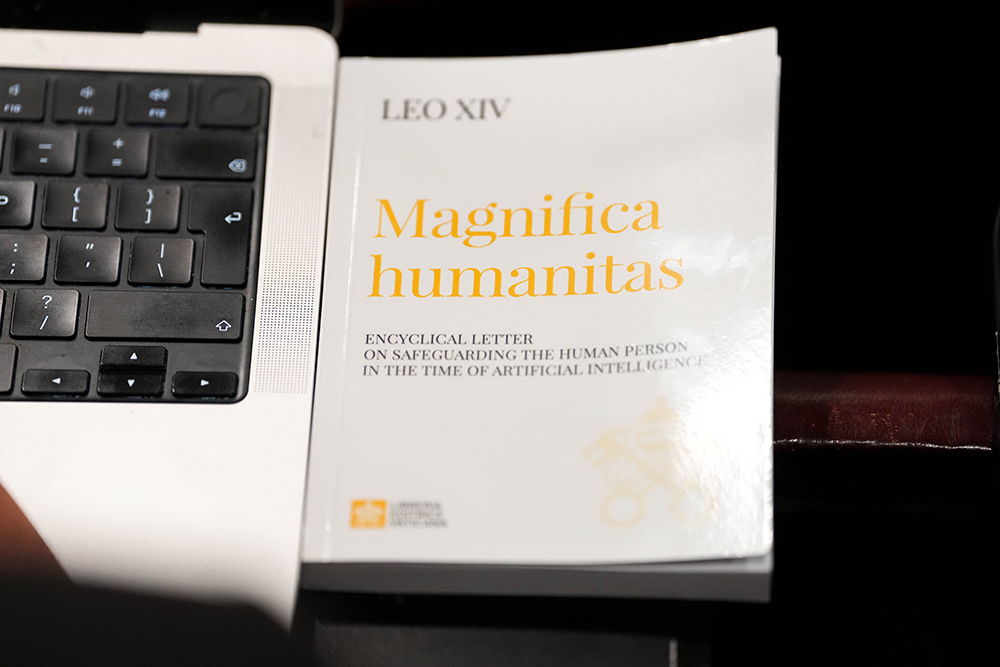
A copy of Pope Leo XIV’s first encyclical, "Magnifica Humanitas: On Safeguarding the Human Person in the Time of Artificial Intelligence," is seen during a presentation on the document at the Vatican May 25, 2026. (CNS/Lola Gomez)
Griffin noted that students in a seminar class at Holy Cross College this fall are also reading Magnifica Humanitas, Pope Leo XIV's encyclical on artificial intelligence.
"The most important thing for us, we think, is to explore the intersection of AI and the Catholic intellectual tradition," Griffin said.
At Sacred Heart University in Fairfield, Connecticut, officials are organizing an academic conference this fall on the encyclical to give faculty and students an opportunity for dialogue.
"This type of community sense-making is so valuable as we adapt to rapid changes while retaining our identity and stay focused on our mission to create leaders who make a positive difference in the world," said Brent French, associate dean for academics and assessment at Sacred Heart University.
Sacred Heart University's Jack Welch College of Business & Technology features an updated MBA program with an AI concentration. Undergraduate students can also pursue an applied artificial intelligence minor that covers machine learning and foundational concepts.
French said Welch College officials start with industry collaboration and identifying the competencies that employers believe will be valuable several years into the future.
"Learning a certain technology is a transferable skill. A student who understands ChatGPT can learn Claude readily," French said. "Our faculty have always been good at keeping courses relevant through contemporary case studies and bringing current events into the classroom, and I can add our pace of innovation is accelerating given changes in GenAI."
French added that he had to redesign part of the university's "Foundations of AI" course last spring to account for new coding tools that were announced in January.
"To say the space is dynamic is an understatement," French said, "But that is what makes it so interesting."