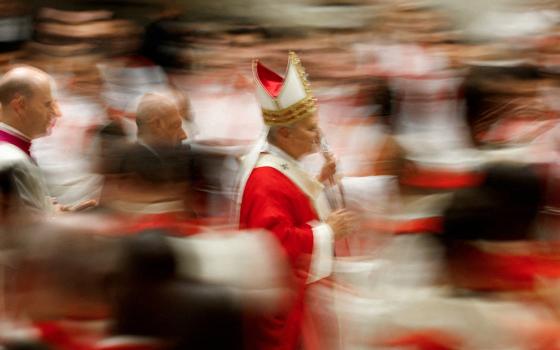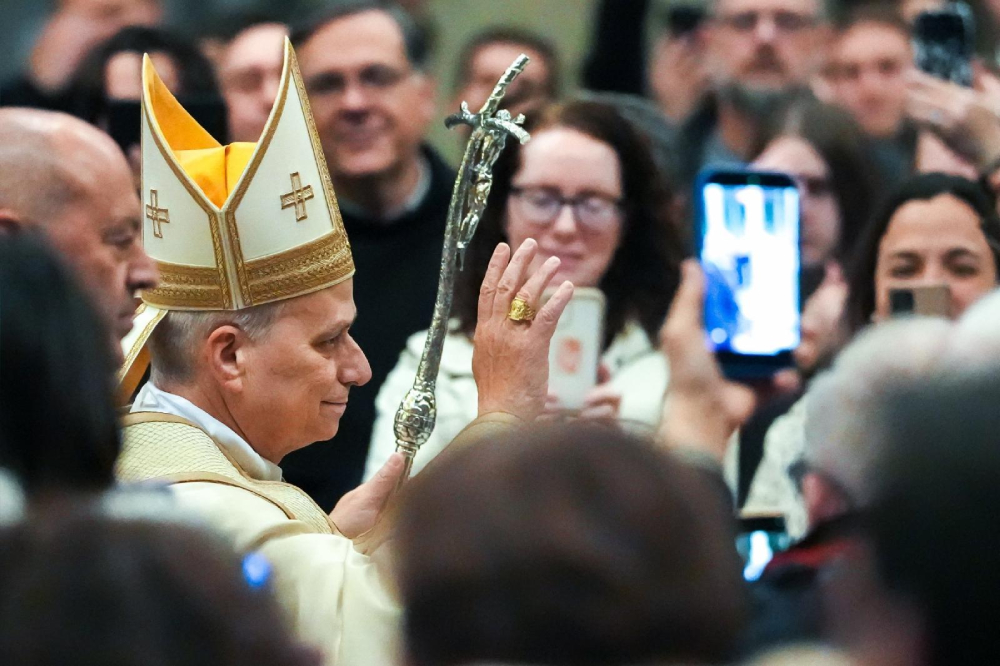
Pope Leo XIV waves as he arrives in a procession to preside over an evening prayer service at the Basilica of St. Paul Outside the Walls in Rome Jan. 25, 2026, concluding the Week of Prayer for Christian Unity. (CNS/Lola Gomez)

by Brian Fraga
Staff Reporter
Join the Conversation
Send your thoughts to Letters to the Editor. Learn more
A little more than 24 hours after the Vatican released Pope Leo XIV's first encyclical, Magnifica Humanitas ("Magnificent Humanity"), theologians, clergy members, scholars and others were still digesting the document's teachings.
In prepared statements, essays, social media posts and interviews with the National Catholic Reporter, several leading lay Catholics, as well as bishops, priests and deacons, mined the encyclical's multilayered insights on the age of artificial intelligence.
"I am convinced that this will prove to be a defining document for our era, a profound and prophetic document," said Notre Dame Law School professor Paolo Carozza, a member of the Pontifical Academy of Social Sciences who studies the intersection of technology and Catholic social thought.
Carozza, who is also the chairman of the oversight board for Meta, told NCR that Magnifica Humanitas is "not just for Catholics," but said it speaks to the concerns all humanity has in a time when AI not only bears the potential for dramatic transformations in daily life but also raises unsettling questions about what it means to be human.
"This is coupled with a real vacuum of moral leadership on the global stage," Carozza said. "In that context, Pope Leo is offering a clear, comprehensive, and coherent voice urging us to take responsibility for constructing a world in which technology will serve humans rather than degrade them."
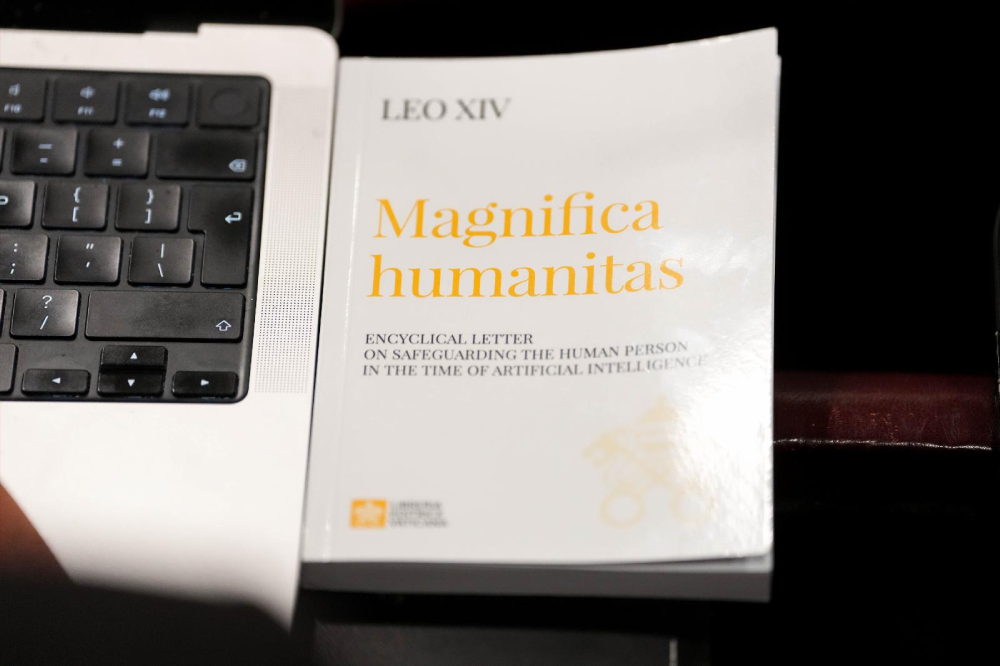
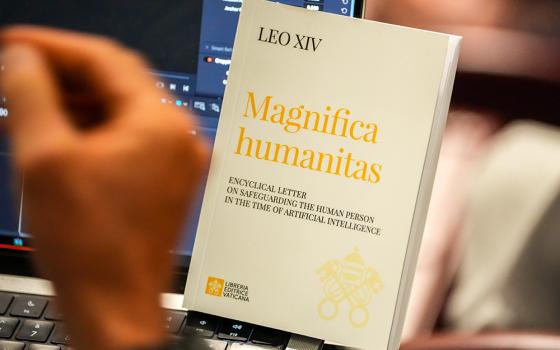
A copy of Pope Leo XIV’s first encyclical, Magnifica Humanitas, is seen during a presentation on the document at the Vatican May 25, 2026. (CNS/Lola Gomez)
Holy Cross Fr. Robert Dowd, president of the University of Notre Dame, said in a prepared statement that it was "a deliberate choice" the pope signed his new encyclical on the 135th anniversary of Rerum Novarum, Pope Leo XIII's landmark 1891 letter that established the modern foundation for Catholic social teaching.
"Just as Leo XIII addressed the disorientation of the industrial revolution," Dowd said, "Leo XIV calls us to moral clarity and solidarity in the midst of this latest societal transformation, underscoring the urgency of the questions humankind faces."
Daniel Rober, a Catholic studies professor at Sacred Heart University in Fairfield, Connecticut, told NCR that Leo is using the "AI question" to push back against the modern technocratic paradigm's framework much in the same way that Francis did with environmental issues in his 2015 encyclical Laudato Si'.
"I thought the use of the word 'disarming' around AI was quite an interesting choice of language. That's clearly a favorite motif of Leo's," Rober said. He added that the pope using the encyclical to describe just war theory as "outdated" was also "quite notable."
"I've spoken a lot on Leo as being a pope who will be known for doctrinal development, with the way he speaks to a lot of contested issues that leaves a temporal for future development," Rober said, specifically pointing out Leo's apology for the Holy See's complicity with slavery.
Steven Greydanus, a deacon in the Archdiocese of Newark, wrote on Substack that Leo's "deprecation" of just war theory was a "bold step forward" that will need further unpacking and discussion but that "could lead to yet another revision of the Catecheism" of the Catholic Church.
Vice President JD Vance, a Catholic who is a proponent of AI technology, told NBC News that he had read "bits and pieces" and scanned summaries of the encyclical.
Advertisement
"What I read of it sounds very profound, and the sort of thing that you would expect and hope from a leader of the church," Vance said. "The thing about morality is that the principles never change, but the way you apply those principles does, because the world changes, right?"
In Magnifica Humanitas, Rober said, Leo emphasizes the need for accountability and the importance of ongoing internal church discussions to prevent abuses of all kinds.
"I think he wants the church to purify itself to be able to be an effective counter-witness to the negative dynamics you see in the world," Rober said.
Mary Catherine O'Reilly-Gindhart Simpson, a theologian at St. Joseph University in Philadelphia who studies the clergy sexual abuse crisis in the Catholic Church, told NCR that she sees the encyclical's discussion of AI's capability to manipulate images and videos as creating an opening for a new church law that would make it an ecclesial crime to possess digitally created images of child sexual abuse.
"We need a continued conversation about addressing the sexual abuse crisis for artificial images, because that is a new avenue that AI creates, an avenue that we wouldn't have thought of 20 years ago," said O'Reilly-Gindhart Simpson, who also noted that the encyclical underscores the link between proclaiming the Gospel and "pursuing a more just social order." She further highlighted the encyclical's emphasis on the "value of every human person and their rights" and its potential to further the church's ongoing debate surrounding the female diaconate.
Brian Patrick Green, director of technology ethics at the Markkula Center for Applied Ethics at Santa Clara University, said he sees Magnifica Humanitas issuing a direct challenge to some of the cultural presuppositions in Silicon Valley with its direct critiques of transhumanism.
"I think the world reads that and breathes a sigh of relief and says, 'Oh good, finally someone said it,'" said Green, who also pointed out the unique manner in which Vatican officials released the encyclical.
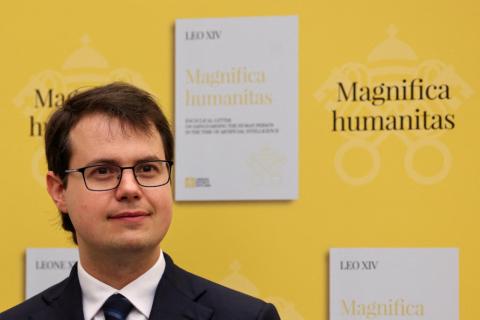
Christopher Olah, co-founder of the U.S. artificial intelligence company Anthropic, attends a news conference in the Vatican's Paul VI Hall May 25, 2026, after the presentation of Magnifica Humanitas, Pope Leo XIV's first encyclical, which focuses on the rise of artificial intelligence. (OSV News/Reuters/Yara Nardi)
"Papal encyclicals are usually not delivered at press conferences with the pope in attendance, so this was really different," Green said, noting that Leo participated in the press conference with Christopher Olah, the cofounder of the AI firm Anthropic.
"That mutual acceptance of invitation is exactly what we want in this dialogue," Green said. "I think it's important to be able to talk and converse on these very difficult subjects."
In Magnifica Humanitas, Leo does not outright reject artificial intelligence but rather points out that advances in technology arise from "our God-given creativity and free will," Detroit Archbishop Edward Weisenburger said in an essay published on the archdiocesan website.
"The choice is not between accepting or rejecting advancements," Weisenburger said. "Rather, the choice is between uses of technology that undermine human dignity or safeguard it."
Katharina Westerhorstmann, a professor of theology and medical ethics at Franciscan University of Steubenville, said in remarks emailed to NCR that St. Paul's statement in 2 Corinthians 12:9 — "Power is made perfect in weakness" — can be viewed as an underlying exhortation in the encyclical.
"The Pope does not condemn technological development, or proper use of artificial intelligence," she said. "However, he strongly opposes transhumanism and a culture that seeks to overcome human weakness through technological manipulation, by dominating resources, and subduing human nature."
Magnifica Humanitas, Westerhorstmann added, presents a "biblical, theological, and spiritual approach based [on] the principles of Catholic Social Doctrine to renew the Church`s commitment in the defense of and the love for the human person in all its grandeur and woundedness."