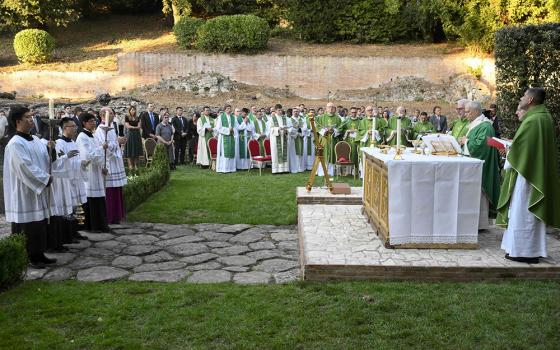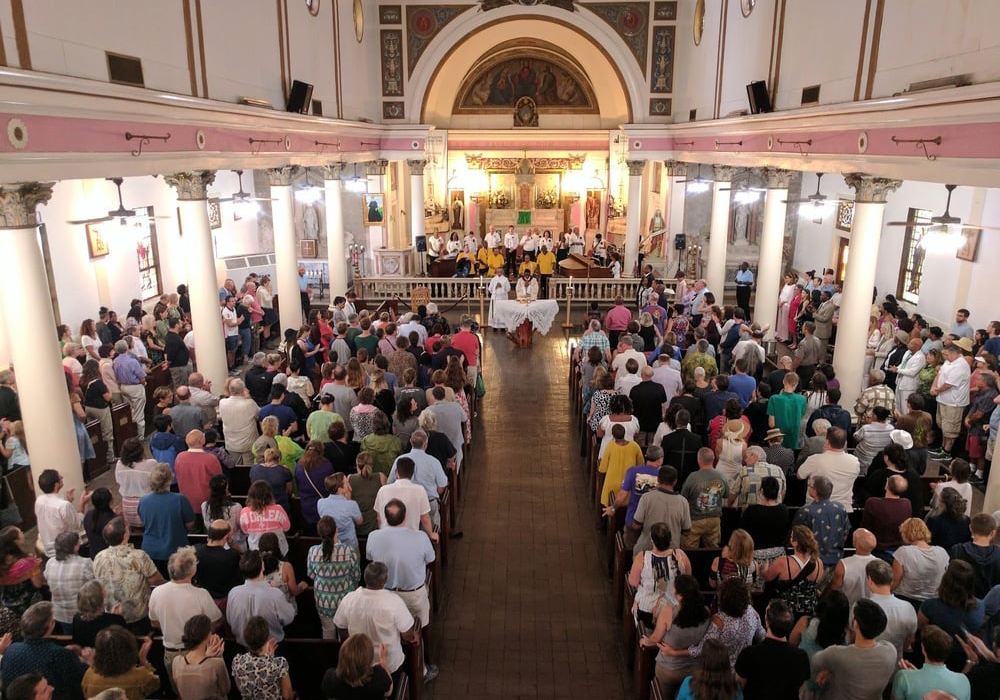
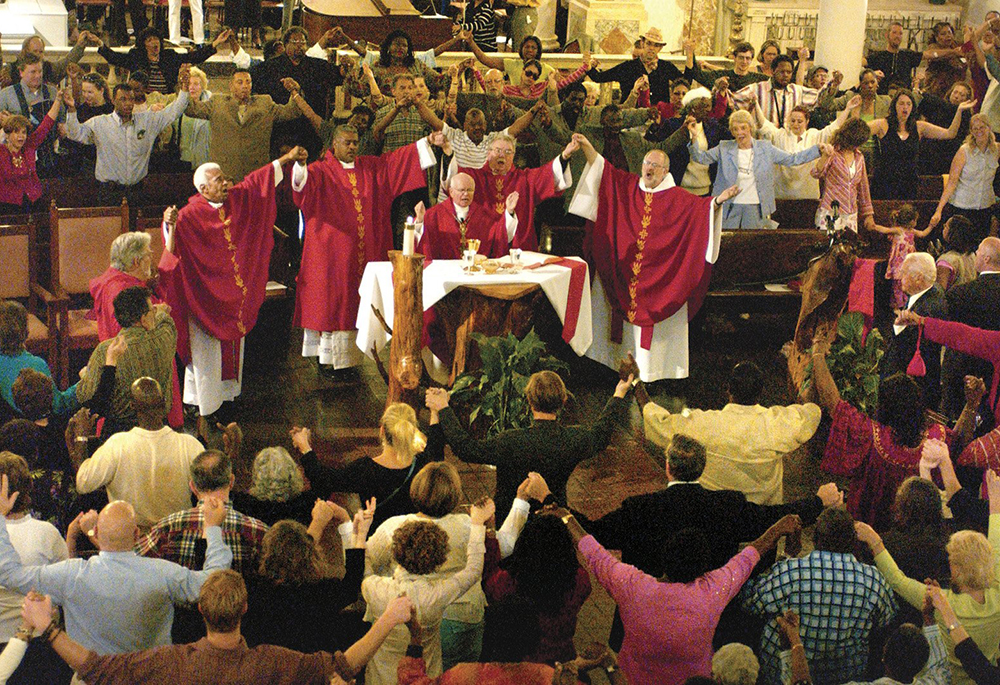
The congregation celebrates inside St. Augustine Church in New Orleans. (Courtesy of St. Augustine Catholic Church)

by Jason Berry
Join the Conversation
Send your thoughts to Letters to the Editor. Learn more
On Aug. 25, 1901, Louis Armstrong was three weeks old when his paternal great-grandmother had him baptized at Sacred Heart of Jesus, a Canal Street parish in working-class Mid-City. During the Jim Crow era, the Catholic Church played a fallback role for African American mothers who gave birth at home and registered the infants at baptisms, rather than deal with state offices.
African Americans make up roughly 13% of Catholics here, compared to about 4% nationally. Yet now, as the annual Satchmo Summerfest just celebrated Armstrong's birth with a jazz liturgy Aug. 2 in the historic St. Augustine Church, other majority-Black parishes have closed and merged in recent years, with the archdiocese citing general financial challenges and demographic shifts, and set against the backdrop of a five-year $360 million bankruptcy case over clergy child sexual abuse.
Armstrong's personal history reflects the interplay between New Orleans' vibrant Black community and the Catholic Church. As Thomas Brothers writes in Louis Armstrong's New Orleans, his mother raised him in a Holiness church with swaying music that influenced his richly layered horn style. He left for Chicago in 1922 to join the Creole Jazz Band of his mentor, "Papa" Joe Oliver. Unaware of his baptism, with no Catholic identity, Armstrong became a cultural titan, claiming a July 4, 1900, birthday until his death in 1971. Later, in 1988, historian Tad Jones discovered Armstrong's baptismal record.
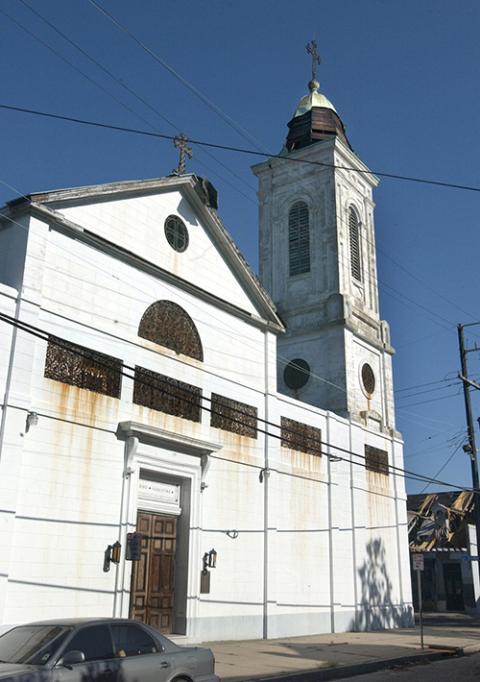
Damage to the roof and steeple of St. Augustine Church in New Orleans can be seen in this post-Katrina file photo from October 2005. (CNS/Clarion Herald/Frank J. Methe)
"We had a big celebration [in commemoration] for his baptism," says Jennifer Molina, a Boston College graduate, Spanish teacher and second-generation resident of the neighborhood.
But by 2005, Hurricane Katrina flooding sent water above the pews at Sacred Heart church.
"One parishioner was a contractor," recalls Kathleen McGoey, a longtime parishioner. "They pulled up the carpet and took up some of the pews, washed down the walls to kill the mold; after that, nothing."
Despite efforts of parishioners to save the parish, the church was eventually closed, one of more than two dozen churches that didn't survive following the devastation. A local developer recently signed a long-term lease for the property. Some longtime Sacred Heart parishioners still believe that the real reason was a priest shortage, which has played a part in other parish closings and mergers in New Orleans.
And that still remains a key factor in parish closings and mergers throughout the United States, including in New Orleans. One report found that parishes serving Black and Latino Catholics in various parts of the United States are disproportionately affected by mergers and closures.
Now, the shrinking footprint in New Orleans continues, but not just because of a natural disaster. And in recent years, during the bankruptcy case, consolidations have been put in place, and they came down hard on African American parishes in this Black majority city.
When a parish consolidation plan was announced in 2023, local media reported that Black parishes were disproportionately affected and some Black Catholics felt like they were not given a chance to make the case that they could sustain their churches. For its part, the archdiocese defended the process, citing a range of considerations – such as the pastoral and financial health of the parishes. It said in a statement that the idea that race played a factor was "without credibility." As NOLA.com reported, parishes and other Catholic entities were previously told by the archdiocese in September 2023 that they would have to contribute to the settlement costs. But when the consolidation was announced later that October, the archdiocese said that the bankruptcy was not the main reason, according to reporting by WWL-TV, and cited natural disasters, inflation and rising insurance rates.
Advertisement
The shrinking footprint includes various Catholic-owned facilities. Our Lady of Lourdes, closed since the devastation following Hurricane Katrina, a Spanish mission style church on Napoleon Avenue in the Uptown area, is now a reception hall. The parish school was razed and is now a Trader Joe's, tastefully done in matching mission style.
The large Jesuit residential house on oak-lined St. Charles Avenue, opposite Loyola University, has a for sale sign in the front yard facing the streetcar tracks. Earlier this year, the Society of Jesus settled a lawsuit against Jesuit High School with a reported seven-figure sum.
The archdiocese in 2024 sold a building it owned that housed a Catholic bookstore, a longtime presence in a stately house on South Carrollton Avenue next to Notre Dame Seminary, part of a plan to fund settlement claims.
But St. Augustine's Parish, tapping into the city's unique culture and history, is bucking the trend.
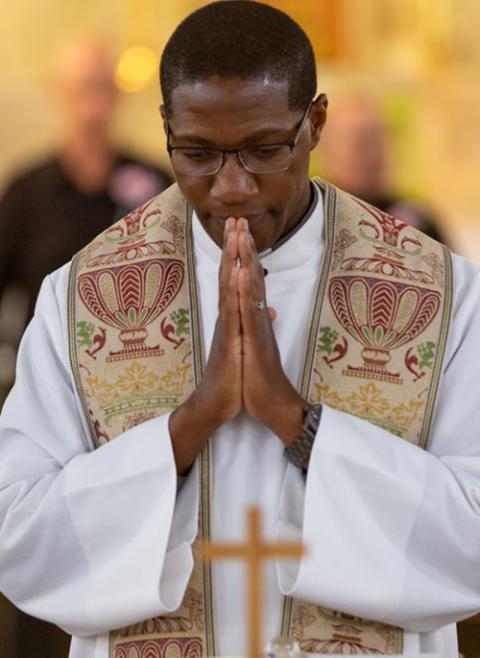
Missionary Oblate of Mary Immaculate Fr. Emmanuel Mulenga (Courtesy of St. Augustine Catholic Church)
Satchmo Summerfest began in 2001 for Armstrong's centennial birthday. The two-day celebration with concerts and panel discussions at the New Orleans Jazz Museum in the French Quarter included an Aug. 2 brass band Gospel Mass at St. Augustine in nearby Tremé. Built in the 1840s, St. Augustine, the nation's oldest African American parish, has survived a rocky ordeal since 2005 with damage from two epic storms, the sacking of a beloved pastor, a changing neighborhood and sacristy closed almost five years from Hurricane Ida, with liturgies in the parish hall.
On June 7, the renovated sacristy, with some patches yet unpainted, reopened after restoration covered by FEMA and insurance. The pastor, Missionary Oblate of Mary Immaculate Fr. Emmanuel Mulenga, of Zambia, at a recent Mass announced the Aug. 2 liturgy for the Satchmo Summerfest "and equally a celebration for our church revitalization."
Tremé's landmark, built in 1841 by free Blacks, Italians and enslaved workers, has a garden anchor symbolizing the Tomb of the Unknown Slave, installed by the late Society of the Divine Word Fr. Jerome LeDoux. In the 1990s, the Sunday jazz Mass and LeDoux's uplifting sermons drew tourists from European, Canadian and U.S. cities.
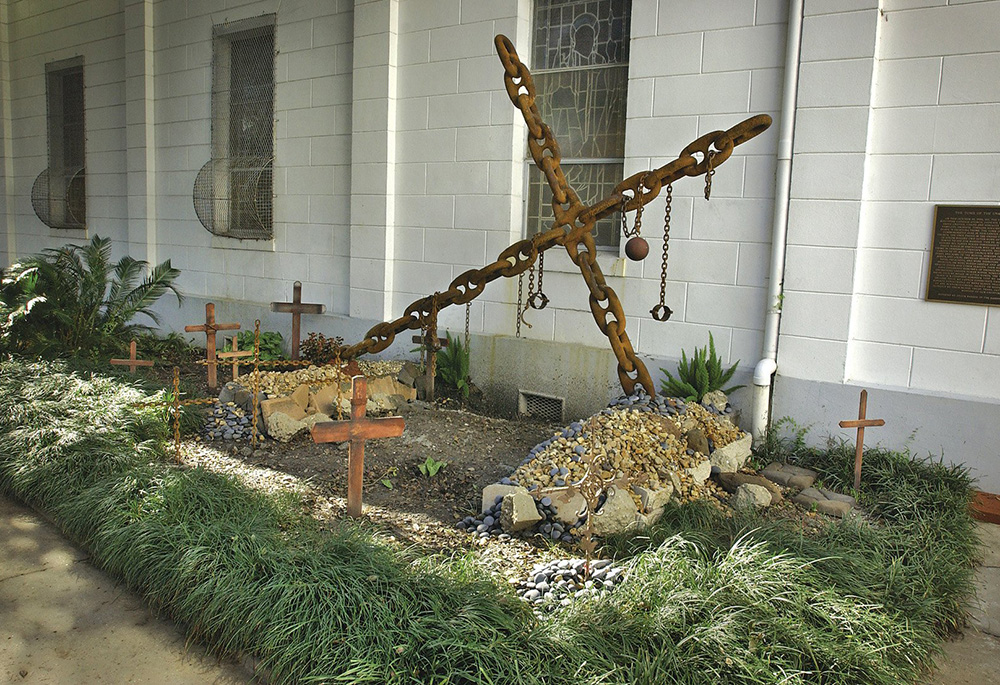
The "Tomb of the Unknown Slave" is seen in a courtyard adjacent to St. Augustine Catholic Church in New Orleans. The memorial shows symbols of slavery such as a massive chain constructed in the shape of a cross and metal neckbands, shackles and unmarked crosses. (CNS/Clarion Herald/Frank J. Methe)
In 2006, with the city reeling after Katrina, St. Augustine's had an explosive standoff with then-Archbishop Alfred Hughes, a former Boston auxiliary bishop under Cardinal Bernard Law. Hughes ordered the closure of the parish, which was $227,000 in arrears to the chancery at the time. After a back and forth with the archbishop, LeDoux left the parish.
"Shake the Devil Off," a documentary on the dispute, shows protestors in pews as a replacement pastor arrives; police arrested demonstrators at Mass. Hughes decried "the sacrilege" of the protest and cancelled Masses. LeDoux, still packing, bristled that the clash "reeks of racial profiling."
Political consultant Jacques Morial, a son of the first Black mayor, Ernest Nathan "Dutch" Morial, and brother of the third, met with the archbishop. "Hughes had no idea that making LeDoux leave would set off so many folk," recalled Morial, a parishioner of St. Augustine's. "With so many people just getting back after Katrina, the timing couldn't have been worse."
In this April 9, 2006, photo, then-New Orleans Archbishop Alfred C. Hughes, center, celebrates Palm Sunday Mass at St. Augustine Church, following a re-consecration ceremony April 8. Hughes, the main celebrant, was joined by former St. Augustine pastor Divine Word Fr. Jerome LeDoux, Deacons Jesse Watley and Ron Guidry, and Edmondite Fr. Michael Jacques, pastor of nearby St. Peter Claver Parish. (CNS/Clarion Herald/Frank J. Methe)
Morial explained that LeDoux embodied the spirit of the city — and said the archbishop failed to capitalize on the goodwill being offered to New Orleans.
"If I were a neutral consultant, first thing, you look at the facts. A church, the pride of the Black community. LeDoux, a pastor everyone loves. The guy's a vegan, drinks carrot juice. LeDoux's eccentric. New Orleans is eccentric. But the city's in the media because of Katrina. The parish owes two hundred plus change to the archdiocese," he said. "So what do you do? Launch a national fundraising campaign! Call Oprah, rally people who love New Orleans. LeDoux would be essential — he's a folk hero. Hughes, from all I could tell, never thought about an alternative."
LeDoux eventually left. The parish limped along as deferred maintenance mounted. Mulenga was appointed in 2014. LeDoux in retirement published a novel about the parish, War of the Pews. When he died in 2019 at 88, St. Augustine gave him a brass band sendoff. By then the church rebounded as both a tourist magnet and anchor for festivals and community meetings.
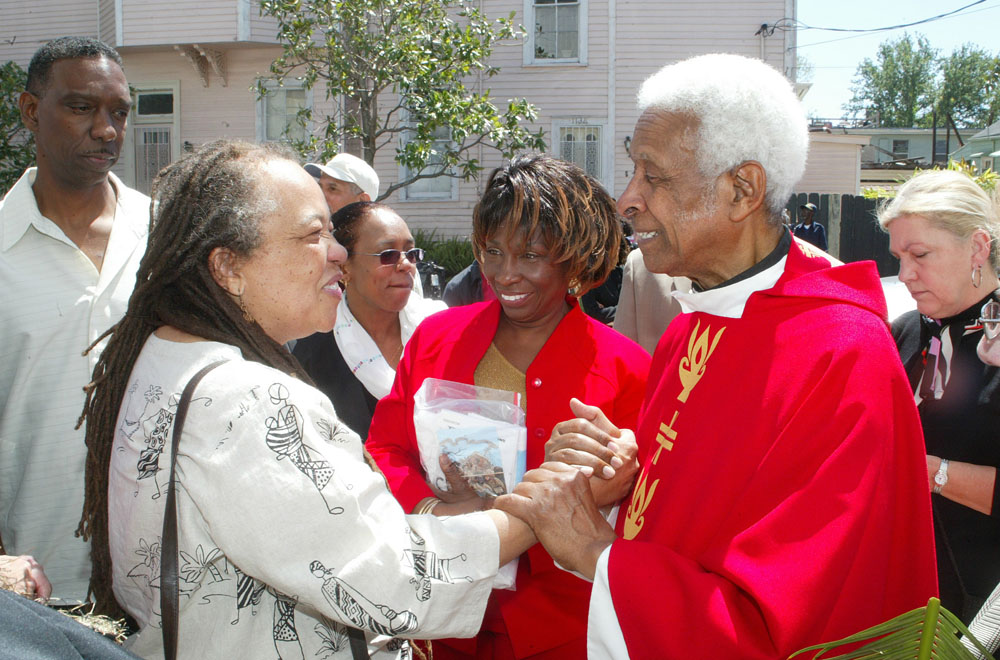
Fr. Jerome LeDoux greets parishioners at St. Augustine Catholic Church in New Orleans on April 9, 2006. (Newscom/UPI Photo/A.J. Sisco)
Over the last decade, however, investors began gobbling up real estate and renovating houses for short-term vacation rentals. Gentrification saw old residents leave, and parish affiliation decline. A fair number of Sunday Mass attendees grew up in Treme and drive in from other neighborhoods.
Parishioner Miriam Gonzalzles* wrote a $200,000 National Trust for Historic Preservation grant to help the renovation after Hurricane Ida. It was awarded in 2024, but disbursement of the funds was stalled for more than a year.
Another parishioner, Alison McCrary, an activist attorney of Cherokee descent and a lay minister for death row inmates, told NCR that she helped connect the parish to the National Trust.* She believes "the elephant in the room was the archdiocese's bankruptcy over the pedophilia cases."
McCrary, in an email to NCR sent after the initial publication of this story, said she believes that the archdiocese's "huge legal costs" associated with the sex abuse litigation delayed the project. She also noted that St. Augustine was part of the archdiocese's revitalization efforts that included potential mergers and closures.*
But Mulenga, the pastor, disagreed, calling the claim that the delay was due to the bankruptcy "unfair and unjust" in an email to NCR following the initial publication of this story. He said that delays were caused by "scope of work" issues, saying that the parish had to differentiate between damages caused by Hurricane Ida and general repairs, which took time.*
But eventually the money arrived and the archdiocese, working with FEMA, contractors and insurance companies, guided the church restoration.
"I think we'll have more funerals and weddings now," said McCrary. "The grant will help for repairing the bell tower."
Parishioner Michael Valentino, a hotelier, served as liaison with the archdiocese, FEMA and construction companies, said that the grant* is "being applied to whatever is not covered by insurance and FEMA."
Patches of peeling sacristy walls will be painted after exterior water drainage repair is done, Valentino told NCR. "The walls need to breathe until the moisture factor is eliminated."
With October marking the church's 185th anniversary, Valentino and McCrary are optimistic about a capital campaign to launch then that will help fund further upgrades to the parish.
"We're feeling a positive trajectory in one of the most culturally important churches in North America," said Valentino.
St. Augustine's revival is a bright spot amid the shrinking church footprint from real estate transactions visible in other neighborhoods and some fear that further consolidation and sales will mean fewer Black Catholics will feel connected to parish life.
Congregation of St. Joseph Sr. Margaret Maggio regularly attended Mass and volunteered at the former St. Gabriel the Archangel Parish in New Orleans, which she described as "a wonderful parish with primarily Black members." Following the flood, she and other parishioners worked hard to fix the damage. But in 2024, the archdiocese announced that the church would merge with two others, citing that the three were "in pastoral programming and sacramental decline and posting financial losses."
She worries that St. Martin de Porres, the name of the new parish that brought together the three churches, shrouds a turbulent subsurface. "It's hard when people working together for a long haul must all of a sudden embrace a whole new building and pastor. Catholics, I find, are very faithful to the church where they grew up and got married. It's hard to switch over to a whole new environment."
*Editor's note: An initial version of this story credited the wrong person for writing the grant St. Augustine's Parish received. The story has been revised to correct this. The story also has been updated to include clarifying comments from McCrary and comments from the pastor of St. Augustine's, who disputes an account offered by a parishioner in the initial version of why the grant was originally delayed.
St. Augustine Church is featured in Jason Berry's film on jazz funerals, "City of a Million Dreams," screening on PBS stations and available on streaming platforms Tubi and Fawesome.