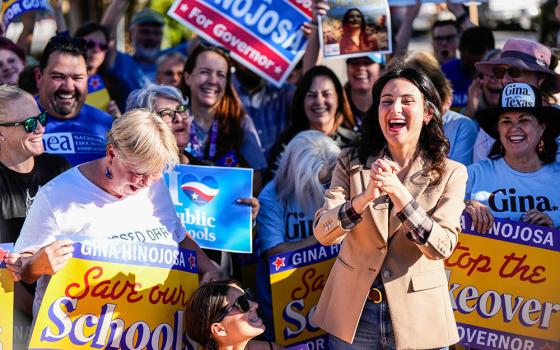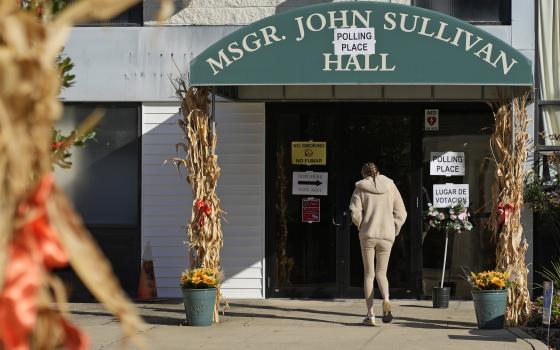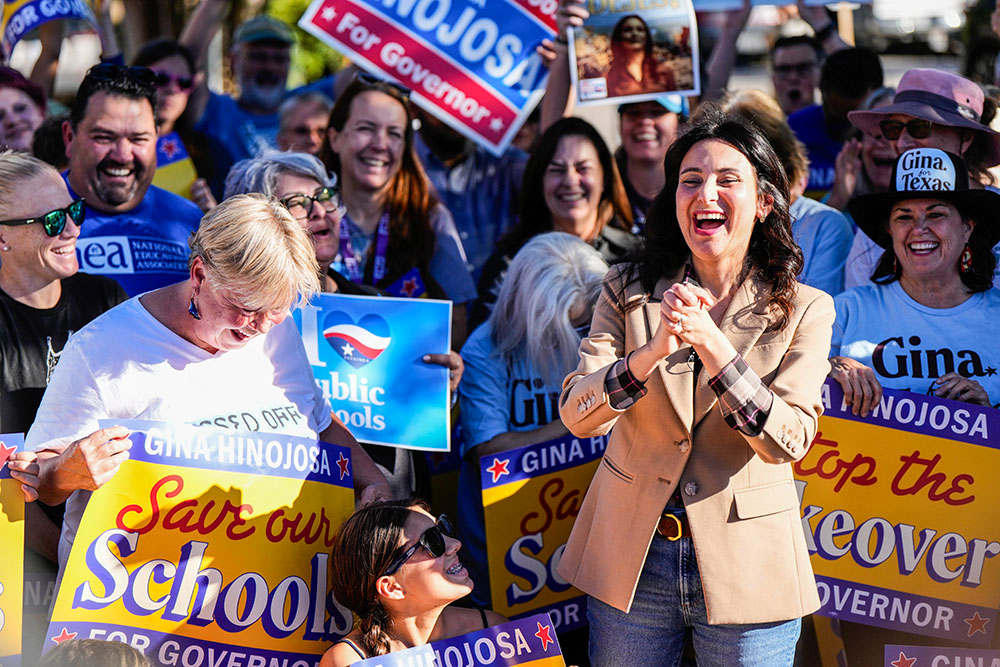
Gina Hinojosa, right, shares a laugh with supporters outside a polling place in Austin, Texas, Nov. 3, 2026. The Democratic state representative unseated Republican Gov. Greg Abbott, becoming Texas' first Latina governor and its first Democratic governor in more than three decades. (AP/Ashley Landis)

Join the Conversation
Send your thoughts to Letters to the Editor. Learn more
The Democrats' sweeping victory in the Nov. 3 midterms returned the party to power in the House and Senate and delivered governorships long held by Republicans. Catholic identity remained visible among winners on both sides of the political divide.
Few victories illustrated that tension more clearly than Gina Hinojosa's in Texas. The Democratic state representative unseated Republican Gov. Greg Abbott, becoming Texas' first Latina governor and its first Democratic governor in more than three decades. Both candidates were Catholic. Abbott told EWTN before the election that church teaching informed his decisions, particularly on abortion and the dignity of workers.
Hinojosa said her Catholic faith is her "moral compass."
"I am Catholic, Mexican, and superstitious," she said in an interview with The New Yorker.
As a state legislator on the Texas House floor in 2021, she declared: "I was raised Mexican Catholic. I am still Catholic, and in that tradition, the value and culture of dignity is held in high esteem."
She spoke about opposing abortion restrictions and has described her experience of her first pregnancy, diagnosed with trisomy 18 — a genetic condition that causes physical growth delays during fetal development. After consulting her pastor and a woman religious at her parish, Hinojosa decided to continue the pregnancy, but her daughter died shortly after she was born. Hinojosa has argued that families confronting abortion-related decisions should retain the freedom to make them, she said in the same 2021 speech to Texas legislators.
"It was in making that choice that I experienced God's grace. It was in making that choice that I found my own strength. And why would we take that opportunity, that choice, away from anyone? From any woman in this state? Isn't that what life is about? The choices that we make?" she asked.
In the Senate, another Catholic story accompanied a Democratic flip. Troy Jackson, a former logger and Maine Senate president, defeated five-term Republican incumbent Susan Collins, who is also Catholic. Jackson grew up Catholic and once held positions restricting abortion. This year, he spoke publicly about changing his mind after listening to women and medical professionals. He now supports legalized abortion.
But the Democratic Senate breakthroughs were not all Catholic victories. Texas' newly elected senator, James Talarico, is a Presbyterian seminarian. Kansas upset winner Adam Hamilton is a United Methodist pastor and North Carolina winner Roy Cooper is Presbyterian. Their campaigns were part of a broader revival of explicitly religious language among Democrats.
Advertisement
In the House, Catholic identity also intersected with Democratic gains, sometimes less directly. Paige Cognetti won Pennsylvania's 8th District, defeating Republican Rob Bresnahan, a Catholic, in the heavily Catholic Scranton region. As mayor of Scranton, Cognetti visited the Sisters, Servants of the Immaculate Heart of Mary for prayer and discussions of homelessness, immigration and other community concerns.
More direct evidence comes from Democrats who returned to Congress. Rosa DeLauro of Connecticut has for years organized colleagues who publicly describe themselves as Catholic. In 2022, a group of Catholic House Democrats invoked the church's social teaching and appealed against denying Communion to lawmakers who support legal abortion.
In 2023, another statement defended abortion access through conscience and religious liberty. Signatories included such now-reelected Democrats as Alexandria Ocasio-Cortez, Pete Aguilar, Nanette Barragán, Greg Casar, Joaquin Castro, Robert Garcia, Sylvia Garcia, Debbie Dingell, Madeleine Dean, Betty McCollum, and others, although the signatures came from different years.
The Catholic Democratic presence was visible in statewide races beyond Texas.
In New Mexico, Democrat Deb Haaland made history as the first Native American woman elected governor in U.S. history. Haaland, who is a practicing Catholic, said in a 2020 candidate questionnaire that her Catholic values included caring for others and respecting different cultures. Her faith, she added, guides her desire to protect marginalized communities.
Her Indigenous upbringing has also shaped her commitment to environmental protection and the preservation of sacred lands.
Gov. Katie Hobbs secured another term in Arizona. She has called herself a "social justice Catholic" and has discussed a miscarriage when explaining her position on abortion. "My Catholic faith taught me to fight for justice and inspired me to serve — first as a social worker and now as a public servant," she said.
New York Gov. Kathy Hochul, reelected Tuesday, likewise described her upbringing as blue-collar social-justice Catholicism. Massachusetts Gov. Maura Healey, also reelected, has defended her Catholic identity while supporting abortion rights.
California elected Xavier Becerra, a self-described practicing Catholic, succeeding a Democratic governor rather than flipping the office.
Democratic Catholic Sens. Ed Markey of Massachusetts, Jack Reed of Rhode Island and Ben Ray Luján of New Mexico also won reelection.
Republican Catholic officeholders survived the Democratic wave, too. Nebraska Gov. Jim Pillen, who described prayer as foundational to governing, won another term, as did New Hampshire Gov. Kelly Ayotte.
Republican Sens. Jim Risch of Idaho, Pete Ricketts of Nebraska and Mike Rounds of South Dakota prevailed. In the House, Catholic Republicans such as Stephanie Bice, Tom Emmer, John Rutherford and Riley Moore have publicly discussed conversion, praying the rosary and attending Mass.
This article is supported by The Bertlesen Fund for Excellence in Catholic Journalism.