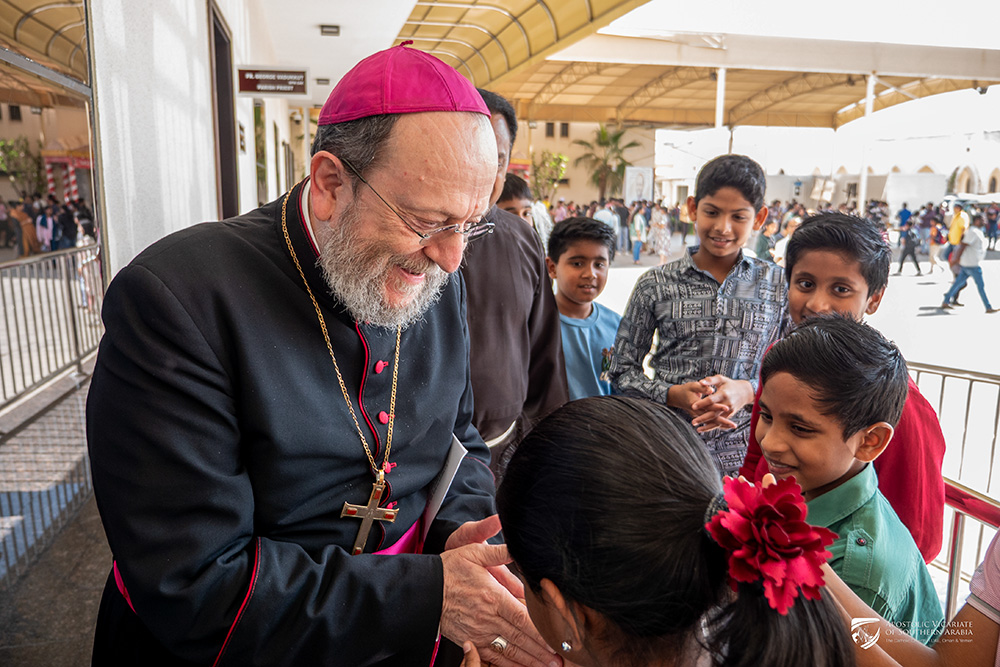
Bishop Paolo Martinelli, apostolic vicar of Southern Arabia, greets children during a pastoral visit in February 2026. (Courtesy of Apostolic Vicariate of Southern Arabia)

Join the Conversation
Send your thoughts to Letters to the Editor. Learn more
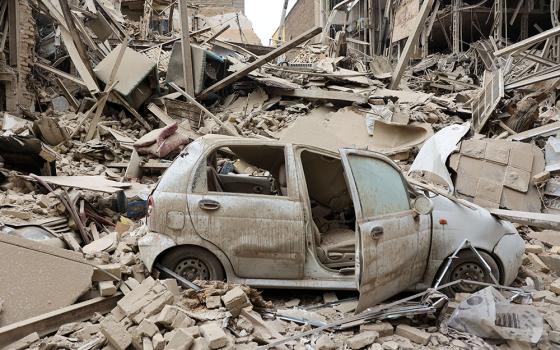
Missile alerts, air-defense interceptions and the thud of distant explosions have become part of the new soundscape of the Gulf. Since Feb. 28, when coordinated American and Israeli strikes on Iran triggered a new wider regional war, the conflict has reached far beyond the original battlefield. Iranian retaliation has included waves of drones and ballistic missiles directed toward Gulf states, including the United Arab Emirates, testing the region's sophisticated defense systems and unsettling millions of residents.
In the UAE, where global cities such as Abu Dhabi and Dubai serve as hubs for trade, diplomacy and migration, the effects are felt even louder: interrupted flights, constant emergency alerts on mobile phones, and a general sense of vigilance. Emirati authorities said their air-defense systems have intercepted the vast majority of incoming threats — hundreds of drones and dozens of ballistic missiles since the escalation began — although debris and isolated impacts have caused casualties and damage.
Within this tense atmosphere lives one of the most diverse Catholic communities in the world. The Apostolic Vicariate of Southern Arabia — covering the United Arab Emirates, Oman and Yemen — is home to hundreds of thousands of migrant Catholics, many from Asia and Africa, whose lives are woven into the economic and social fabric of the Gulf.
The apostolic vicar, Franciscan Bishop Paolo Martinelli*, based in Abu Dhabi, now finds himself guiding a church that must navigate pastoral life amid geopolitical shock waves.
The church itself has had to adapt, he said in a March 7 email interview with the National Catholic Reporter. While parish life continues, some pastoral activities have been modified to suit the current security environment. Against the background of intensifying military exchanges between Iran and its adversaries — and mounting international concern about the war's regional consequences — Martinelli insisted that the church must remain a voice for reconciliation.
"There is no alternative to dialogue and diplomacy," he said.
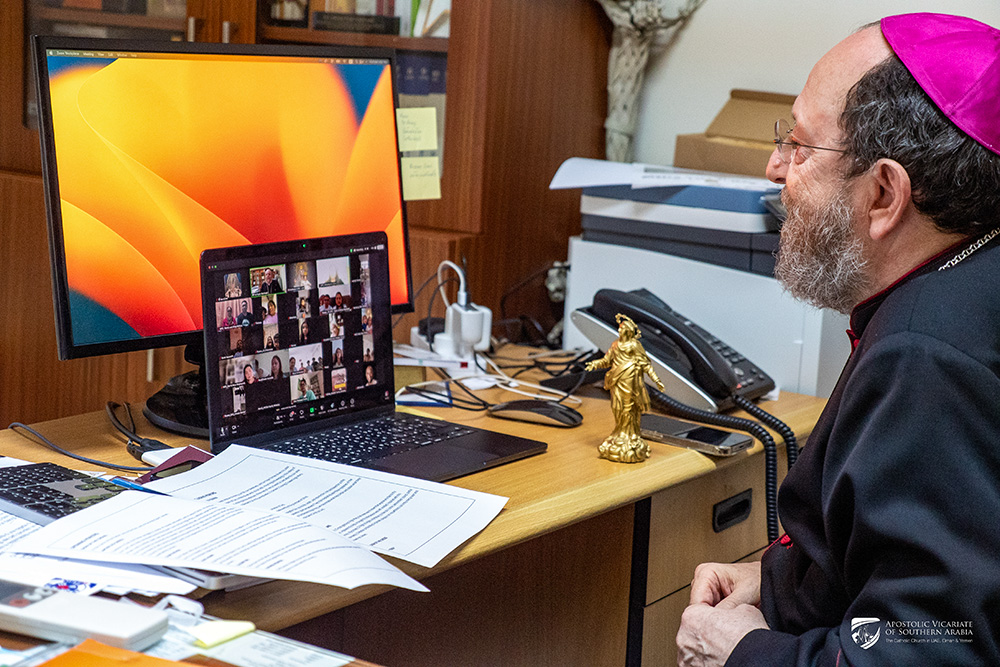
Bishop Paolo Martinelli, apostolic vicar of Southern Arabia, leads a virtual rosary with local faithful on March 6, 2026.** (Courtesy of Apostolic Vicariate of Southern Arabia)
For the bishop, that call begins at the grassroots level. "Our communities are made up of people from more than one hundred countries, with different languages, cultures, and rites. Precisely for this reason, we are called to be places of unity and dialogue."
In a region where missiles now cross borders and alliances shift rapidly, such quiet spaces of encounter may seem fragile. Yet, Martinelli suggested, they may also be among the few places where the patient work of peace can still begin.
The interview has been edited for purposes of length and clarity.
Bishop Martinelli, how is the current escalation of hostilities involving regional and global powers reshaping daily life for Catholics in the Apostolic Vicariate of Southern Arabia, particularly amid rising tensions between Israel, Iran and Western actors?
At this time, our Catholic faithful share the concerns and difficulties experienced by all the inhabitants of these countries, particularly in the United Arab Emirates. There have been several attacks, especially targeting the main cities such as Abu Dhabi and Dubai. However, we must acknowledge that the Emirati defense system has responded effectively, intercepting almost all of them. For this reason, although people are understandably shaken by what is happening in the region, they also feel reassured by the protection provided by the local authorities. Like all residents, our Catholic faithful are affected by the situation in the Gulf. Daily life continues with prudence, and people try to carry on their activities while avoiding large gatherings. In general, the life of our communities continues in a regular way, even though some pastoral activities have been adapted to the current circumstances.
In practical and pastoral terms, how are parishes in the Gulf adapting to heightened security concerns, including restrictions, virtual liturgies and limits on public gatherings — while striving to preserve sacramental life and ecclesial communion?
At the beginning of the conflict, I wrote a short letter to the faithful, inviting them to remain calm and to place their trust in God. Above all, I encouraged them to remain united in prayer and in solidarity with those who may be in greater need during this time. In particular, I invited everyone to pray the rosary for peace every day. I have been deeply touched by the response of the faithful. Many families have organized themselves to pray together, often meeting online, and hundreds of faithful are now gathering virtually to pray for peace. Our churches remain open and the celebration of the Eucharist continues regularly. Following the recommendations of the civil authorities, we have limited some gatherings involving large numbers of people, adapting certain pastoral activities where necessary. In some parishes they temporarily suspended catechism classes or moved them online, given the large number of children involved. After an initial moment of uncertainty, the participation of the faithful in the liturgical celebrations has gradually returned to its usual rhythm.
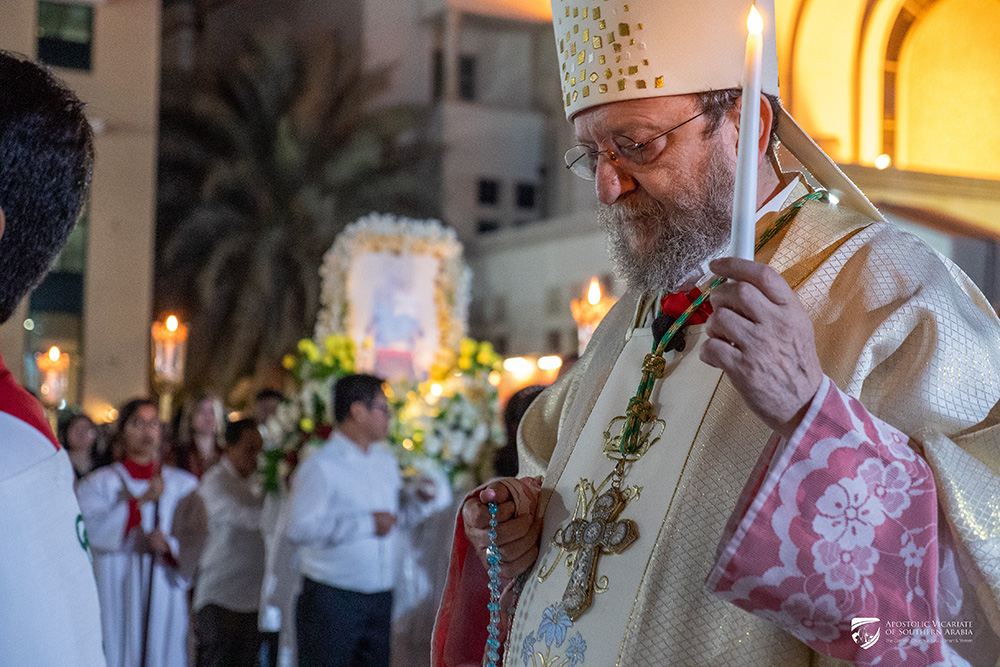
Bishop Paolo Martinelli, apostolic vicar of Southern Arabia, leads a procession and rosary for the solemnity of Our Lady of Arabia, Jan. 17, 2026.** (Courtesy of Apostolic Vicariate of Southern Arabia)
Many of your faithful are migrant workers living far from their families and often in vulnerable conditions. What spiritual and material needs are most urgent for them at this moment, and how is the church responding?
All our faithful — over 850,000 in the UAE and about 100,000 in Oman — are migrants and, with very rare exceptions, do not hold citizenship. Many of them live here without their families. At the moment, there are no particular material needs. What is most needed, rather, is spiritual support to sustain hope. I often think of the importance that our faithful never feel alone, but experience themselves as part of a larger community where charity and solidarity are lived in a concrete way. This is also why our parishes are organized into linguistic communities and enriched by the presence of many ecclesial associations and movements. In this way, everyone can find a group in which to belong, share moments of prayer, and support one another according to their different sensitivities. Since the current situation does not allow us to organize large external initiatives, our effort is focused above all on strengthening the network of relationships within the community, so that no one feels isolated.
In a region where Christians are a small minority, what does it mean concretely to be a "church of presence" during a geopolitical crisis that risks fueling fear, polarization or suspicion among religious communities?
Being Christian in a Muslim country brings us back to the experience of Saint Francis of Assisi. It is significant that the majority of our clergy belong to the Capuchin Franciscan Order, which began pastoral work in this region nearly two hundred years ago. Saint Francis not only personally encountered the Sultan in Egypt and engaged with Muslim believers, but he also dedicated a chapter of his unconfirmed rule to how Christians should relate to them. He recommends avoiding disputes and quarrels, placing oneself at the service of others for the love of God, and at the same time living and professing one's Christian identity. In many ways, this remains our program today. Christians desire to serve these countries loyally, bearing witness to the Gospel above all through daily life — in families, in communities, in schools and in society. The situation we are experiencing today calls us to avoid all forms of polarization and instead to promote paths of dialogue, mutual respect, and peaceful coexistence among all who live in this region.
Advertisement
Both the Holy See and episcopal conferences worldwide have renewed calls for deescalation and diplomatic dialogue. How is your vicariate echoing and embodying these appeals at the local level?
Peace and stability cannot be built on mutual threats or aggression. What is needed instead is a culture of encounter and dialogue that permeates everyday life. For us, this attitude begins within the church itself and extends outward. Diplomacy, for its part, remains a precise and indispensable responsibility. We must not abandon the patient work of building relationships among nations, healing wounds, and fostering stable and trustworthy cooperation and relationships.
Recent statements from the Vatican have emphasized authentic interreligious dialogue as a path away from mutual threats and toward shared security. How can the church in Southern Arabia contribute to meaningful Muslim-Christian cooperation in this delicate moment?
Interreligious dialogue is essential to overcoming the ideological and nationalistic misuse of religion. It cannot be limited to occasional summit meetings; it must become a daily attitude that fosters encounters and stable relationships among people of different faiths. This is especially true in our context, where our faithful live and work every day alongside Muslims and followers of other religions. During Ramadan, for example, there are many opportunities to meet and share moments of fraternity, particularly through invitations to the "iftar," the breaking of the fast. These encounters allow us to know one another better and to recognize the values that different religious traditions can share and promote for the good of all. When people of different faiths walk together, they also remind us of the mystery of God, from whom we implore the gift of peace. Peace is truly a gift from God, one that we must ask for, welcome, and help to spread. For this reason, two years ago I established in our apostolic vicariate the Interfaith and Ecumenical Dialogue Office (IFEDO). Its task is not only to promote dialogue with believers of other faiths, but also to help our priests and faithful recognize that this dimension is an integral part of Christian life.
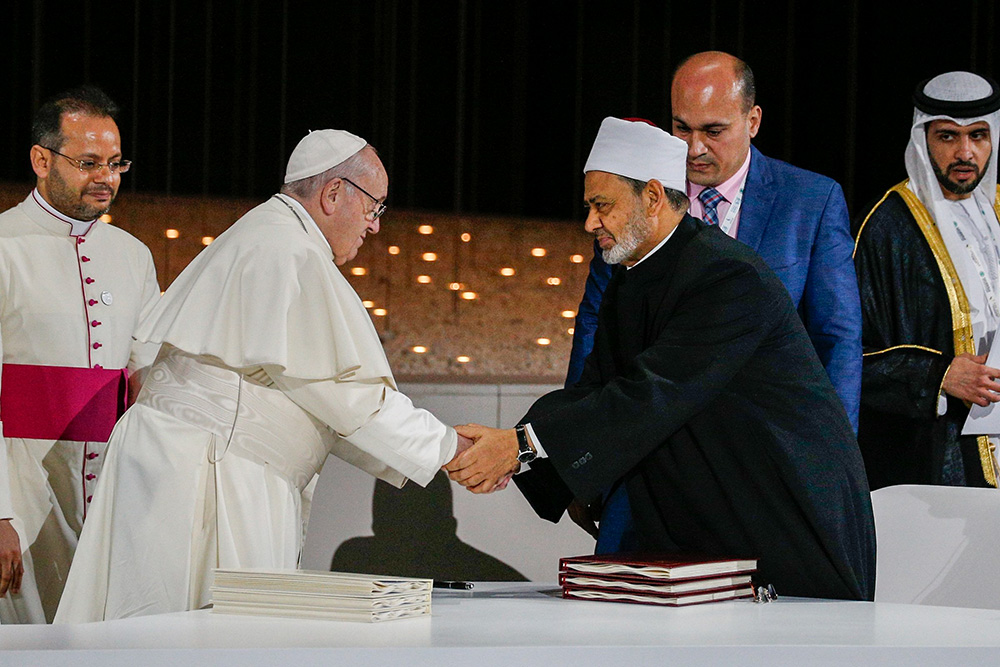
Pope Francis shakes hands with Sheikh Ahmad el-Tayeb, grand imam of Egypt's Al-Azhar mosque and university, during a document signing at an interreligious meeting in Abu Dhabi, United Arab Emirates, on Feb. 4, 2019. (CNS/Paul Haring)
During Pope Francis's visit to Abu Dhabi in February 2019 — the first papal trip to the Arabian Peninsula — he joined with the grand imam of Al-Azhar in signing the "Document on Human Fraternity for World Peace and Living Together," a landmark declaration aimed at fostering interreligious cooperation and mutual respect. In the midst of the current crisis, do you feel that the vision of the interfaith fraternity still holds, or has it been weakened by renewed conflict? How do you see the legacy of that visit and historic document playing out today in your vicariate's work for peace and dialogue?
The "Document on Human Fraternity" is a prophetic text that deserves to be revisited especially in these days. It clearly denounces every form of violence committed in the name of God and calls for mutual understanding, collaboration, and encounter among people of different faiths. In our vicariate we often refer to this document, particularly through the initiatives promoted by the Interfaith and Ecumenical Dialogue Office of the Apostolic Vicariate of Southern Arabia, especially with young people and catechists. We have also recently marked the 60th anniversary of the Second Vatican Council's declaration Nostra Aetate, which encourages the church to promote dialogue with followers of other religions. It remains an important text that we should continue to know and share with our faithful. This year we are also celebrating the eighth centenary of the passing of Saint Francis of Assisi. In our pastoral journey we frequently return to his witness and writings. In particular, I invite our faithful to pray the words attributed to him that are so meaningful today: "Lord, make me an instrument of your peace."
*This article has been edited to correct Martinelli's title.
**Two photo captions have been edited to add more detail and correct the date.