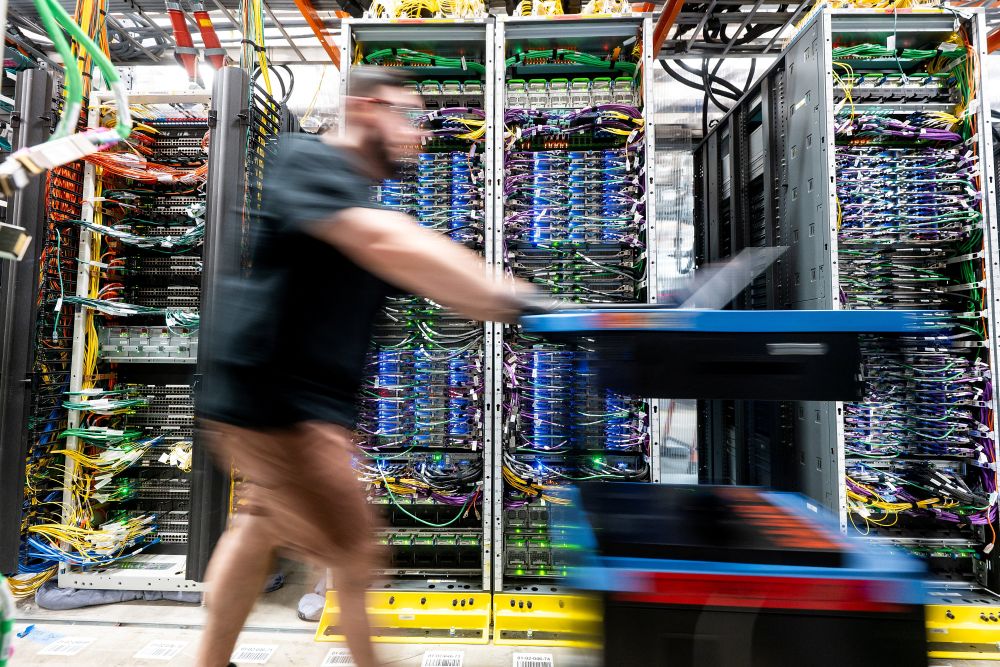
A technician works at an Amazon Web Services data center in Hermiston, Ore., May 9, 2025. The explosion of massive data centers to handle the increasing generative demands of artificial intelligence have placed high demands on both power and the water used in cooling systems. Low-income communities have typically endured the brunt of the air pollution they create. (OSV News/Reuters/Noah Berger for AWS)

Join the Conversation
Send your thoughts to Letters to the Editor. Learn more
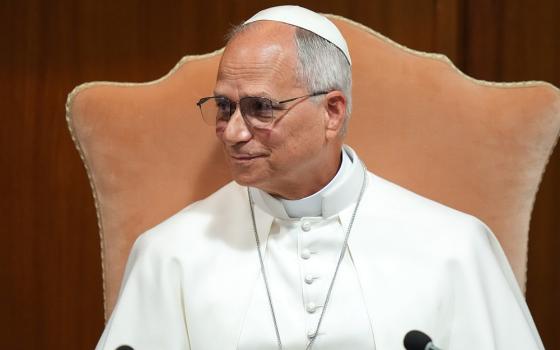
During the presentation of his first encyclical, Magnifica Humanitas, Pope Leo XIV explained why he turned the Catholic Church's attention to the rapid rise of artificial intelligence, just as his namesake Pope Leo XIII did toward the Industrial Revolution of the late 19th century.
"Like the earlier 'Leo,' I feel entrusted to look upon another huge transformation with eyes of faith, with lucidity of reason, with openness to mystery, and with cries of the poor and the earth resounding in my heart," the first U.S.-born pope said at the May 25 event inside the Vatican's Synod Hall.
The remark also offered an apparent nod to Pope Francis, who 11 years ago in his social encyclical on ecology "Laudato Si', on Care for Our Common Home" urged the world to "hear both the cries of the earth and the cries of the poor" as it works toward solutions, including technological ones, to socio-environmental problems like climate change.
"Care for our common home and our responsibility toward the poor and future generations," Leo wrote in Magnifica Humanitas, "require that the use of the goods of creation and the new possibilities offered by technology be regulated in such a way as to respect the environment, avoid waste and prevent new forms of exploitation."
"Our task today is not only ethical or technical. It is ecological in the deepest sense, for it concerns a new dimension of our common home," the pope stated later in the text. "AI is already an environment in which we are immersed, as well as a force with which we must engage. For this reason, merely regulating it is insufficient; it must be disarmed, welcoming and accessible."
Environmental issues posed by AI make up but a portion of the pope's 42,000-word encyclical, yet in those sections Leo delves into some of the key concerns emerging from the means of the powerful technology's development. He refers to the vast resources needed to power data centers and the extraction of its key building blocks, rare earth metals and minerals.
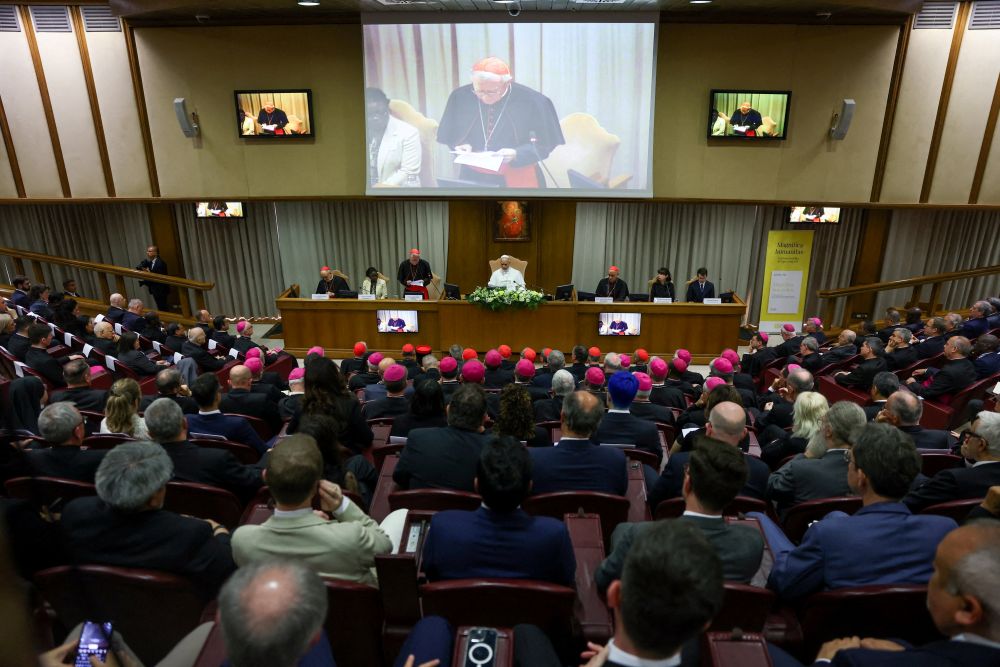
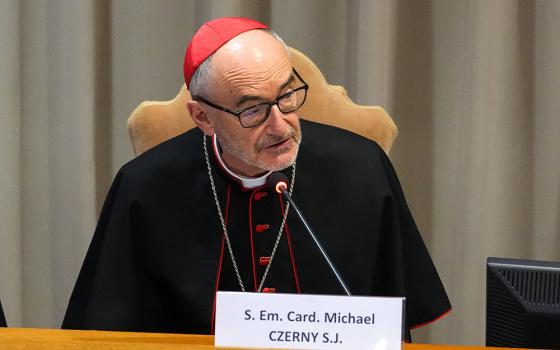
Pope Leo XIV attends the presentation of "Magnifica Humanitas" at the Vatican's Synod Hall May 25, 2026. Also pictured on the panel are Cardinal Michael Czerny, prefect of the Dicastery for Promoting Integral Human Development; Léocadie Lushombo; Cardinal Víctor Manuel Fernández, prefect of the Dicastery for the Doctrine of the Faith; Cardinal Pietro Parolin, Vatican secretary of state; Anna Rowlands; and Anthropic co-founder Christopher Olah. (OSV News/Reuters/Yara Nardi)
Magnifica Humanitas, in reflecting on AI's ecological impacts, "stands in profound continuity" with Laudato Si' and its follow-up apostolic exhortation Laudate Deum, said Cardinal Michael Czerny at its presentation.
"In those texts, Pope Francis taught that when technical power is separated from wisdom capable of safeguarding relationships, it can turn into domination over humanity and over creation," said Czerny, who heads the Vatican's Dicastery for Promoting Integral Human Development.
"In the age of artificial intelligence, this awareness takes on new urgency. The digital construction site and the construction site of our common home converge on the same question: What kind of world are we building and what place does the human person have in it?"
AI's potential and pitfalls
In Magnifica Humanitas, Leo presents his evaluation of the potential and pitfalls artificial intelligence poses for the world, including on environmental challenges.
"Technology has the power to heal, connect, educate and protect our common home; but it can also divide, exclude and generate new forms of injustice," he wrote early in the text.
The pope's pleas for greater discernment and regulations in the creation and use of AI extended to consideration of the created world. He stressed economic progress must respect the limits of creation and called for new development metrics beyond GDP, which he said often neglects the well-being of people and the environment. He reiterated church teaching that the goods of the earth — soil, water, air and natural resources — "are given by God to the entire human family to sustain the lives of all, and that every person has an inherent right to the use of such goods, both now and in the future."
Leo referenced climate change twice, in describing drivers of migration. He cited Laudato Si' 10 times, calling integral ecology — to which Francis devoted a full chapter — "an indispensable dimension of the Church's Social Doctrine."
"Indeed, the quality of development is measured by the ability to integrate justice toward people and the care of our common home, and to promote dignified living conditions, access to necessary goods, just social relations, care of creation and consideration for future generations," Leo wrote. "It follows that true progress is not what increases the wellbeing of some by degrading ecosystems, shifting costs onto the most disadvantaged communities, or compromising the living conditions of those who will follow us."
That cementing of integral ecology into church teaching is significant, said Lorna Gold, executive director of the Laudato Si' Movement, a global network of 900-plus Catholic organizations mobilizing church action on climate change and ecological issues.
Like Francis, Leo highlights the interconnections among humans, technology and the environment, said Brian Patrick Green, a technology ethicist at Santa Clara University. The pope also revisits Francis' critique of the technocratic paradigm — where technology is viewed as a means of profit maximization and mastery over the earth — reaching the conclusion, Green said, that "at this point, things are getting out of control."
"The technocratic paradigm is turning into the Tower of Babel … Something that was maybe the foundations for the Tower of Babel 10 years ago have now become the beginnings of the tower, and we have to ask ourselves, why are we building this thing?" he told EarthBeat.
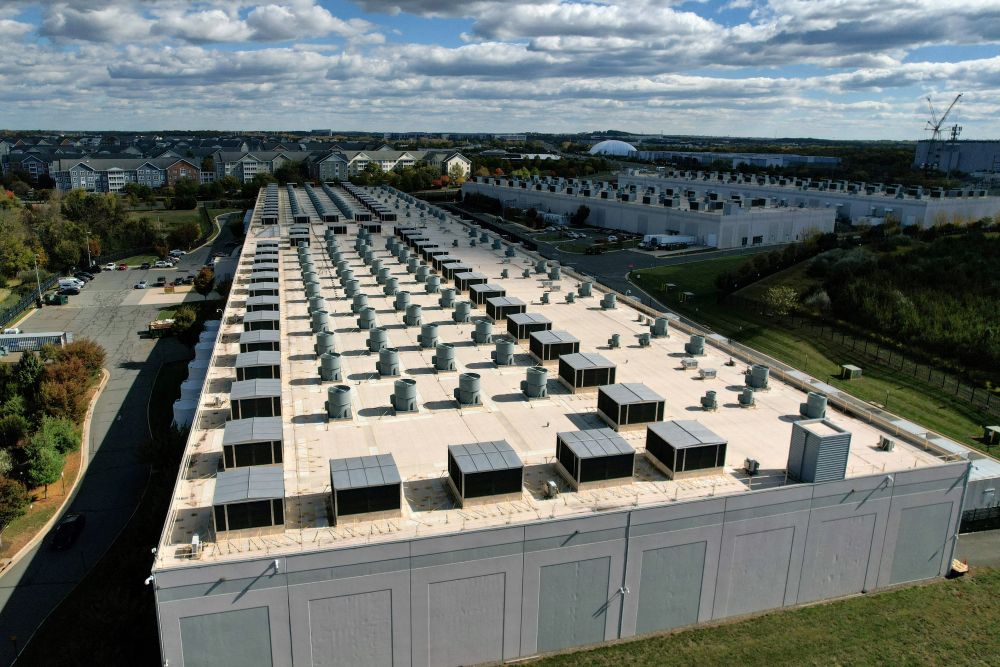
An aerial view shows an Amazon Web Services Data Center known as US East 1 in Ashburn, Va., Oct. 20, 2025. (OSV News/Reuters/Jonathan Ernst)
Concern with data centers, mining
In a joint statement, the Catholic Climate Covenant and North American chapter of Laudato Si' Movement applauded the pope for insisting on greater discernment in the creation and implementation of AI technology.
"Communities already facing poverty, pollution, displacement, and climate impacts are shouldering the hidden environmental and social burdens tied to advancing technologies," they said, "which prioritize profit and efficiency above human dignity, including extractive industries, infrastructure, and unchecked development."
Leo highlighted two such areas: data centers and mineral extraction.
"Nothing in the world of AI is immaterial or magical," he wrote. "Every seemingly immediate and flawless response is the result of a long chain of mediation, involving vast networks of natural resources, energy infrastructure and, above all, people."
In discussing new forms of slavery fueled by today's digital economy, the pope lamented the "invisible labor," often children, working in harsh and dangerous conditions to mine the minerals and metals needed for microprocessors and other components for AI and emerging technologies, including clean energy.
"The bodies of these people are scarred, injured and worn down so that computational flow may continue uninterruptedly," the pope said, later calling for careful examinations of tech supply chains and working conditions.
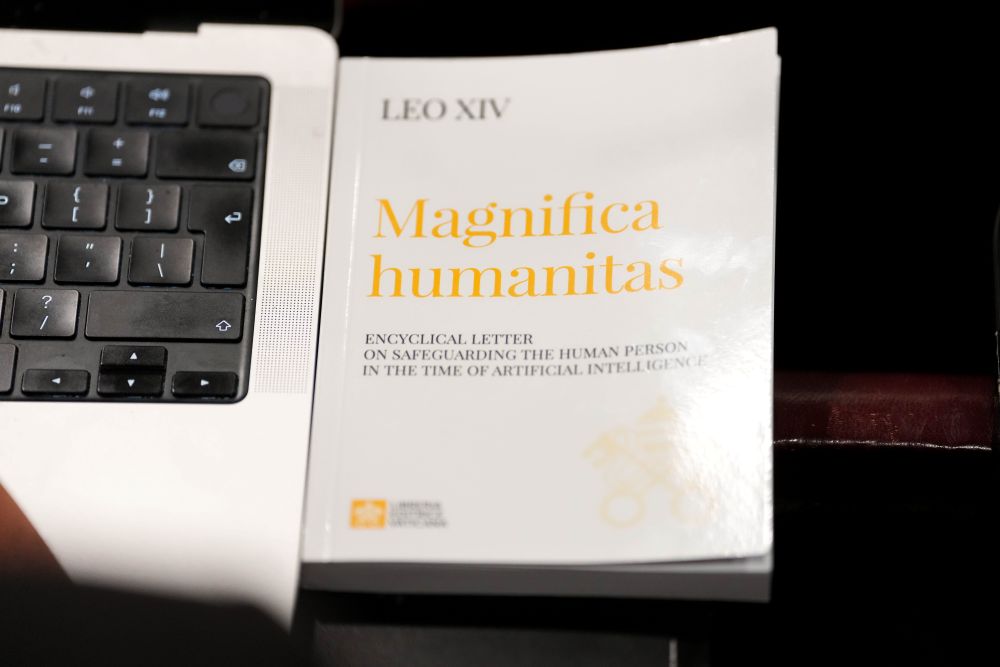
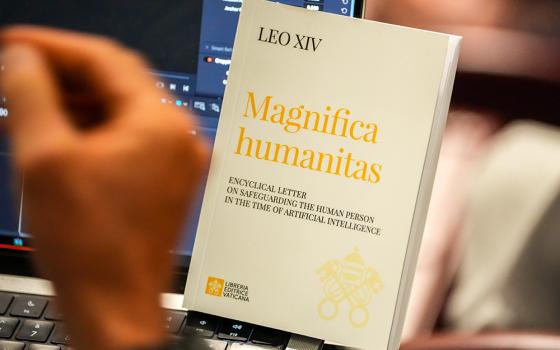
A copy of Pope Leo XIV's first encyclical, "Magnifica Humanitas" (On Safeguarding the Human Person in the Time of Artificial Intelligence,) is seen during a presentation on the document at the Vatican May 25, 2026. (CNS/Lola Gomez)
At the Vatican presentation, Léocadie Lushombo, a theological ethicist at Santa Clara and member of the Integral Human Development dicastery, said some miners describe their conditions "as we work in our own grave."
"The ethical obligation to shatter these oppressive chains and defend the rights of vulnerable workers rests with us all," she said.
Along with human rights abuses, Leo said, there is a tendency to overlook the environmental impacts with the rapid and uncritical adoption of AI, including the "enormous amounts of energy and water" current systems require, along with their carbon emissions. Typical AI data centers use the equivalent power of 100,000 houses, according to the International Energy Agency.
"As their complexity increases, especially in the case of large language models, the need for computing power and storage capacity grows too, which requires an extensive network of machines, cables, data centers and energy-intensive infrastructure," Leo wrote. "For this reason, it is essential to develop more sustainable technological solutions that reduce environmental impact and help protect our common home."
The pope raised important questions on the extensive energy and water demands of AI, which require much larger data centers to power the massive level of calculations involved in training models, said Benjamin Lee, a professor at the University of Pennsylvania specializing in sustainable computing and a consulting scientist with Google's Global Infrastructure Group.
"There needs to be a lot more thoughtfulness that goes into how to mitigate the cost and the environmental impacts of data center [computing], that's for sure," Lee told EarthBeat. "And that means figuring out where the energy is coming from, where the data centers go, and how to maybe invest in perhaps even more expensive sources of energy" to limit emissions contributing to climate change.
Advertisement
Amidst these development dangers, AI has already been utilized in myriad ways on environmental issues: helping predict floods; identifying rainforest biodiversity by analyzing recorded animal sounds; scanning the earth's land surface for deforestation and other changes; as well as improving energy efficiency in its own data centers.
Green, the Santa Clara professor who has consulted AI developers like Anthropic, said those examples demonstrate that AI can do tremendous good for the environment. To maximize the good and limit the bad he said requires the kind of discernment to which Leo has appealed with Magnifica Humanitas.
"It needs to be done with some conscientious effort, where people are actually thinking about what they're doing and wanting to do the right thing," he said.