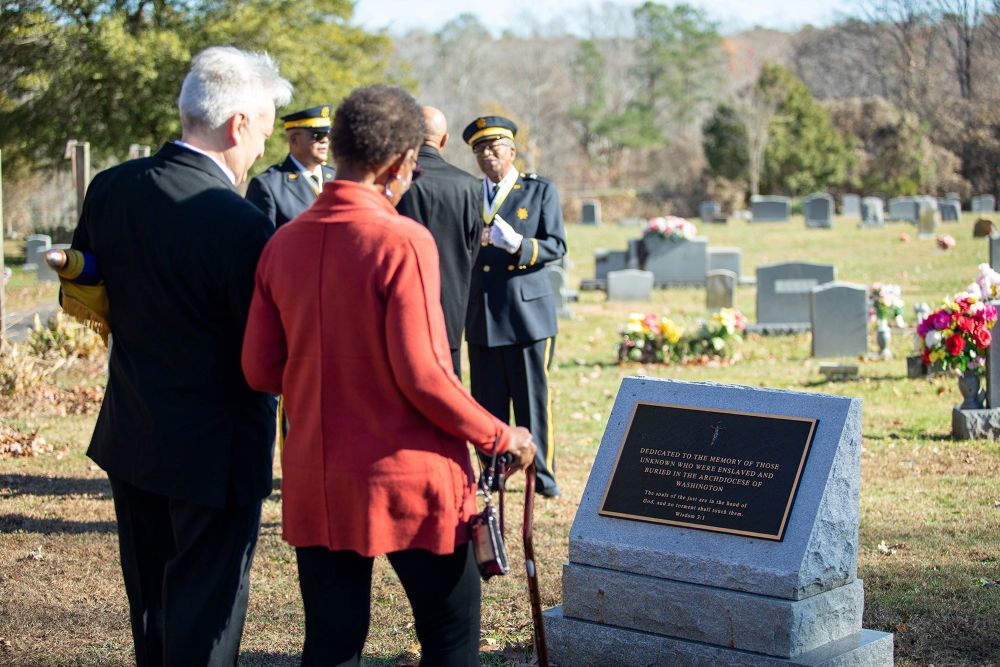
People pause to view a memorial marker to the unknown enslaved people buried at St. Peter Claver Parish's cemetery in St. Inigoes, Md., after Cardinal Wilton Gregory of Washington blessed the memorial Nov. 26, 2022. At least 24 parishes in the archdiocese have requested that memorial to honor formerly enslaved people buried in their cemeteries. (CNS/Catholic Standard/Ashley Barnas)

Join the Conversation
Send your thoughts to Letters to the Editor. Learn more
Descendants of slaves once owned and sold by the Jesuits are among those welcoming Pope Leo XIV's formal apology for the Catholic Church's historical involvement in slavery. The move has been largely praised by Black Catholic leaders, scholars and descendant communities as it renews debate over how fully the church has reckoned with its past.
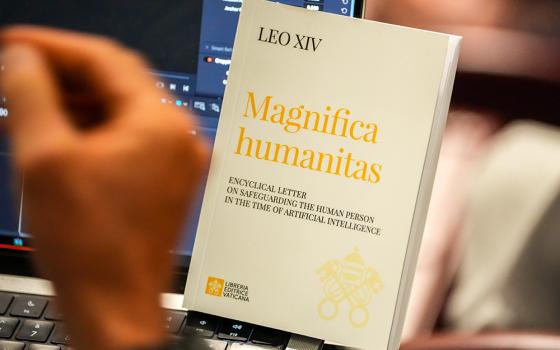
The apology appears in Magnifica Humanitas, Leo's first encyclical. While the document primarily focuses on artificial intelligence and human dignity in the modern world, one paragraph drew immediate attention for addressing slavery and the church's complicity in it.
In paragraph 176, Leo acknowledged that ecclesiastical institutions owned slaves in antiquity and the Middle Ages and that the Apostolic See had "intervened several times in order to regulate and legitimize forms of subjugation" and even the enslavement of "infidels." He described slavery as "a wound in Christian memory" and concluded: "For this, in the name of the church, I sincerely ask for pardon."
For many Black Catholics and descendants of enslaved people, the statement marked a significant departure from previous papal language because it explicitly connected the institution of the church to slavery rather than focusing solely on individual wrongdoing.
Monique Trusclair Maddox, president and chief executive of the Descendants Truth & Reconciliation Foundation, based in Baton Rouge, Louisiana, said her first reaction was surprise. She said the encyclical had been widely presented as a document centered on artificial intelligence, making the inclusion of a paragraph on slavery unexpected.
"I felt like he was actually making a step beyond, to bring the enslavement of my family and other Catholic families to the forefront in the U.S. and in the world," she told the National Catholic Reporter.
'We cannot get beyond our racial, tragic past without a confrontation with our history. We can't get over something that we've never acknowledged.'
—Fr. Bryan Massingale
In the days after the encyclical was released May 25, Maddox said she came to view the apology as "the first step" rather than a final resolution.
"I do not think it's the last word," she said. "I believe it's the beginning of more to come."
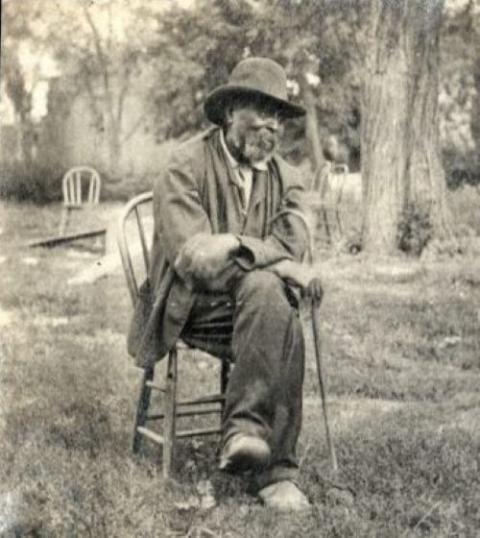
Peter Hawkins poses in 1905 at the Jesuits' St. Stanislaus Novitiate and Farm in Florissant, Missouri, for a photo taken by Jesuit Fr. William Grace. Hawkins was born in 1824. His parents had been sold from the Jesuit plantation in White Marsh, Maryland, in 1823. (Courtesy of the Jesuit Archives and Research Center.)
The Descendants Truth & Reconciliation Foundation emerged from efforts to address the legacy of one of the most consequential slave sales in American Catholic history. In 1838, the men's religious community the Jesuits sold 272 enslaved people from plantations in Maryland to Louisiana buyers in a transaction intended to help stabilize Georgetown University's finances. The descendants of those enslaved families, together with Jesuit leaders, later established the foundation as part of a broader reconciliation effort.
The organization traces its origins to research that brought renewed attention to the 1838 sale and has since focused on educational advancement, racial healing and dialogue between descendants and the Jesuits. Through scholarship programs and community initiatives, it seeks to address the long-term effects of slavery while promoting what its leaders describe as restorative justice.
Maddox said that for descendants, reconciliation is a long-term process rather than a single event.
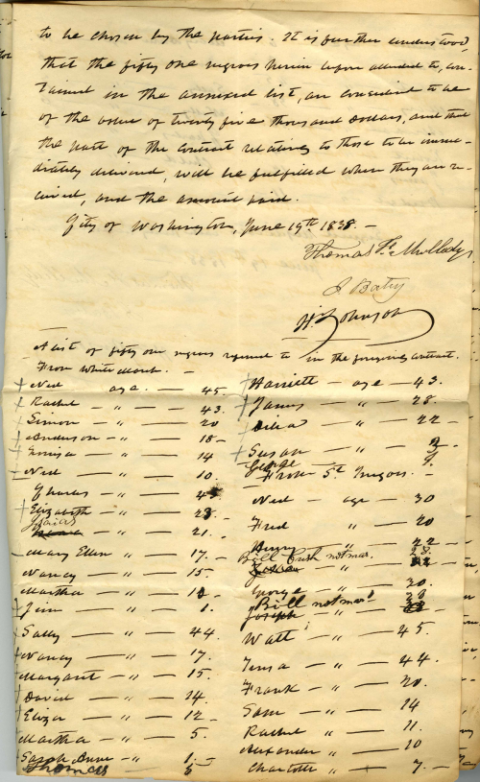
A document dated June 19, 1838, shows the agreement for the sale of 272 enslaved people from Jesuit Fr. Thomas Mulledy of Georgetown, to Jesse Beatty and Henry Johnson of Louisiana. The document identifies the people by name. (Courtesy of the Georgetown Slavery Archive)
"Healing is a journey. It doesn't happen overnight. We may feel better for a moment, but it is a journey," she said. "As someone who lives this past every single day, I work through this foundation and work with Jesuit priests who pray for the families who have been enslaved every single day. That is healing."
Some Black Catholics have said the pope's statement, while welcome, came too late and did not go far enough. But Jesuit Fr. Timothy Kesicki, chair of the Descendants Truth & Reconciliation Trust* and a central figure in Jesuit apologies related to slavery, rejected the notion that acknowledgment can come too late.
"I never think something is too late, because if you say it's too late, that means you can't do it," he said. "I don’t believe that our sins have an expiration date."
"[But] If I've hurt someone, until I acknowledge that hurt, that pain lives in both of us," he said.
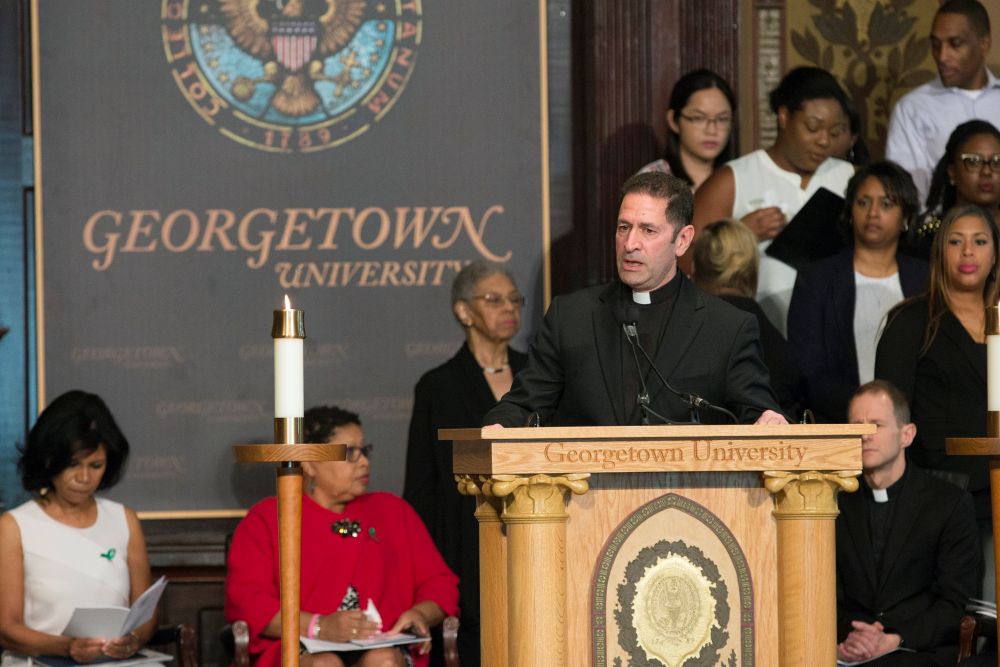
Jesuit Fr. Timothy Kesicki, then president of the Jesuit Conference of Canada and the United States, delivers the homily at an April 18, 2017, "Liturgy of Remembrance, Contrition and Hope" in Gaston Hall on the campus of Georgetown University in Washington. (CNS/Catholic Standard/Jaclyn Lippelmann)
"We want others to replicate what we're doing," Kesicki said. "There are hundreds of universities and banks and insurance companies and churches, to name a few, that benefited and found their roots in slaveholding. This is a way for them to connect with others, their historic descendants and partner together on making our lives better until we heal from this historic sin," he said.
Jesuit Fr. David Collins, a historian at Georgetown who chaired a Georgetown University initiative known as Slavery, Memory, and Reconciliation — originally formed to address the issue of renaming a building dedicated to the Jesuit superior responsible for the sale of slaves — said one of the most important developments over the past decade was the increasing role of descendants themselves in reconciling their ancestors' journeys with the church.
Collins cautioned against focusing exclusively on what the Vatican might do next.
"The real work of racial reconciliation is done by those who can hear words like that and whose hearts are moved," he said. His hope, he added, is that the pope's statement encourages broader participation in reconciliation efforts.
Among scholars and religious of race and Catholicism, reactions have been positive but more qualified.
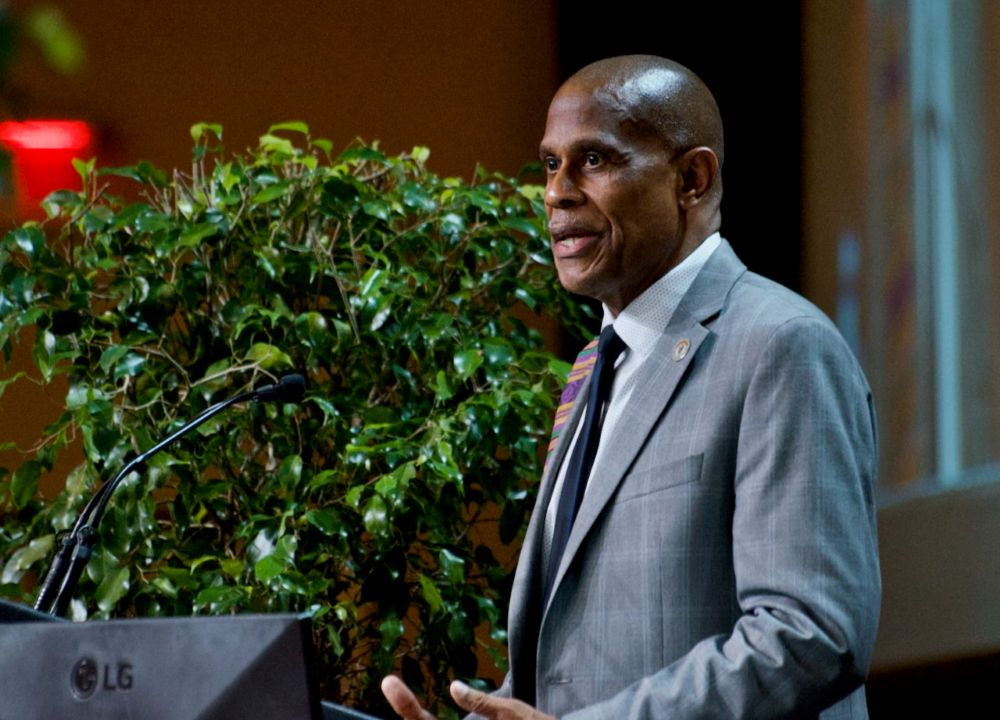
Fr. Bryan Massingale, who teaches theological and social ethics at Jesuit-run Fordham University, gives the keynote address Aug. 14, 2024, during the annual assembly of the Leadership Conference of Women Religious in Orlando, Fla. (GSR photo/Dan Stockman)
Fr. Bryan Massingale, a professor at Fordham University and one of the most prominent Catholic voices on racial justice in the U.S., described his initial response as surprised.
"I was not expecting this treatment of enslavement, especially about the church's complicity in it," he said.
Massingale said that the encyclical includes an important acknowledgment by recognizing that slavery was not merely the work of isolated individuals acting against church teaching.
"For the first time, we're seeing a pope say that these agents were acting with the official approval of the church," he said. At the same time, he identified limitations.
"It's a crack, because nowhere in the document does it talk about the fact that this was a racialized enslavement," he said.
Magnifica Humanitas includes no acknowledgement "of the church's support for and complicity with an ideology of white supremacy that is at the core of enslavement and the core of colonization," Massingale said.
"The document is important," he said. "I think it's a positive step, but it's a very limited step, especially when dealing with something that's so complicated and complex in a single paragraph."
Massingale said that future efforts should include a more comprehensive Vatican treatment of slavery, a national truth-and-reconciliation process in the U.S., and stronger formation on racial justice in seminaries and Catholic educational institutions. "We cannot get beyond our racial, tragic past without a confrontation with our history. We can't get over something that we've never acknowledged," he said.
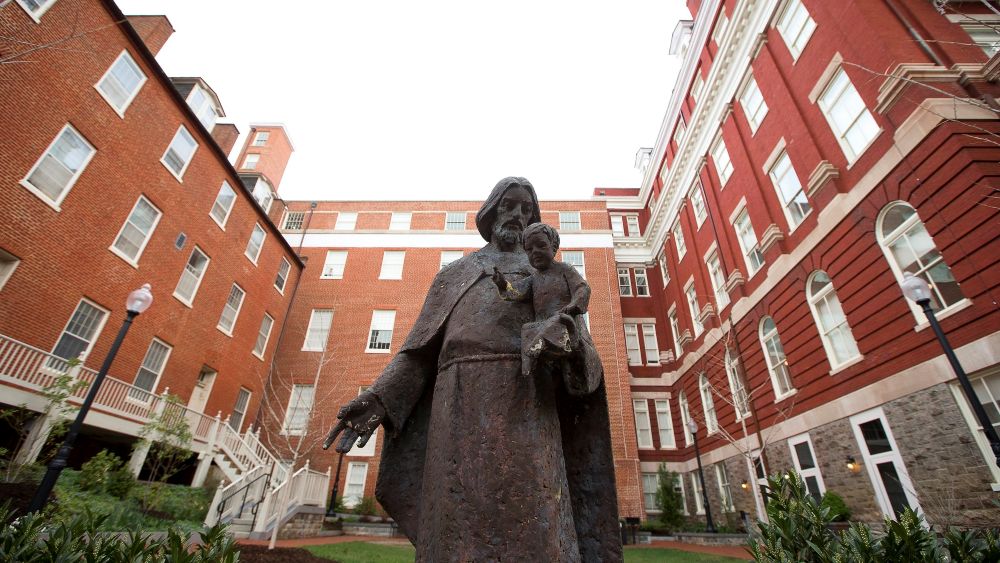
Isaac Hawkins Hall is seen on the campus of Georgetown University April 4, 2017. The hall, previously known as Mulledy Hall and later Freedom Hall, was renamed in 2017 for one of the 272 enslaved men, women and children sold by Georgetown's Jesuit community to plantation owners in Louisiana in 1838. Hawkins was the first enslaved person listed in the sale documents. (CNS/Tyler Orsburn)
Nate Tinner-Williams, co-founder and editor of the Black Catholic Messenger, said he was surprised to learn that no pope had previously issued an apology explicitly acknowledging the Vatican's role in sustaining slavery.
"The church had never actually said we as an institution at the highest level helped perpetuate the slave trade," he said.
For Tinner-Williams, the timing of the apology is notable because Leo is both the first American pope and the first pope known to have African ancestry. "I would say it's better late than never, and what better time than with the first American pope and the first pope with known African ancestry, including enslaved people?" he said.
Like others interviewed, he emphasized the need for action by American bishops.
"I think there's still a lot of work to be done in fully reckoning with the fact that the church was a major part of what perpetuated this institution here in America," he said. That legacy, he said, continues to shape Black Catholic communities today.
Sr. Barbara Spears, president of the National Black Sisters' Conference, also welcomed the pope's statement, saying she felt the desire to pen a letter of gratitude to Leo after she read the encyclical.
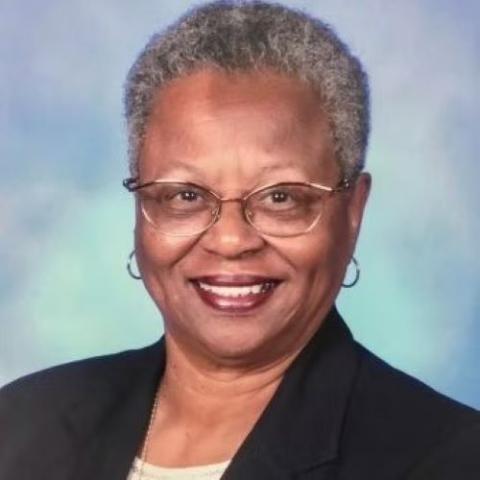
Sr. Barbara Spears is president of the National Black Sisters' Conference. (Courtesy of Sr. Barbara Spears)
"Wrong is wrong in any aspect, but so many times we pick and choose. I felt like the Holy Father could have talked about AI and what he thought about that and never mention slavery, but he did," she said.
She also expressed hope that the apology would encourage continued dialogue and reflection among Catholics.
"Words are empty without actions," she said. "I hope it will keep the conversation going. It will force us to begin to work."
"I know there are places I'm not welcome as an African American religious and I've been 65 years serving this church. I know that, but I'm not going to let it stop me from doing what I feel God calls me to do. That's what I want other Catholic people to do, that's what I want our bishops to do, just to live the Gospel, follow our words," she said.
Advertisement
*This story has been updated to correct the organization Jesuit Fr. Timothy Kesicki chairs. It is the Descendants Truth & Reconciliation Trust.