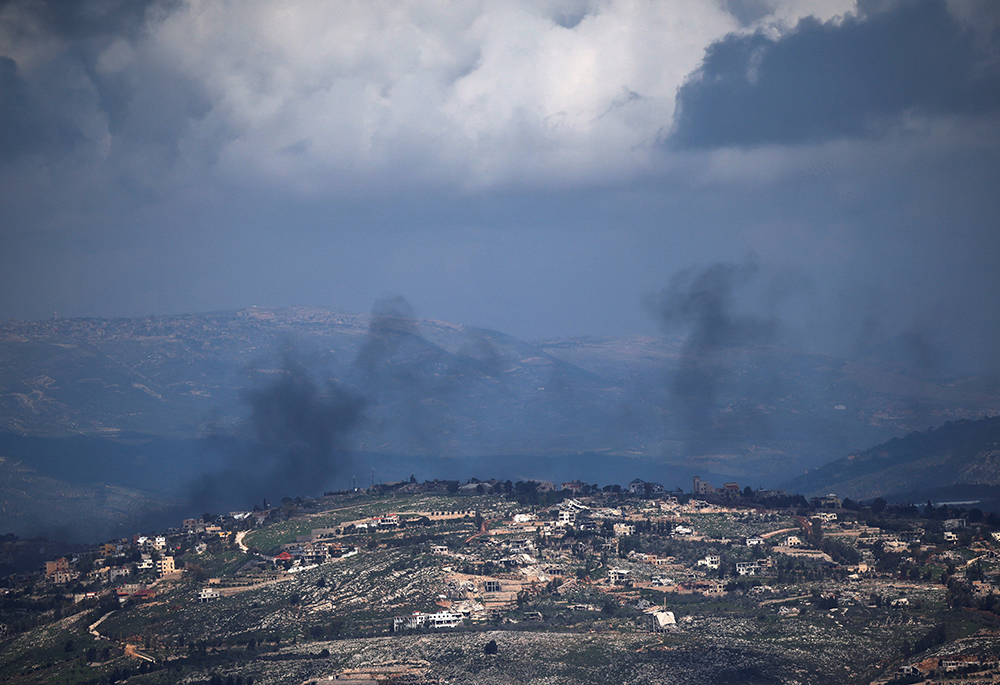
Smoke rises from a village in Lebanon as seen from northern Israel, March 16, 2026, following an Israeli airstrike, amid escalation in aerial attacks between Hezbollah and Israel as the U.S.-Israel war with Iran continues. (OSV News/Reuters/Shir Torem)

Join the Conversation
Send your thoughts to Letters to the Editor. Learn more
At around 2:30 a.m. on March 2, the first explosions shattered the quiet of the capital. Powerful airstrikes struck Beirut's southern suburbs, sending shockwaves across the city. Residents woke to the sound of missiles overhead and windows rattling in apartment buildings. Within hours, the violence spread across southern Lebanon and the Bekaa Valley.
By morning, thousands of people were on the move.
According to the U.N., more than 30,000 people were displaced in the first wave of attacks. Highways leading out of southern Lebanon and the capital quickly became clogged with cars as families tried to flee the bombardment. Evacuation warnings sent to dozens of villages triggered panic across communities already worn down by years of political and economic crisis.
Churches, monasteries and schools began opening their doors to those arriving with little more than bags packed in haste. For Lebanon's Catholic communities — many of them concentrated in towns near the Israeli border — the renewed violence has revived fears that echo earlier conflicts in the country's long history of war.
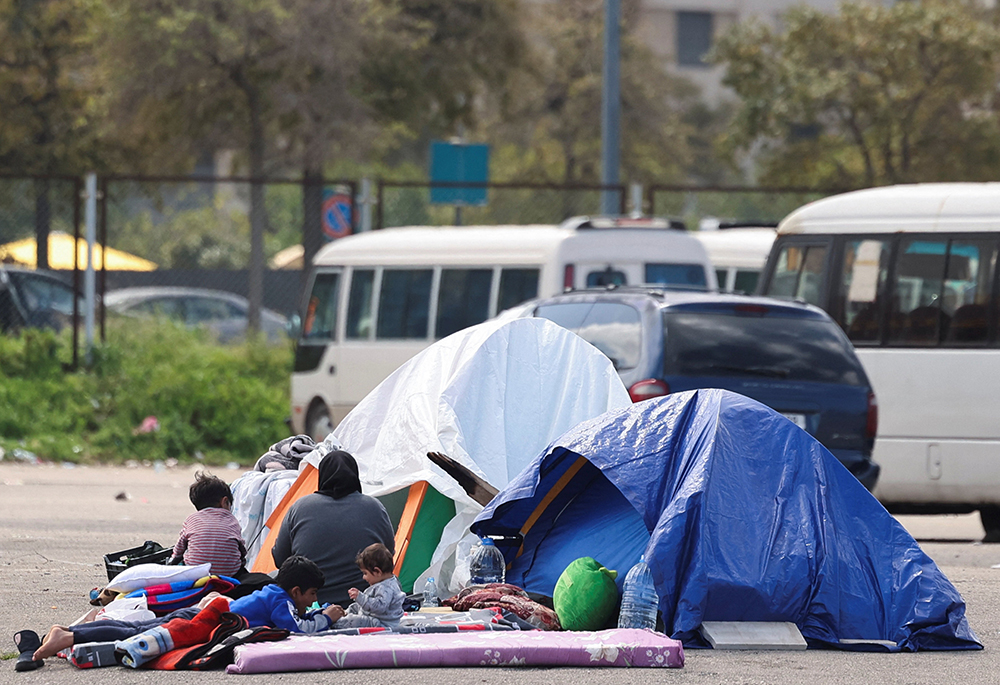
Displaced people with belongings sit next to tents in Beirut March 16, 2026, following an escalation of aerial attacks between Hezbollah and Israel, amid the U.S. and Israel-Iran war. (OSV News/Reuters/Amr Abdallah Dalsh)
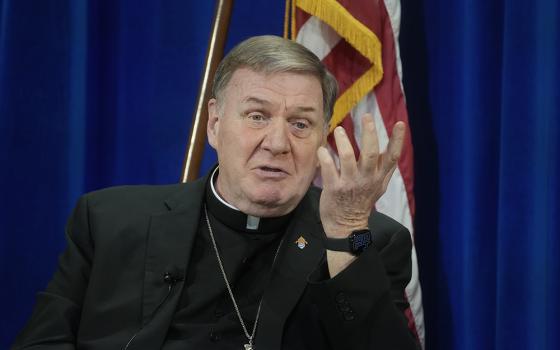
In the southern city of Saida, Melkite Catholic Archbishop Elie Béchara Haddad said the escalation had been feared for months.
"It's not easy where we are now, really," he said in an interview with the National Catholic Reporter. "But we were waiting for this moment a long time ago. We don't believe in peace in this region now, in this period of life."
Saida has become a refuge for families fleeing villages closer to the Israeli border. Church buildings and schools are sheltering displaced people, while parishes attempt to coordinate food, shelter and basic assistance.
The archbishop described a region in flux, where people are moving in every direction depending on where they can find safety.
"So we are divided into both missions, receiving the people who are leaving the South or the borderline and taking care of them," he said. "And some of our people here in this region are leaving for Beirut also, with other people, so it depends on where they have family to be received, and where they have hospitality."
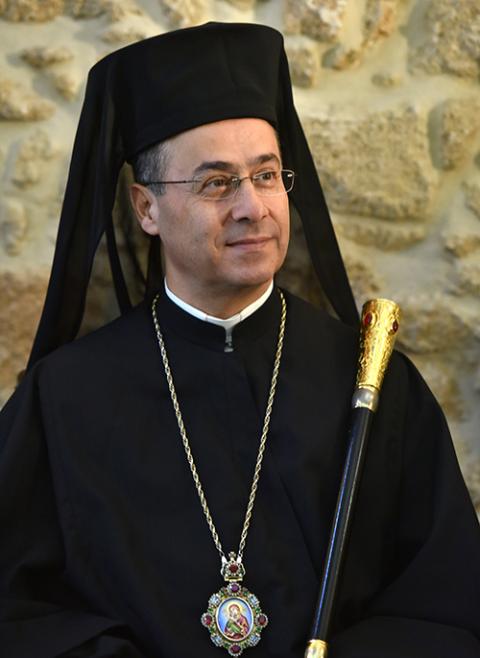
Melkite Catholic Archbishop Elie Béchara Haddad of Saida is pictured in an undated photo. (CNS/Courtesy of Melkite Catholic Archdiocese of Saida)
In southern Lebanon, the lines between civilian life and the front line are often blurred. Armed groups operate across the region, a reality that, according to Haddad, makes daily life for residents deeply precarious.
"We are living among Hezbollah, among Hamas. They are here in Lebanon. They are everywhere. And they are on the roads. They are in the apartments not far from us, and Israel has already attacked some of them," he said.
For many Christian families, the constant proximity to danger leaves little room for hesitation. When violence escalates, the instinct is often to leave quickly, sometimes with little more than what they can carry.
"These people seem to be not afraid of Israel, but the Christians really are afraid," Haddad said. "They are afraid of all kinds of danger, and Christians are very sensitive to any violence [that] could happen. They take their luggage and go away easily."
The result is a gradual but steady thinning of Christian communities in the South. Some families move north toward Beirut or other parts of the country where they can stay with relatives. Others decide to leave Lebanon altogether, joining a diaspora that has increased since September 2024..
"It's not easy for us to let them stay in the country," Haddad said. "They leave for Europe."
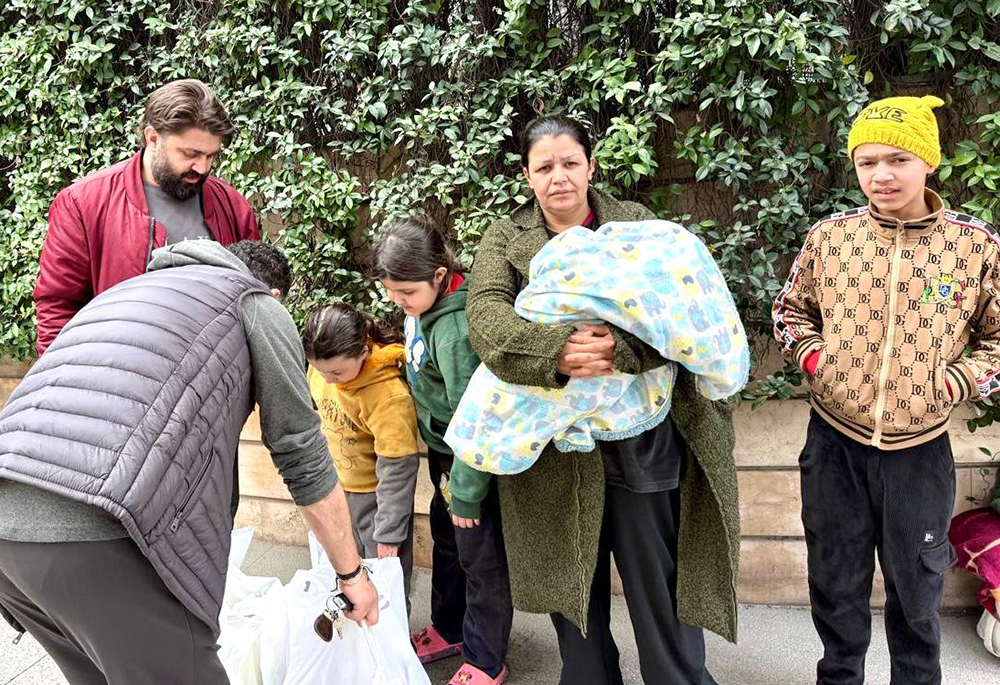
Lebanese internally displaced persons who migrated to Beirut after leaving their towns in southern Lebanon because of the U.S. and Israel-Iran war, finding temporary housing in tents, in March 2026 (Courtesy of Rima Abi Karam)
The escalation has already taken lives within the Catholic community. Among those killed was Fr. Pierre Al-Rahi, a Maronite priest from the Diocese of Tyre who had been assisting people affected by an earlier bombardment when another strike occurred nearby. Another Catholic, Sami Ghafari, 70, was killed in the garden of his home in the border village of Alma al-Shaab.
For church leaders, the killings have become a stark symbol of how vulnerable civilians have become. The possibility that entire dioceses might one day have to evacuate is now openly discussed, though Haddad said they are still hoping the escalation can be contained.
"It's very critical even to predict," he said. "But if we should leave the diocese, it will be the first time we do this."
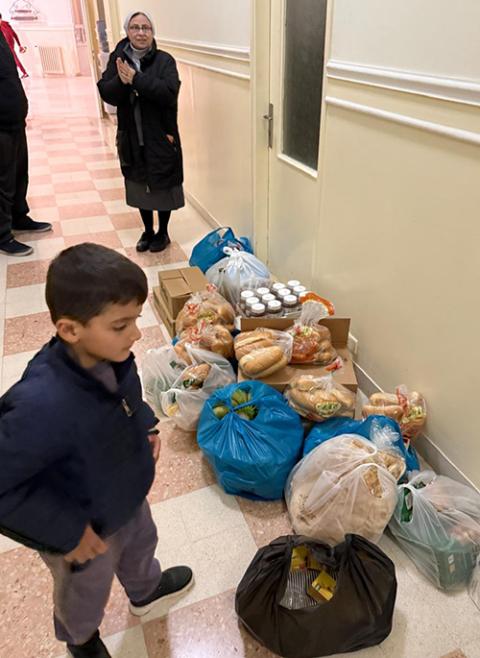
A Lebanese child impacted by the war in southern Lebanon is pictured at the aid office of the Sisters of Jesus and Mary in Beirut, in March 2026. (Courtesy of Rima Abi Karam)
In Beirut, the war is felt through destruction and the constant anticipation of what might come next. Marielle Boutros, regional project coordinator for the Catholic charity Aid to the Church in Need (ACN), told NCR she remembers clearly the moment the conflict resumed.
"At night, at 2:30 in the morning the day it started, we woke up to the sound of bombs falling on Beirut," she said.
Although her neighborhood has not been directly struck, the psychological impact has been immediate. Sirens, distant explosions and the sight of people fleeing from affected areas have become part of daily life.
The uncertainty surrounding the conflict, she said, is what weighs most heavily on people.
"I'm really speechless in front of these events, because you don't know when it will be your turn, when and how political changes will happen, and who will be the next victim."
Having lived through multiple wars in Lebanon, Boutros said the unpredictability remains the hardest aspect. "I've already lived through six wars in my homeland," she said. "The sound of the bomb still makes me uncomfortable, but I feel that the uncertainty makes me more uncomfortable than this."
Across Lebanon, church institutions have become a central pillar of the humanitarian response.
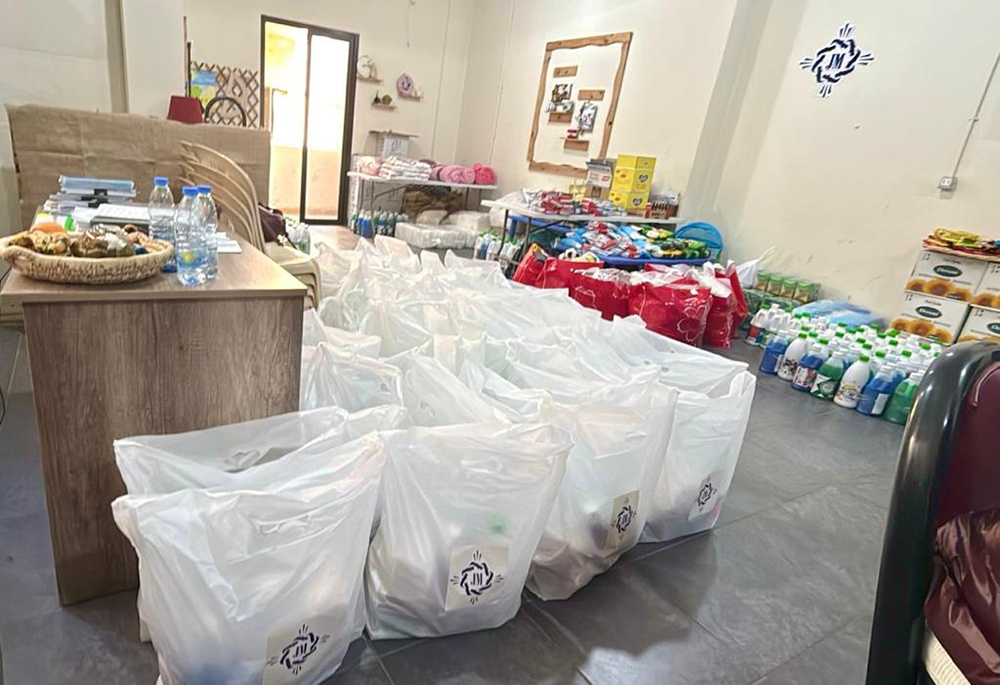
Supplies of water, food, medicine and basic necessities piled up at the aid office of the Sisters of Jesus and Mary in Beirut, waiting to be distributed to hundreds of displaced Lebanese who evacuated from southern towns on the border with Israel, in March 2026. (Courtesy of Rima Abi Karam)
Parishes, monasteries and religious schools are now sheltering displaced families while trying to organize food, medicine and essential supplies. Boutros said ACN's first priority was to check on church partners across the country before assessing the scale of the crisis. Soon after, attention turned to humanitarian needs.
"We have 1 million civilians displaced all over Lebanon," Boutros said.
Providing even the most basic necessities has become an urgent priority. Many families have arrived with little more than the clothes they were wearing, leaving parishes and church-run shelters scrambling to supply essential items.
"The needs are on all humanitarian levels: the food hygiene products, the mattresses, the blankets, the medication," she said.
Advertisement
Beyond the material needs, the emotional and psychological strain on displaced families is becoming increasingly visible. Even Lebanon's extensive church network is beginning to feel the strain of the growing crisis, Boutros said. With resources already stretched by years of unprecedented economic collapse, sustaining the humanitarian response is becoming increasingly difficult.
"The local church itself is facing a great financial challenge. They will do everything, everything they can in the short term, but realistically, this response cannot be sustained for long without international solidarity and support," she said.
In a small aid office in central Beirut, volunteers are already confronting the reality of that challenge. Boxes of donated food, hygiene products and clothing are stacked against the walls. Phones buzz constantly with emergency alerts announcing new airstrikes or evacuation warnings.
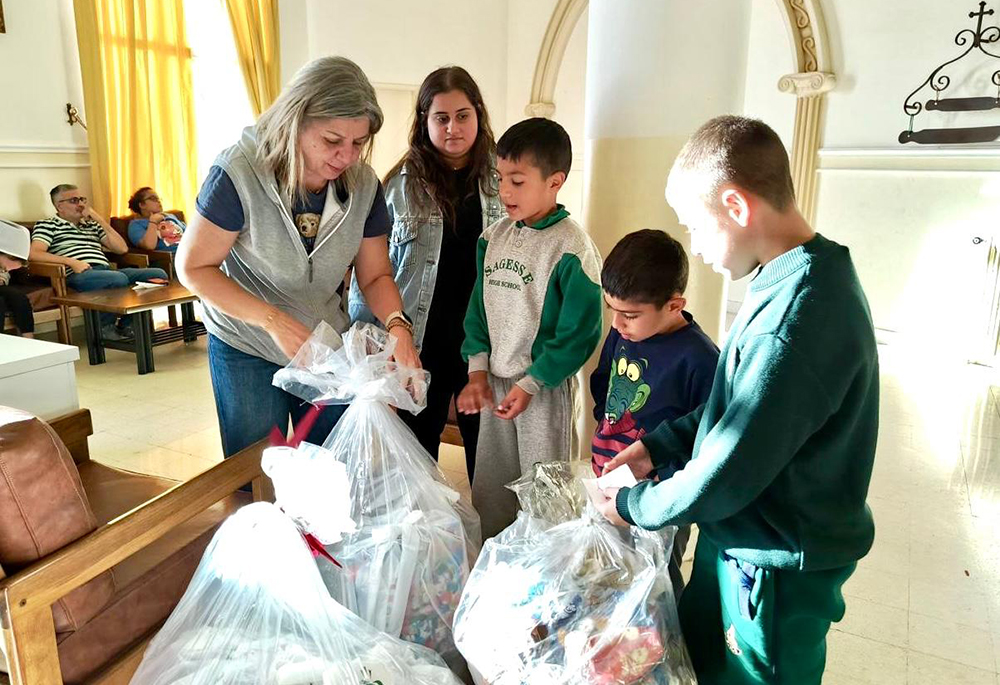
Rima Abi Karam, who runs the aid office for the Sisters of Jesus and Mary in Beirut, distributes toys and clothes to Lebanese children who fled from their towns in southern Lebanon because of war, in October 2024. (Courtesy of Rima Abi Karam)
Rima Abi Karam, who runs the aid office for the Sisters of Jesus and Mary, had spent the past year organizing programs for disadvantaged children before the latest war began. She said that she has now had to suspend those activities.
"The past 10 days have been like a nightmare," she said. "We can't believe that this started again."
Her office has turned into a distribution point for families arriving from southern Lebanon. Volunteers prepare food parcels, hygiene kits and clothing, but supplies remain limited. Housing has become one of the most urgent problems, she said. The majority of displaced families are sharing small apartments with relatives or have found refuge in religious institutions like local convents.
"And some of them are still on the street," she added.
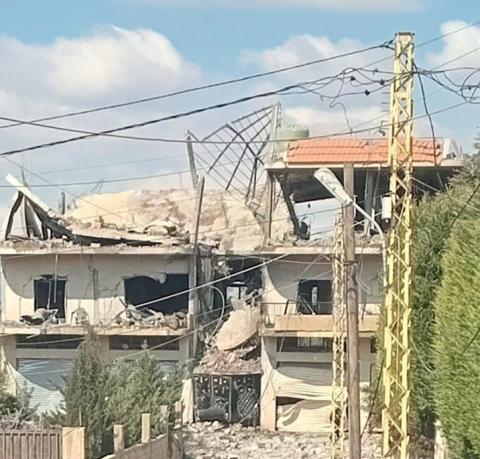
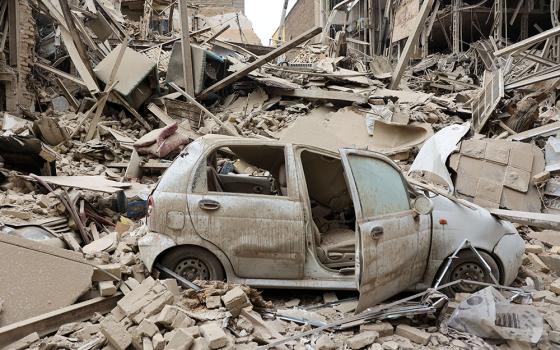
Destruction in Deir al-Ahmar, Bekaa, Lebanon, March 2026 (Courtesy of Aid to the Church in Need)
Volunteer Rita Jabbour said the number of displaced families continues to grow as evacuation warnings expand across southern Lebanon. Entire communities are being asked to leave with little warning, forcing families to abandon homes and villages that have been inhabited for generations. "More and more villages are becoming empty," she said.
For many Lebanese, however, the new war is only the latest crisis in a long chain of upheavals. Years of economic collapse have already pushed much of the population to the brink, leaving people with few resources to cope with yet another emergency.
"People are not allowed to get their money from banks," Jabbour said. "So you can imagine having restrictions on your money plus having a war, and before that, another war, and before that, the explosion that hit the port and really damaged the whole city."
After years of financial crisis, political paralysis and repeated shocks, fatigue is visible across the country.
"People are really tired," she said.
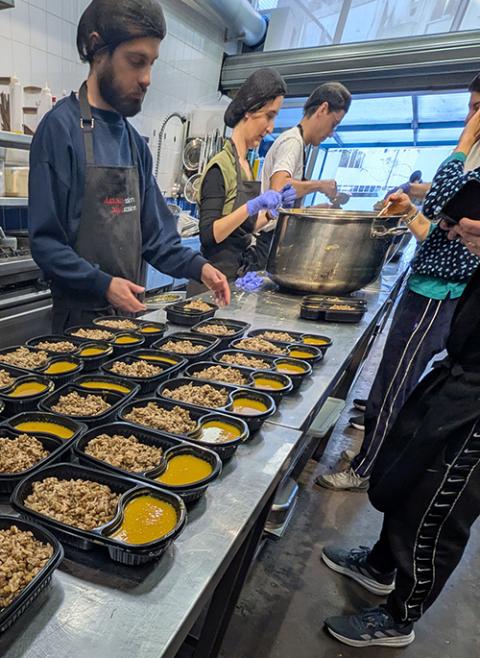
Meals prepared and served for Lebanese internally displaced persons at the Nation Station organization in Beirut, in March 2026. (Courtesy of Aid to the Church in Need/Charlotte Hallé)
The economic collapse has pushed increasing numbers of families into extreme poverty, making even the most basic necessities difficult to obtain. "Currently there are kids or children that are sleeping hungry," Jabbour added.
Much of that hardship is tied to the dramatic collapse of Lebanon's currency, which has wiped out savings and driven prices sharply higher, especially after the catastrophic August 2020 explosion of the port of Beirut.
With public services weakened and social safety nets largely absent, many families now rely almost entirely on churches, charities and informal networks for survival, she said.
As the war continues, exhaustion is spreading as quickly as fear. Airstrikes remain a daily occurrence in parts of Beirut and southern Lebanon. Drones circle overhead, and emergency alerts appear on phones throughout the day.
"You can hear that every day, you can see and smell the smoke," Jabbour said, her phone vibrating with emergency notifications of potential missile strikes and new evacuation orders from the Israeli army.
"We are resilient, but we don't want to be resilient anymore," she said. "We just want to live. We just want to have a normal life without worrying all the time."