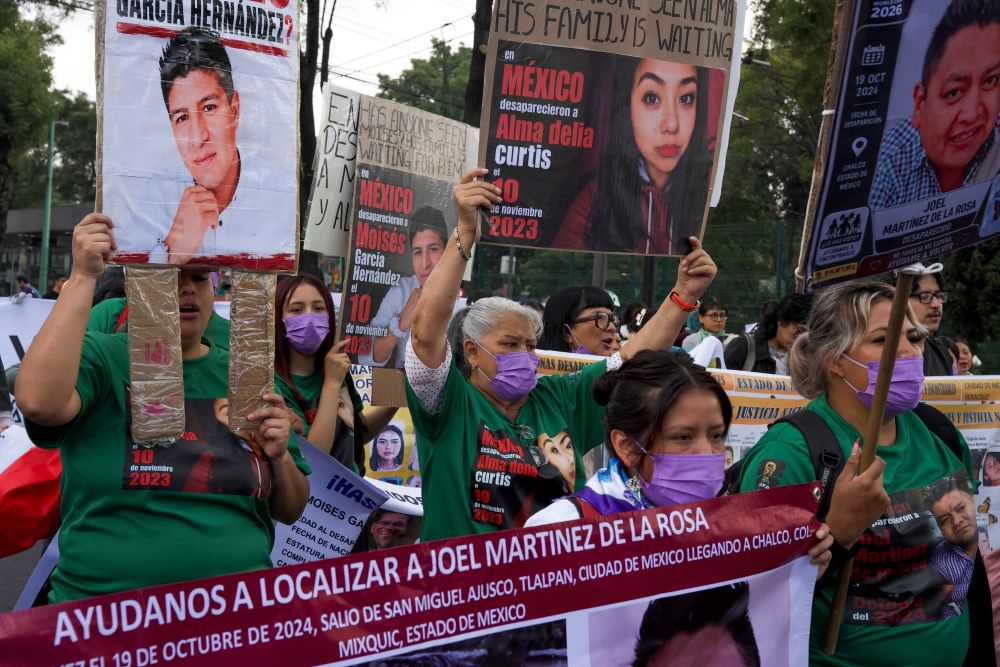
Relatives of Mexico's disappeared march before the opening day of the 2026 FIFA World Cup in Mexico City, Thursday, June 11, 2026. (AP/Alejandro Cegarra)

by Yolanda Chávez
Join the Conversation
Send your thoughts to Letters to the Editor. Learn more
A disappearance wounds differently than a death. Families remain suspended between hope and grief, unable to bury their dead and unable to fully return to ordinary life. In untouched bedrooms, unanswered phone calls and birthdays that still arrive, the missing continue to inhabit daily life.
In Mexico, thousands of mothers known collectively as Las Madres Buscadoras search for their disappeared children. In another reality, these women might have spent weekends tending gardens, caring for grandchildren or resting after years of work. Instead, they have learned to carry shovels across fields and deserts, studying maps and organizing searches. They have become investigators, organizers and guardians of memory, carrying hope stretched beyond what the human heart should be asked to bear.
Each time they enter the fields, they force the nation to confront what polite discourse avoids: that beneath the language of progress and security lies a geography filled with absence. The mothers searching Mexico are not only looking for the disappeared; they are searching for a country that has not completely surrendered its conscience.
The Book of Revelation is often misread as a text about destruction. But the Greek word apokálypsis means "unveiling." It is the tearing away of the veil that hides what empire prefers not to see.
In Chapter 12, a woman cries out in labor while a dragon waits before her, ready to devour what is about to be born. The scene is terrifying not necessarily because evil appears, but because vulnerable life does. The horror is not merely death, but disappearance; the destruction of vulnerable life before it can fully belong to the world.
The mythical beast feels painfully recognizable as the alliance of violence, corruption, indifference and silence; it feels like a nation where citizens themselves must search for the disappeared because the state cannot, or will not.
Authoritarian systems depend on exhaustion. They survive when people grow tired of remembering, when violence becomes routine enough to stop interrupting daily life. Little by little, horror becomes administrative language: statistics, cases, numbers that no longer disturb.
This is why the mothers searching across Mexico matter, far beyond their own personal grief. They interrupt the normalization of disappearance. They refuse to let the collective look away. When mothers become forensic searchers, grief is forced into public squares. Mourning refuses to stay private.
Advertisement
Mexico's searching mothers embody a profoundly apocalyptic vocation: They unveil what society prefers not to see. They uncover not only bodies, but truths. The apocalypse was never about predicting the end of the world. It was about revealing what is hidden beneath the illusion of stability: the violence that empires conceal with patriotic slogans, military power and public order.
Their persistence carries a deeply biblical resonance. They are like the women at Jesus' tomb in the Gospels; women who remained near death when others fled, women who carried memory when the world moved on too quickly. In Scripture, it is often women who remain close enough to suffering to witness resurrection before anyone else can imagine it.
So too do Las Madres Buscadoras evoke Rizpah, the grieving mother in 2 Samuel 21 who refused to abandon the exposed bodies of her sons but kept vigil in public grief until the conscience of the nation was forced to respond. Long before this generation of Mexican women gathered their search parties, Scripture had already told the story of a mother who refused to surrender the dead to anonymity and forgetting.
Perhaps this is what Revelation still has to teach us: The dragon fears the truth carried by vulnerable people who refuse silence.
The most extraordinary thing happening in Mexico today is that despite all that's been buried or threatened, there are mothers who continue to uncover what the nation tries to deny — the unbearable but necessary truth that every disappeared person still belongs to someone, and therefore still belongs to all of us.