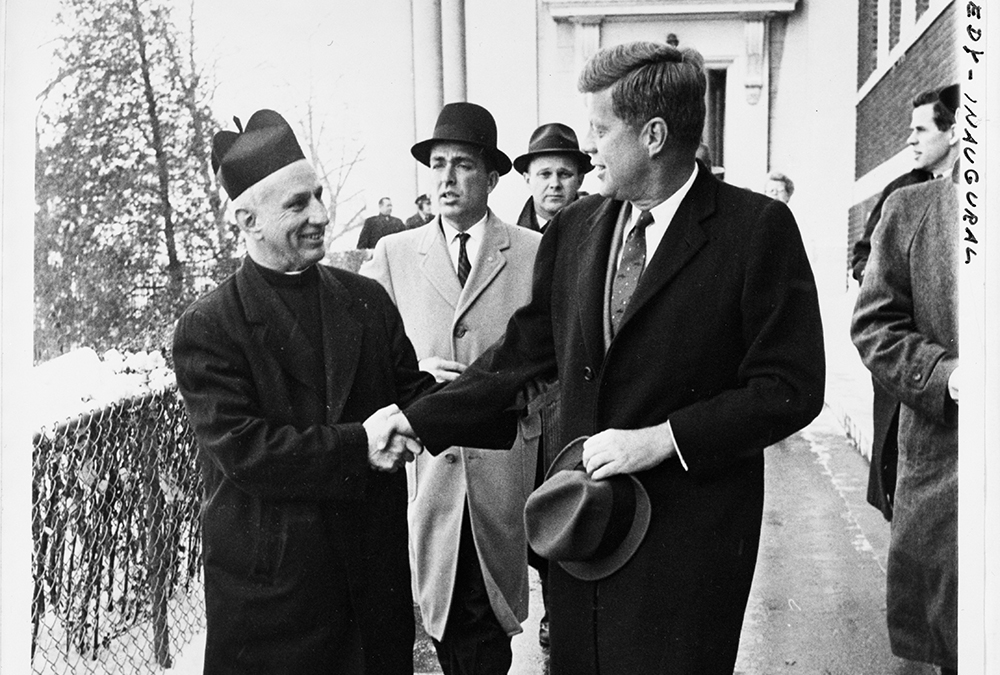
President-elect John F. Kennedy shakes hands with Fr. Richard J. Casey, pastor of Holy Trinity Church, after attending Mass at the church prior to inauguration ceremonies in Washington Jan. 20, 1961. (CNS/Library of Congress Prints and Photographs Division Washington)

Join the Conversation
Send your thoughts to Letters to the Editor. Learn more
"Our form of government has no sense unless it is founded in a deeply felt religious faith, and I don't care what it is," President Dwight Eisenhower told an audience at the Waldorf-Astoria on Dec. 22, 1952. The next month, he began his inaugural address with a prayer. When he died, he was buried in a chapel called "Place of Meditation" which features a large cross and stained glass windows but is about as nondenominational as a chapel can be.
The Eisenhower presidency, and that of his successor, John F. Kennedy, marked the heyday of civil religion. In 1967, Robert Bellah penned his famous essay outlining the contours and necessity of America's civil religion, using Kennedy's inaugural address as his starting point and surveying a raft of statements from the founders onward to make his argument. Noting that this civil religion relied on many biblical images, he nonetheless argued that America's civil religion "has its own prophets and its own martyrs, its own sacred events and sacred places, its own solemn rituals and symbols." Civil religion was "concerned that America be a society as perfectly in accord with the will of God as men can make it, and a light to all the nations."
I remember reading Bellah's essay in college and was profoundly suspicious. Even then my Catholicism was a tad fervent. Unlike Eisenhower, I did and do think it matters to which religion a person adheres.
In The Washington Post recently, University of Florida professor Samuel Goldman argued that "the United States needs a revival of American civil religion — a system of belief distinct from Christian orthodoxy and secular neutrality." Bellah believed that civil religion was necessary to a pluralistic society, a kind of bridge between the deepest spiritual yearnings of the American people and the pacification of the differences amongst those yearnings.
This echoes the argument made by James Davison Hunter in his book Democracy and Solidarity: On the Cultural Roots of America's Political Crisis which I review in two parts here and here. He diagnosed the "shrinking telos" of American public life and the corrosive effect of deconstructionism and the way its skepticism trickled down into the rest of our society.
Similarly, I recently called attention to an essay in The New Yorker in which Harvard University's Jeannie Suk Gersen examined why liberals abandoned a moral reading of the Constitution, specifically abandoning natural law reasoning in their legal arguments. It is the prospect of any metaphysical reality that has been precluded. Yet without a metaphysical horizon, how do we, as a society, avoid reducing all legal issues to volition, all philosophy to utilitarianism, and all ethics to, at best, a meritocratic norm that reinforces the power and the preferences of society's winners?
Advertisement
Civil religion died of multiple causes: the war in Vietnam, the corruption revealed in Watergate and graduate school seminars. Go back and read Kennedy's inaugural address and ask yourself: What would happen to any Democrat who delivered such a speech today? Its focus on the communist threat was unique to the time, but the main difference lies elsewhere. Kennedy spoke for a generation of Americans that had not been chastened. The sense of national purpose was acute, and the confidence with which it was articulated is astonishing to contemporary ears.
I am sure it would be a good thing if we could rekindle civil religion. For one thing, it served as a moderating influence. Its fusion of religion and politics was far different from that which certain conservative Christians advocate today. And it is difficult to see how we bind the nation's wounds without some kind of shared national mythos and telos. The key points in our national story all involved crisis: The revolution, the Civil War, the economic crises of the late 19th and 20th centuries, the two world wars, the Cold War, the civil rights struggle. Each of those crises entailed intense and widespread polarization, and we overcame it in part because the nation's leaders invoked our national mythos and explained the crisis as adding a new chapter that ratified the national story.
The COVID-19 pandemic was a moment when the nation faced a crisis which did not recognize societal distinctions between left and right, rich and poor, Democrats and Republican, college educated and working class. But because providence possesses a sense of humor that is sometimes a source of pain instead of mirth, we had the worst possible president to lead the nation through that crisis. Calvin Coolidge would have done better.
There is one other reason civil religion likely can't return to heal and renew the nation: affluence. The rugged individualism of our forebears has been replaced by cushy consumer conformity. Our individualism is no less problematic, but it is now flaccid, not rugged, and it is skeptical of a transcendent horizon. The sense of solidarity that characterized people who did not bowl alone has given way to a pervasive cultural libertarianism. The idea of national purpose appears quaint. And now that affluence is increasingly concentrated in the hands of the few, a profound resentment at the loss of the "American Dream" makes the electorate prone to demagoguery.
I agree with Goldman that the country needs a return to civil religion. But civil religion, a national mythos that defines a sense of national purpose, may be one of those things which, once lost, can never be retrieved.
Editor's note: You are reading a selection from Michael Sean Winters' weekly newsletter. To get the full edition — including the "In the News" link roundup — delivered 24 hours before it appears online, sign up here!