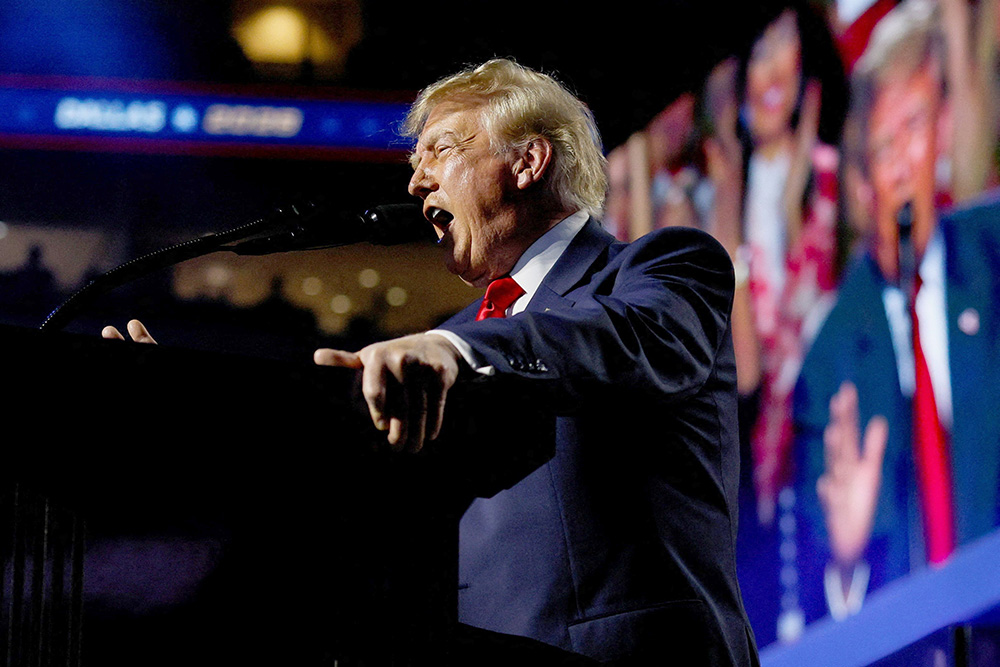
U.S. President Donald Trump delivers closing remarks at the Republican National Midterm Convention in Dallas Sept. 10, 2026. (OSV News/Reuters/Evan Vucci)

Join the Conversation
Send your thoughts to Letters to the Editor. Learn more
Last week's Republican midterm convention was, like so many of President Donald Trump's productions, both farcical and sinister. His opening night speech on Sept. 9 ran for an hour and 45 minutes, a meandering retelling of talking points and slogans that put one in mind of one of Comrade Leonid Brezhnev's hourslong addresses to a Soviet Communist Party congress.
But did it work? The goal of the event was not to decide anything as a typical convention does but to get the base excited about voting. The convention was an interminably long political ad for the president and his grievances. He believes that the only way the Republicans can win the midterms is if they nationalize the election and make it a referendum on his leadership. His ego permits no other strategy. It is more than a little ironic that the Democrats believe his approach is also their best strategy for winning back the House and the Senate.
The polls indicate that the upcoming midterms could be a disaster for the Republicans, largely because of Trump's low approval numbers. But how can anyone trust polls after election night 2016? Trump has repeatedly outperformed the polling in each of his three races. Many of the people who showed up to vote for Trump had previously been unengaged politically. They did not fit the pollsters' models as people likely to vote. But they showed up and voted for Trump. Primary polls this year have also been widely off in several key races.
What role will Catholics play? In national elections, it is a truism that there is no Catholic vote, but the Catholic vote decides the elections. Unlike evangelical Protestants who are overwhelmingly Republican and mainstream Protestants who are overwhelmingly Democratic, Catholics straddle the center of the electorate. We do not vote as a bloc, but convincing 10% of Catholics to vote one way or the other can tip the election. In three of the key Senate races this year — Michigan, Texas and Maine — Catholics are also more than 20% of the population.
The 2018 midterms during Trump's first term are the best historical point of comparison for this year's midterms. Then the Republicans lost control of the House as the Democrats picked up 23 seats, but the GOP held the Senate and actually increased their margin by two seats. Democrats increased their vote share in 239 House districts, while Republicans only increased their vote share in 67 districts.
Advertisement
Michigan Sen. Debbie Stabenow was running for reelection in 2018, so the seat was not open as it is today. She won by six points, with a little more than 4 million votes cast. In the 2016 presidential contest, almost 5 million voters were cast in Michigan and in 2020, 5.5 million voters went to the polls. Turnout will be key if the Republicans want to capture the Michigan Senate race, and the 900,000 Catholics in the Detroit Archdiocese could make the difference. In the Democratic primary this summer, the eventual nominee, Dr. Abdul El-Sayed, lost all six counties that make up the archdiocese.
In Texas in 2018, Rep. Beto O'Rourke convinced many Democrats he had a real shot at beating Sen. Ted Cruz, but he lost by a little under 3 points, with more than 8 million votes cast. Almost 9 million Texans had voted two years earlier in the 2016 presidential race, and in 2020, that number rose to more than 11 million. President Joe Biden lost to Trump in the Lone Star State by 6 points. In 2024, Trump beat Vice President Kamala Harris by almost 14 points, with similar turnout to that in 2020.
Can Texas state Rep. James Talarico defeat Attorney General Ken Paxton this November? It is not impossible but it will only happen if enough Trump voters stay home on Election Day, and if enough people who voted for Trump in 2024 are feeling buyer's remorse. In 2020, Biden carried most of the heavily Catholic districts along the Rio Grande, which are overwhelmingly Latino. In 2024, Trump carried most of them, and his coattails brought along a few Republican congresspeople in those same districts. Can the GOP hold those seats? Will turnout there boost Talarico?
Maine's Senate race is a toss-up and Catholics also make up about 20% of the electorate there. Looking back at the 2018 election is no help: That year, Sen. Angus King, who is an Independent who caucuses with the Democrats, did not face a serious challenge and he defeated his closest competitor by 19 points. Some 600,000 Mainers voted in that midterm, compared to more than 771,000 in 2016.
2026 is not 2018. Back then, the inflation rate was a modest 1.90%. Diesel was not more than $6 per gallon. Trump had not started a foolish war in the Mideast nor had he torn down the East Wing of the White House. People have more reasons to be angry with Trump, and that should motivate them to vote. There were fewer competitive races in both the House and the Senate in 2018, which should also boost turnout this year.
Control of the U.S. Senate will depend on the results of races in these three states with large Catholic populations. Trump's effort to nationalize the election could work or it could backfire, depending on whether people who voted for him two years ago, including Latino Catholics in Texas and blue-collar Catholics in Michigan, will also turn out to keep the Congress compliant. Democrats will turn out because they are angry. Trump's approach may actually be the only shot the GOP has, but it is a long shot. 2026 is looking like a big blue wave.
You are reading a selection from Michael Sean Winters' weekly newsletter. To get the full edition — including the "In the News" link roundup — delivered 24 hours before it appears online, sign up here!