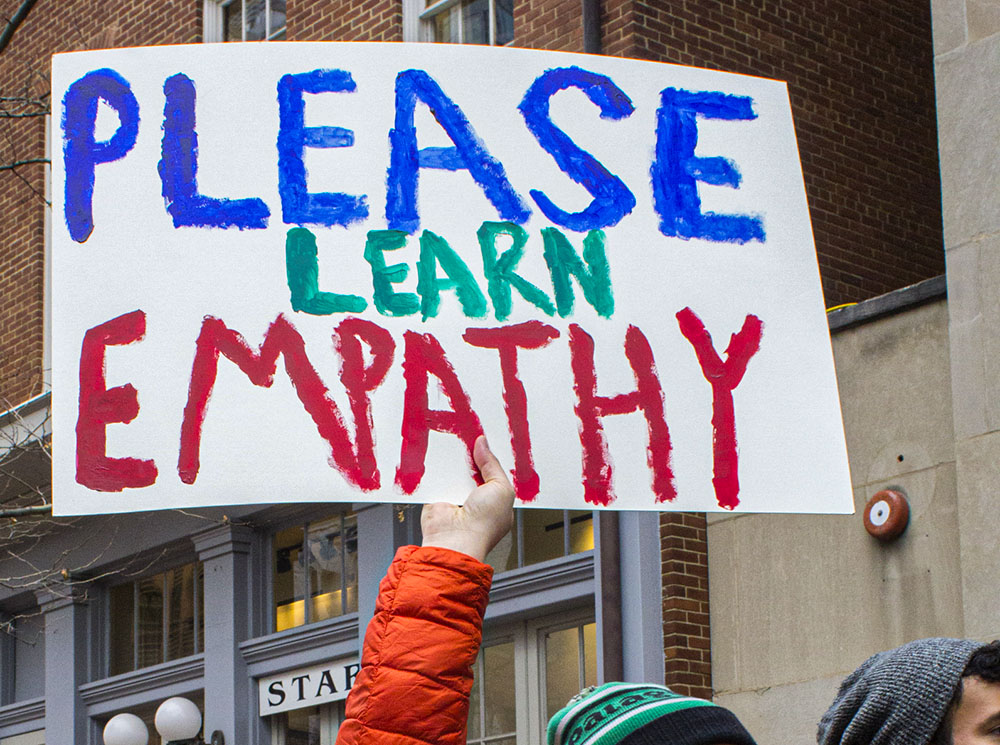
A sign promoting empathy is seen among protesters at Donald Trump's first presidential inauguration Jan. 20, 2017, in Washington, D.C. (Dreamstime/Arienne Davey)

by Jeromiah Taylor
Join the Conversation
Send your thoughts to Letters to the Editor. Learn more
A prominent Catholic bishop and commentator has waded into the ongoing culture war over empathy and its role in Christianity, siding with conservative influencers who argue that practicing empathy carries great risk. Bishop Robert Barron, who heads the Diocese of Winona-Rochester, Minnesota, and founded the popular online media organization Word on Fire, devoted a recent podcast and homily toward undercutting the role of empathy in U.S. culture.
In a YouTube video posted Sept. 6, Barron said, "If you put empathy, so defined, in the center of your preoccupation, truth, reality, justice and love are going to be threatened."
Barron was preaching on marketing professor Gad Saad's New York Times best-selling book Suicidal Empathy: Dying to be Kind, which Barron characterized as the "best exposure and takedown of the lunacy at the heart of much of the wokeist philosophy that dominates things today."
In his book, Saad writes, "A society dies when it cares more about exhibiting infinite tolerance and empathy than invoking its survival instinct." Saad's theories have been supported by a number of prominent right-wing figures, including Elon Musk.
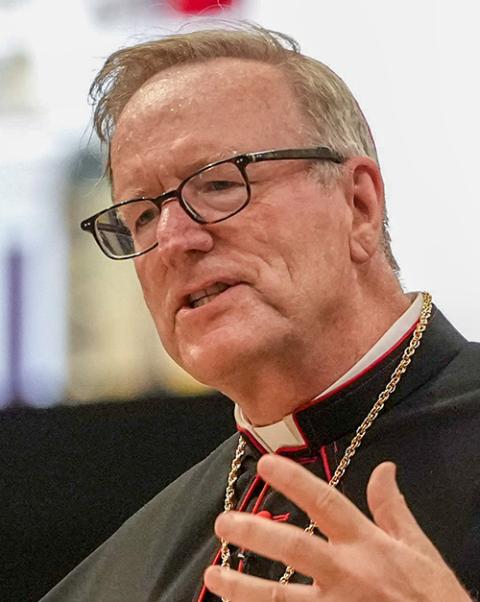
Bishop Robert Barron of Winona-Rochester, Minn., in 2025 (CNS/Lola Gomez)
Drawing a distinction between empathy and love, and taking aim at "wokeism," Barron said that sometimes love requires pointing out truth that causes hurt feelings.
"We need, I think, to reassert with biblical boldness that what stands at the center of our society is not refraining from hurting people's feelings, but is the kind of hard-edged language of love," Barron said.
Speaking to an interfaith group in May, Pope Leo XIV lent his support for empathy, saying, "Human compassion and empathy are not something additional or optional, but are a call from God to reflect his goodness in our daily lives."
He added, "Compassion and empathy are sadly in danger of disappearing today."
Some Catholic commentators took issue with Barron's characterization of empathy.
Jesuit Fr. James Martin alluded to the ongoing debate in a Sept. 7 Facebook post. Exploring the implications of the doctrine of the Incarnation, and biblical passages describing Jesus' emotions, Martin wrote, "This is what Jesus invites us to experience when we see any kind of suffering: deep sympathy, or a radical empathy."
Writer and retired priest of the Diocese of Orange, California, Msgr. Arthur Holquin, weighed in with a Sept. 8 Facebook post, warning followers that "ideological frameworks — including ones offered in the Church's own name — can quietly convert persons into abstractions."
In his post, Holquin shared a Sept. 7 essay from transgender Catholic writer Maxwell Kuzma written in response to Barron's remarks. Kuzma emphasized the centrality of the human person to Catholic social teaching.
Referencing the work of Fr. Bryan Massingale — a prominent theologian and a priest of the Milwaukee Archdiocese — Kuzma wrote, "Fr. Massingale describes the danger of treating human dignity as merely an abstract principle."
Advertisement
"Barron's 'wokeism' framework risks turning people into political issues," Kuzma wrote. "Immigrants become immigration, Black people become racial politics, poor people become economic policy, and transgender people become gender ideology."
Barron's critique of empathy as the cause of a dominating woke ideology reflects a long-brewing discord over the word. Musk helped popularize the idea of "suicidal empathy," describing it as an exploitable "bug in Western civilization" on a Feb. 28, 2025, episode of Joe Rogan's podcast.
The term "suicidal empathy" had been coined by Saad to refer to the supposedly self-destructive impulse behind a host of ideological boogeymen, such as the Black Lives Matter movement and transgender rights.
The denigration of empathy goes back further, with some Christian nationalists having also supported the notion that overly emphasizing empathy is destructive. Conservative theologian Joe Rigney deemed it the "sin of empathy" in 2019. Commentators have noted its similarity to the older "great replacement theory" — a xenophobic conspiracy theory stating that non-white or non-Christian immigrants threaten to dilute racial purity in the West.
Vice President JD Vance expressed similar sentiments about the supposed dangers of unbounded empathy last year, when he invoked Augustine of Hippo's concept of ordo amoris — a usage that received an unusual papal rebuke in the form of a letter from Pope Francis to the United States bishops decrying the administration's immigration policies. In response to Vance's claim that Christian love required prioritizing some people over others, Francis wrote that the true order of love "builds a fraternity open to all, without exception."
According to Barron's video sermon, that same openness poses a grave threat. The bishop seemed to allude to affirmative action policies when making his point, saying, "So as not to undermine the self-esteem of minorities, we'll allow them, even if they're unqualified, to have positions in universities and the corporate world."