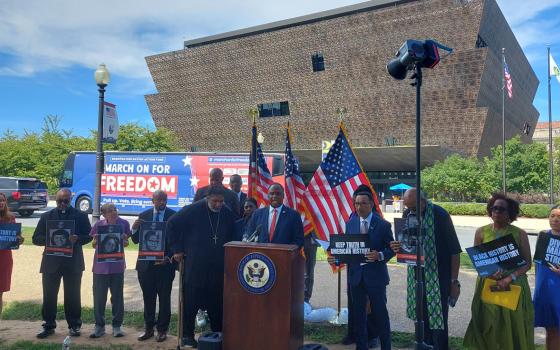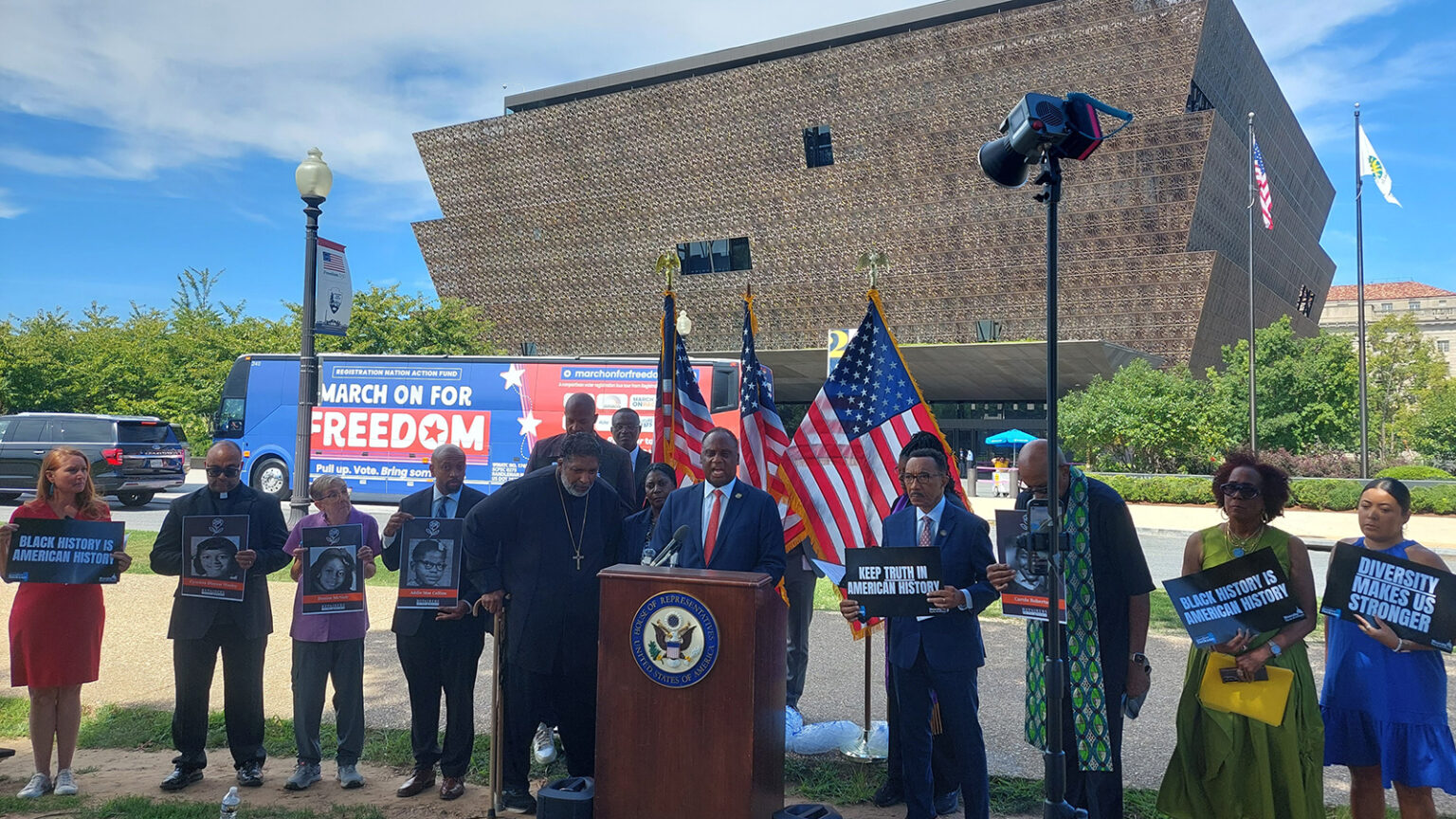
Rep. Jonathan Jackson, center, speaks in front of the Smithsonian's National Museum of African American History and Culture on Sept. 15, 2026, in Washington. Sept. 15 was National Voter Registration Day and also the 63rd anniversary of the bombing of the 16th Street Baptist Church in Birmingham, Alabama. (RNS/Adelle M. Banks)

Religion News Service
Join the Conversation
Send your thoughts to Letters to the Editor. Learn more
With less than a month before the midterm elections, Black churches are boosting their efforts to get voters to the polls, using new outreach methods like postcard writing campaigns, multistate tours, weekday rallies and other strategies to get their congregants and the broader Black community involved.
Black churches have long led get-out-the-vote efforts, registering people when they attend worship services and urging congregants to travel en masse in "Souls to the Polls" events to the polling places when the hymns and sermons have concluded on the Sunday before Election Day.
With concerns about gas and grocery prices and lingering exhaustion over former Vice President Kamala Harris' loss to President Donald Trump, this year there is renewed energy and collaboration with community organizers, civil rights and labor leaders, and college students to pump up voter turnout. For the midterms, 70% of Black voters are backing Democrat candidates while 7 percent support Republicans, new data from Pew Research Center shows, and 81 percent of Black voters who voted for Biden in 2020 turned out in 2024.
The push comes in the wake of Supreme Court decisions gutting a section of the Voting Rights Act and permitting states to use a. It also comes amid personnel will be present at polling places this fall. Homeland Security and ICE officials have said there are no such plans, but Trump said he would "do anything necessary to make sure we have honest elections" when speaking to reporters in May.
Countering such threats means more effort to get people out to vote, said the Rev. James C. Perkins, a veteran Black Baptist minister in Detroit who is a Michigan leader of Faiths United to Save Democracy, which is holding new "mobilization and unity" rallies across nine states in September and October. The coalition recently began a series of virtual rallies geared for nine states, including Michigan.
"This virtual rally is just another tool in our toolbox that we can use to steer people prior to the actual Election Day," said Perkins, a former president of the Progressive National Baptist Convention, a historically Black denomination. "We have to try to make it so big it can't be rigged."
A September University of California San Diego survey found that 49% of Americans said they expect "free and fair" midterm elections; 23% said they do not and 28% said they did not know. Forty percent or more of people of color said they expected to face intimidation or think ICE will likely be at the polls.
Bishop William J. Barber II, president of Repairers of the Breach, a nonprofit social change organization, is urging houses of worship and other community groups to demonstrate "conspicuous courage" by heading to the polls as soon as early voting is available.
"We are calling on a thousand marches to the polls, the first day of early voting in every state," said Barber, standing with Black clergy and Illinois Democratic Rep. Jonathan Jackson, son of the late Rev. Jesse Jackson, on National Voter Registration Day in front of the Smithsonian's National Museum of African American History and Culture. They linked heading to the polls with preserving Black history at a time when national museums have been criticized by the Trump administration.
"And the reason we want you to do this is because every attempt to retrogress voting rights is an attempt to desecrate the graves of our foremothers and fathers," Barber added.
As of Friday (Oct. 9), the organization's website showed it had reached more than half of its goal with signups by more than 600 individuals, churches and other groups in more than 400 locations from Seattle to St. Croix in the U.S. Virgin Islands.
At an early October event, Impact Church in East Point, Georgia, hosted some 350 people in its parking lot for a post-worship service rally to encourage members of the predominantly Black congregation and the surrounding community to vote — especially when early voting starts on Oct. 13.
Amid the food trucks and the line-dance music played by a DJ, attendees checked their voter registration and signed up to text or phone others to encourage them to get to the ballot box.
"People will be checking their registration because, in Georgia, a lot of people have gotten purged, but they may not know it," said Deborah Scott, a longtime community organizer who is the CEO and president of the nonprofit Georgia Stand-Up and a trustee of the United Methodist church just north of Atlanta's airport.
In an interview ahead of the event, Scott said the outdoor gathering continues efforts by Black churches and others in and beyond the Atlanta metro area to ramp up voter education following the removal of some 450,000 outdated voter registrations in 2025, the subject of a lawsuit by Black Voters Matter Fund and two union groups. Republican Secretary of State Brad Raffensperger has described the removals as part of "election safeguards."
The Rev. Barbara Williams-Skinner, a co-convener of Faiths United to Save Democracy, a multiracial nonpartisan group with roots in Black church voter mobilization, is working with clergy and lay people from historically Black denominations and leaders of other faiths and races to gather, train and assign polling chaplains and peacekeepers who seek to welcome voters and deescalate tensions at the polls.
But Williams-Skinner, who has worked on voter mobilizing since the 2014 midterms, said they are also redoubling encouragement for people to vote at those polls — even if they were disappointed in the defeat of Harris by Trump and the subsequent actions of his administration.
"We're seeing the 'I'm done' group because Black women feel that they have been singularly targeted in the civil service cuts, in the DEI cuts by this administration," she said. "I don't think that's the majority. I think a majority of Black people who have for 407 years been dealing with systemic racism, we always have — there's a spirit and seed of hope in us that if we keep fighting, things will be better — not necessarily for our lives, but for our children's children's lives."
Advertisement
Pastor Mike McBride, executive director of Live Free USA, a nonpartisan group involved in voter mobilization, and co-founder of the Black Church PAC, a political organization, described twice-a-week phone banks and text-a-thons planned before the midterms, emphasizing voter education and early voting encouragement.
"We need everybody to gather, to organize, to activate, to train, and to show up and show out," he said. "And so, our hope is to get 1,000 congregations moving in some concert together, pushing early voting messages, so our communities don't have to stand in long lines."
Black church leaders have partnered with organizations like Faith Out Loud!, a project that encourages Black churches to meet community needs, and All Roads Lead to the South, a movement countering recent Supreme Court voting rights decisions, for months to motivate some 400 congregations through Freedom Summer 2026 programs and "Justice Revivals," he said.
McBride added that the volunteer, nonpartisan activity demonstrates that Black churches have "had to roll up their sleeves" and move beyond work that might have been primarily shortly before an election. The Associated Press reported in September that there has been a decline in donations from wealthy philanthropists since the 2024 presidential election that has affected voting groups known for engagement with communities of color.
"It has been very disheartening to see donors and philanthropic partners and even in some regards political campaigns and Democratic Party institutions, in essence, defund voter engagement strategies," he said.
Perkins, the Baptist leader in Michigan, said turnout activists often have conversations with possible voters who are disappointed in the Democratic Party.
"I think there's a sense among some that the Democratic Party has not been assertive enough in confronting the present administration that, in spite of the fact that we don't control either the Senate or the House, that there ought to have been something that we could have done to make it look and feel like we're fighting," he said.
And in his state, there are mixed feelings about Democratic Senate candidate Abdul El-Sayed. The Michigan race is one of a dozen considered key to determining control of the Senate.
"He was not widely known in the Black community prior to this, even though he had served as director of health for Detroit," Perkins said. "He was not engaged as such, as widely engaged, I should say, in the Black community as he needs to be now."
Two weeks before Election Day, the Rev. Michael W. Waters, the pastor of Abundant Life African Methodist Episcopal Church in Dallas, is spearheading an eight-state, 19-city tour to trace the steps of Freedom Riders to the South 65 years ago. He expects about 50 people to travel the bulk of the journey, which will include buses, cars and motorcycles and connect with houses of worship and historically Black colleges and universities as faith leaders, original Freedom Riders and their descendants join together for the intergenerational and interfaith journey. Along the way, local artists and community organizations are expected to join the multicultural event.
"We will be going in many ways to the spaces and places where they have already gone in decades before as a way to uplift and support our communities today and to empower them to get out the vote," said Waters of the initiative called "The Ride."
"In the same spaces and places where they fought to bring about liberation are the spaces and places where democracy is under duress."
Waters, who also is director of Black voter engagement for Vote Common Good, a liberal-leaning advocacy group, said the goal of The Ride is to spur greater voter turnout at a time when there may be fewer places to vote. He pointed to Tarrant County, which borders the county where his church is located, as an example. A suit has been filed against Republican commissioners after they voted to cut the number of polling places by almost one-third, according to the Fort Worth Report.
Stops on the tour include Southern cities such as Greensboro, North Carolina; Anniston, Alabama; and Nashville, Tennessee, all of which are in states where redistricting has split up majority-Black voting areas.
Several predominantly Black churches also are hosting stops in the Interfaith Alliance's 15-state bus tour that officially launched on Oct. 6 at the Tri-Faith Initiative in Omaha, Nebraska, said Guthrie Graves-Fitzsimmons, vice president of programs and strategies. Featuring get-out-the-vote and potential voter interference training, the tour included a preview visit to the United Methodist church in Kansas City pastored by the Rev. Emanuel Cleaver III, son of the Missouri congressman, and is set to have a later stop at Dallas' Friendship-West Baptist Church, where congressional candidate the Rev. Frederick D. Haynes III is senior pastor. Haynes, one of at least a dozen pastors, seminarians and former clergy running for office this year as Democrats, is widely expected to win his race.
The Progressive National Baptist Convention, which has affiliated churches serving as stops on the tour, also has joined forces with the AFL-CIO and Rainbow Push Coalition, including Yusef Jackson, who has succeeded his father as leader of the civil rights organization. They are planning new "People's Revival" events before the midterms in Texas, Georgia and the Carolinas at historically Black colleges and churches to offer "teach-in" and "text-in" programs for training people on engaging voters and using texting for outreach.
Deirdra Reed, a lead organizer with the PNBC's Social Justice Commission, said the denomination hopes dozens of its churches will use a portion of their October worship services to fill out postcards to be sent to infrequent voters in states the leaders will visit. It's an approach to gain new voters that's been used in secular circles but Reed views the PNBC version as a spin, she said, on the New Testament letters from Paul to churches in Corinth and Rome.
"We're modeling this idea of letters from the churches of PNBC that, hey, this is an election season — not telling you who to vote for," she said. "But what we want you to understand is that we believe that voting is a sacred sacrament and that you should vote."
The Rev. Micah Gaines, whose Detroit PNBC-affiliated church is a polling site, plans to serve as a poll chaplain, as he has during previous election seasons, and also has committed to join his denomination's postcard campaign. He said some Black church members may lament Harris' 2024 loss and some young adults may view social media that "can make you think that your vote doesn't matter," but they must press on.
"We cannot afford to be lackadaisical or to be apathetic or to just feel like there's no hope because there are still active battles for us to fight," he said. "Which is why, as a Black church, we have to ensure that we're not just coming on Sunday mornings and having a great, great time and not doing any activism, any justice work after that, because there's an actual battle being fought every single day of the week."
The Soul of Atlanta, a year-old civic organization that has expanded from DEI advocacy to voting rights, is bringing speakers like the Rev. Andrew Young, a longtime civil rights activist and former Atlanta mayor, other politicians and Black ministers to weekday rallies at historically Black churches long connected to the Civil Rights Movement to address defending democracy, including voting rights. Young is expected to speak at Salem Missionary Baptist Church in Lilburn, Georgia, one of the oldest Black churches in North Georgia, on Oct. 22.
"Some people thought that we were in a post-racial America with the election of President Obama, and that people could really just say, thank God, we've finally seen this, and now we can just live regular lives," said Ray McClendon, a planning committee member of The Soul of Atlanta and a member of a predominantly Black United Methodist church in the city.
"But they've seen that there's been a terrible reversal once Obama left office, and it has really turned back the clock to the 1950s, and I truly believe that these clergy and faith leaders are recognizing that they need the same type or even more urgent response as was in the 1950s and '60s."