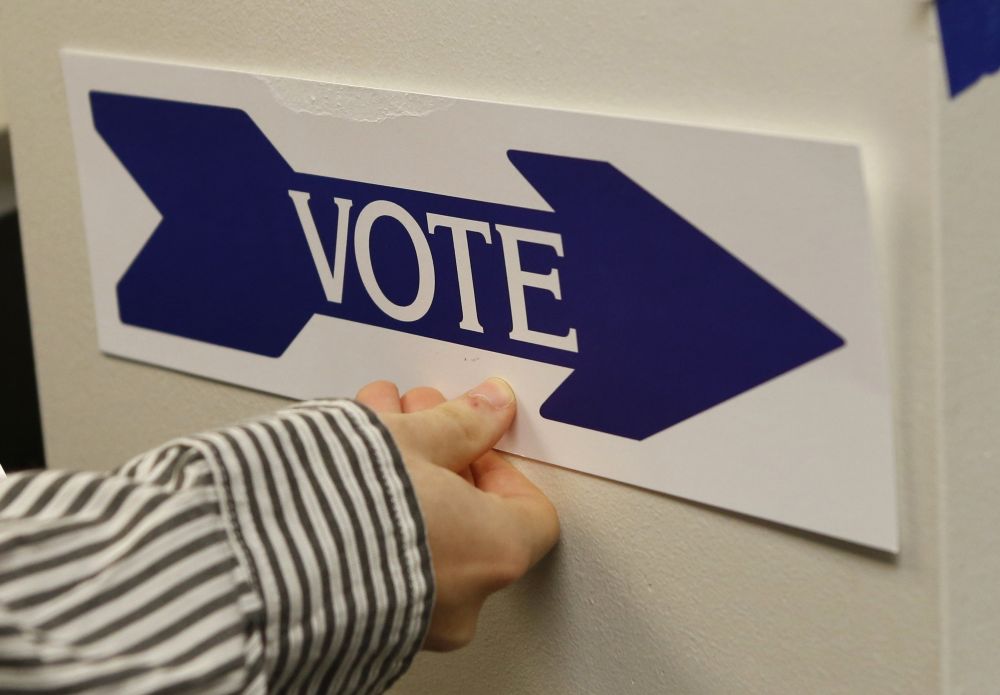
An election worker puts up a sign at a polling station in McLean, Va. (OSV News/Reuters/Kevin Lamarque)

by Robert Christian
Join the Conversation
Send your thoughts to Letters to the Editor. Learn more
Our democratic institutions are facing grave threats, including corruption, the role of money in politics and ongoing efforts aimed at making it harder for people to vote. Those of us working to protect democracy worry about violations of the rule of law, threats to independent media, and the destruction of vital democratic norms.
This all comes at a time of rising prices and growing economic precarity; hyperpolarization and partisanship; record levels of loneliness and isolation; disinformation and misinformation swirling all around us; a general dearth of institutional trust; and the government's unwillingness or inability to secure important political and policy reform.
Policy change is necessary. Legislation like the John Lewis Voting Rights Act and the Freedom to Vote Act would protect vital voting rights and make our democracy more genuinely democratic — more aligned with the principle of participation. But we also need everyday Americans to embrace norms that can strengthen our democracy from the bottom up.
Here are five simple ways Americans can strengthen democracy.
Be a good listener. At a time when partisan slogans and simplistic memes (that few people genuinely, consistently believe) are far more popular than nuanced arguments, this can be hard. But when we stop listening entirely, the collapse of thoughtful democratic discourse will only accelerate. Partisanship will deepen, as we parrot cable news, popular politicians and social media influencers, instead of thinking for ourselves and engaging in real dialogue.
To really know what we actually think, we need to be good listeners. Rather than looking for the weakest straw man argument, we should seek out thoughtful, nuanced ideas and arguments that challenge our assumptions. If nothing else, this will help us to be responsible participants in democratic dialogue. And it also opens the door to the next step.
Try to actually persuade others. Social media rewards preaching to the choir, dunking on people, and outlandish hot takes. Advancing the common good through the democratic process requires actually persuading people to change their views and behavior. It is helpful to think of people who disagree as potential converts, rather than heretics or apostates, understanding that not everyone who will end up in the same place is on the same path.
Many on both the right and left seem to have given up on this. They prefer a "base mobilization" political strategy, enjoy the adulation they receive in echo chambers, and seek to shut down the speech of others using their economic, political or cultural influence, either through direct coercion or by shaming others.
Some refuse to ever discuss important political issues because they believe these issues should be beyond debate. But that is not how democracy works. In Catholic social teaching, for instance, we believe that people have a fundamental right to food. If we refuse to defend this belief and persuade others that it is true and that this right should ground our approach to anti-hunger programs, the cuts to SNAP and foreign aid will likely continue and more kids will go to bed hungry. It may be frustrating to debate issues where the moral stakes seem obvious (and, of course, it is not always necessary), but completely evading debate in this way merely cedes the field to those on the other side. When there is not popular support for certain policies vital to human flourishing, persuasion is necessary.
Exercise intellectual humility. Anyone who thinks they have all the answers to every complex policy matter on the planet is wrong. There are always blind spots and unintended consequences. There are gaps in our understanding or our thinking is distorted by hubris.
Sometimes we need more knowledge to use good judgement, while other times, we can develop a technocratic mentality that only we should make decisions that involve moral reasoning because we have greater technical knowledge. Or we might think our experiences or background gives us wisdom that should not be questioned.
In a democracy, the civic formation of everyday people is critical. Republics cannot survive without virtue. To ignore the need for some technical understanding of important policy issues is perilous. But it is also a mistake to think that only those with specialized knowledge should have a say on vital issues. This attitude is fundamentally anti-democratic. Smug elitism undermines persuasion. Cultivating one's knowledge and prudence is critical, but so too is it essential to remember we are all called to be equal participants in the shared project of our democracy.
Stop turning politics into a pseudo-religion. Intermediary institutions are disappearing, religion is in decline, and loneliness is pervasive. People are turning to politics for their entire identity, their worldview, their sense of purpose and connection. This is dangerous.
Hannah Arendt noted that "totalitarian movements are mass organizations of atomized, isolated individuals." Even if we are not on the precipice of totalitarianism, this has made us more vulnerable to personality cults, extreme partisanship, and even political violence. When politics take on this disproportionate role, the pursuit of power may seem more vital than preserving democratic institutions and norms.
Advertisement
Politics matters. It can and should be a vehicle for protecting the vulnerable and promoting the common good. When we love others and value justice, we cannot simply ignore the role politics plays in our society. But when it becomes all-consuming, it constitutes a real threat to the flourishing of ourselves and our democracy.
Accept defeat. In a democracy, your side will sometimes lose. A candidate you love will be defeated. An issue you care about will go the other way. If people cannot accept this, we cannot have a democracy.
Democracy allows us to resolve our political differences through a peaceful, nonviolent process. Accepting defeat, learning lessons from it, getting back out there and persuading more people, and trying to win the next election or pass the next piece of legislation is part of this process. When we cannot accept defeat, the democratic process is short-circuited. In the most dangerous cases, it could destroy our system of free and fair elections. Regular people can end up supporting democratic backsliding or even authoritarianism.
In addition, if one accepts the defeat, yet blames it on conspiracies or anything else outside their side's control, the critical learning and persuasion process will stall. Parties will drift away from voters. Frustration will rise as trust recedes. And the entire democratic process will be further strained.
Understanding why one has lost and accepting it is therefore vital for anyone committed to operating through the democratic process.