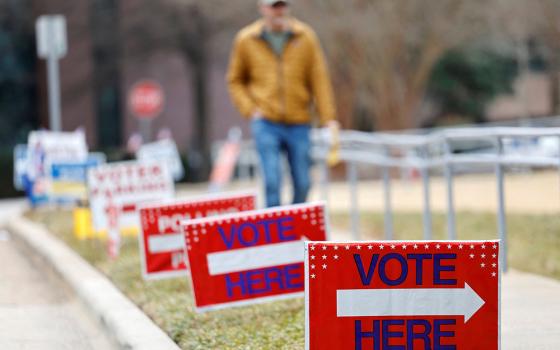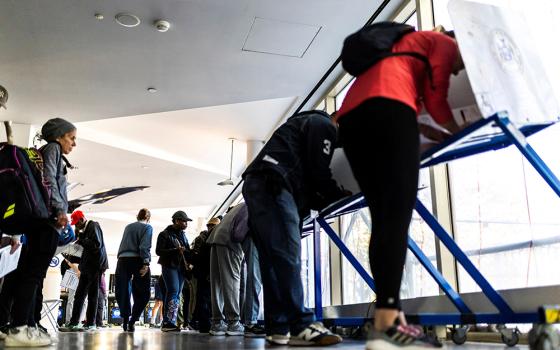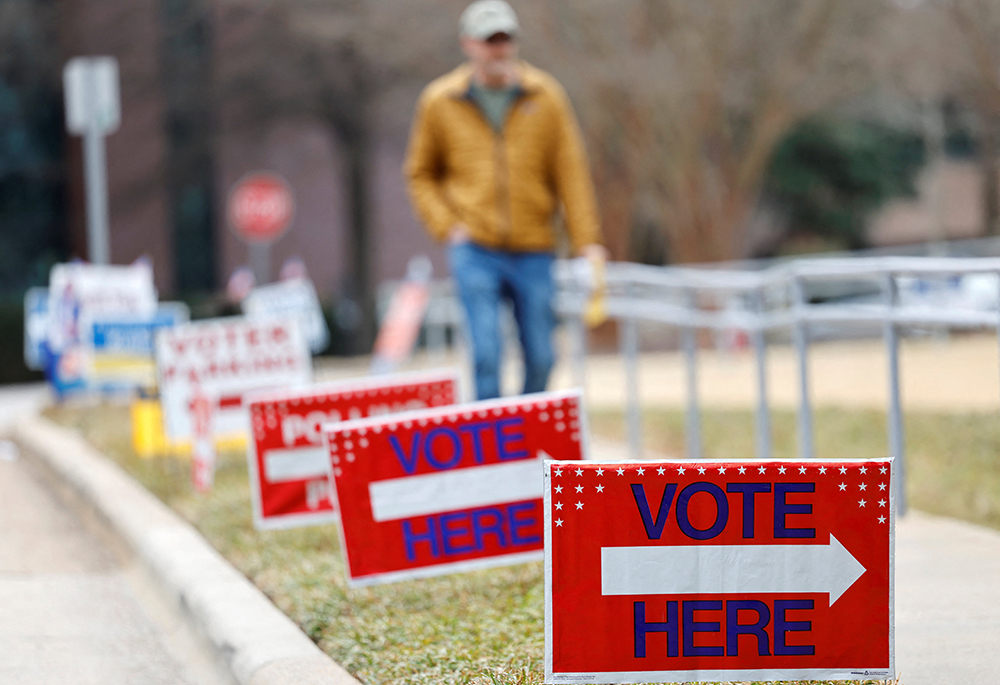
A voter walks toward his polling place in Cary, North Carolina, during his state's primary election March 3, 2026, to choose candidates for the November midterm elections. (OSV News/Reuters/Jonathan Drake)

Join the Conversation
Send your thoughts to Letters to the Editor. Learn more
The Senate Leadership Fund, the largest political action committee helping Republican Senate candidates, announced last week that it was pulling all ad spending from North Carolina. The blue wave is rising, and while it may not lift all boats, it is apparently lifting some. And religion is part of the story.
North Carolina is one of seven swing states the country focuses on every four years. Trump won the Tar Heel State in 2024 by a margin of 51% to 48%, by a narrower margin of 50% to 49% in 2020, and by 50% to 46% in 2016. Both current senators are Republican but the state is always going to be close. The Democrats recruited two-time Gov. Roy Cooper as their Senate nominee and attack ads do not land against a known quantity like Cooper. The GOP candidate, Michael Whatley, has failed to catch fire. Put North Carolina in the Democratic column.
If you have been to North Carolina, you know it is Bible Belt country. One of the roads you take to Charlotte's airport is the Billy Graham Parkway. But the Catholic Church has seen substantial growth in recent years. The Diocese of Charlotte reports it is home to over half a million Catholics, 10% of the population within its boundaries. The numbers in the Diocese of Raleigh are much the same, over half a million Catholics constituting about 10% of the local population. Much of the growth in the Catholic population is from Hispanics who are unlikely to support allies of President Donald Trump this election cycle.
The only other swing states to hold Senate elections this year are Georgia and Michigan. Georgia, like North Carolina, has seen significant growth in its Catholic population. The archdiocese of Atlanta reported that it has more than half a million Hispanic Catholics. Overall, there are more than 1.2 million Catholics in the archdiocese, about 15% of the total population.
Incumbent Democratic Sen. Jon Ossoff was considered a target for the GOP, given Georgia's status as a swing state. The state voted with the winner of the presidential contest in each of the past three elections, although it voted for the Republican presidential candidate in the previous nine elections. Bill Clinton was the last Democrat to win Georgia, in 1992.
Ossoff has run a masterful campaign, and has a reputation for providing responsive constituent services. Cook Political Report rates the race as "likely Democrat."
Michigan remains close according to the polls. In the current political climate, this should have been an easy seat to retain for the Democrats, but former public health official Abdul El-Sayed narrowly won the primary, running as a progressive. His opposition to U.S. support for Israel is more pronounced than any other Democratic Senate nominee and, in the primary, he failed to connect with Detroit's large Black population, the core of the Democratic Party base in the state. Look for Michigan, where there are almost one and one-half million Catholics constituting almost 15% of the state's population, to be a nail-biter. White working-class and immigrant Catholics may tip the scales.
Advertisement
While states like North Carolina and Georgia seem firmly in the Democratic column, states in which Republicans seemed like a lock even just a few months ago are becoming competitive. As the Times article about pulling ad funding from North Carolina noted, the GOP Super PAC will be diverting some of that money to Kansas. Democrats have not won a U.S. Senate election since 1932. That's right, 1932.
The quality of a candidate matters and in Kansas the Democrats nominated Adam Hamilton, pastor of the largest church in the state. He is facing incumbent Sen. Roger Marshall who appears to spend more time in Florida than in Kansas. Hamilton made headlines last week when he declined to have either former Vice President Kamala Harris or Senate Democratic Leader Chuck Schumer come to Kansas and campaign for him. Trump beat Harris there by a whopping 57% to 41% in 2024.
Texas is another state in which Republicans have been sailing to victory in recent decades. In 2024, Trump won all but two of the counties along the Rio Grande, counties with large Hispanic populations which had traditionally voted for Democrats. In 2016, Hillary Clinton carried all but three of the border counties. The population of the Diocese of Brownsville, which contains the two most eastern counties along the border, is about 85% Catholic. If they swing back to the Democratic column, Democratic nominee James Talarico could be on his way to the Senate.
As in Kansas, candidate quality matters in Texas. The Republican nominee, state Attorney General Ken Paxton, was impeached by the GOP-controlled House of Representatives in Austin in 2023, accused of abusing the power of his office. The Texas Senate ultimately acquitted him. Talarico has made mistakes, but even his most egregious ones ("God is nonbinary," he said in a floor debate in the Texas legislature) were well-intentioned.
Talarico is a seminarian in the Presbyterian Church. It is noteworthy that two of the Democratic Senate candidates who have created a real shot for themselves are so overtly religious. Talarico is more liberal than Hamilton, and Republicans have been attacking him as a heretic, but the New York Times' David French posed the right question: "Will Talarico's religious faith help put him — and his party — over the top?" Liberal or not, Talarico's frequent invocation of Scripture distinguishes him from the caricature of a liberal, East Coast elite. And, unlike Kansas, it will be Catholics along the Rio Grande who may decide the election.
Democrats should not count their proverbial chickens before they hatch. As CNN's Harry Enten recently pointed out, polls have failed to predict Republican turnout in recent elections. In 2024, Republicans outperformed the polls by 9 points in Iowa, by 6 points in Ohio and by 5 points in Michigan.
Trump was on the top of the ticket in 2024, but the polls were also off in 2018, the midterm held during Trump's first term. Then, Republican candidates outperformed the polls by 6 points in Iowa, by 6 points in Ohio and by 8 points in Michigan.
Religion would not even be a factor in these Senate races if the economy were booming or if the Iran War had gone as promised. But the economy is not booming and the Iran War is a mess. Catholics will play almost no role in Kansas, but will in North Carolina and Michigan. In Texas, they could be decisive. The election is still a month away, and any candidate is always just one banana peel away from disaster. But the Democratic wave is rising, and some of the winds causing that rise are religious, and specifically Catholic breezes.
Editor's note: You are reading a selection from Michael Sean Winters' weekly newsletter. To get the full edition — including the "In the News" link roundup — delivered 24 hours before it appears online, sign up here!