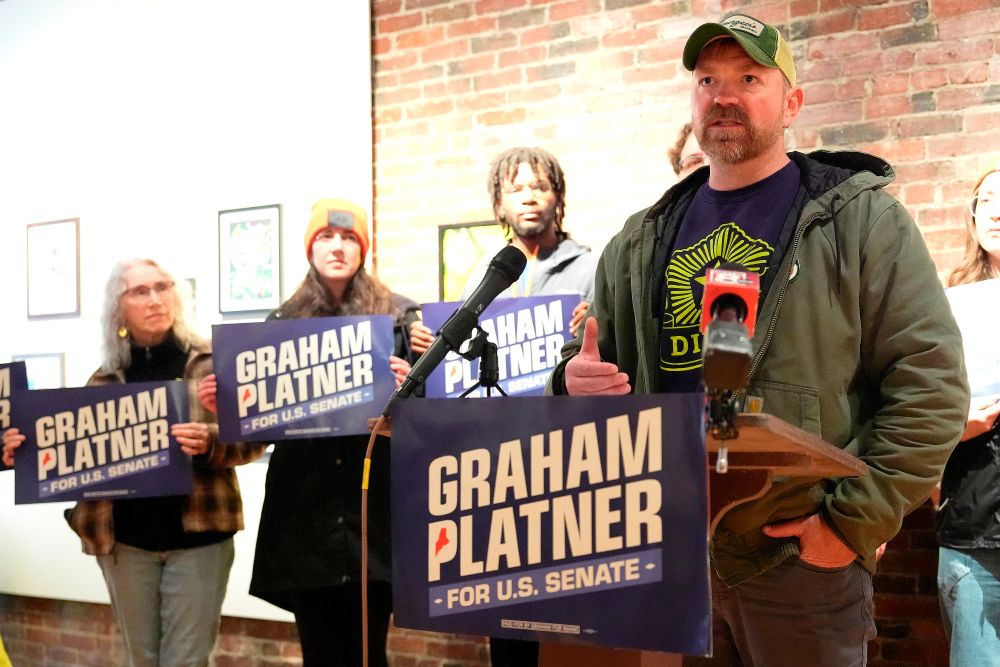
Graham Platner, Democratic candidate for U.S. Senate, speaks at a news conference April 30, 2026, in Lewiston, Maine. Maine Gov. Janet Mills announced dropped out of the Senate race the same day. Platner, the presumptive nominee, faces incumbent Republican U.S. senator Susan Collins, who is running for re-election to a sixth term and is uncontested in the primary. (AP/Robert F. Bukaty)

Join the Conversation
Send your thoughts to Letters to the Editor. Learn more
As President Donald Trump's polling numbers continue to tank, more and more analysts are asking what the resurgent Democratic Party might look like. In Maine, Gov. Janet Mills dropped out of the Senate primary because she was trailing oyster farmer Graham Platner by a huge margin. In Michigan, Abdul El-Sayed is in a three-way contest for a Democratic Senate nomination despite campaigning with podcaster Hasan Piker, whose antisemitism is as stupid as it is vicious. Looming behind this year's primaries is the early shuffling for the 2028 presidential nomination.
The first thing the Democrats have to realize is that the mood of the nation is profoundly anti-establishment. That has been the key to Trump's domination of the political landscape, just as it has accounted for the fact that dissatisfaction with Britain's Labour Party resulted not in a victory for the Tories in recent local elections but for Reform UK, led by England's version of Trump, Nigel Farage. The democracies of the West face an increasingly skeptical electorate, willing to consider outrageous, and often ugly, alternatives if that is the only way they can register their intense displeasure and desire for serious change.
At The Washington Post, Riley Beggin reported on how Democratic candidates for the House of Representatives are positioning themselves in order to woo working-class voters back to the party of Franklin Roosevelt. Some more progressive candidates are promising policies many working-class voters applaud such as capping childcare costs and offering $20,000 to first-time home buyers to help with a down payment. The problem? How do you get major programs passed when Congress is evenly divided and the national debt is at $39 trillion and counting?
More moderate Democrats are leaning into policies that might pass Congress but which might not make a real difference in enough people's lives to stave off the populist anger. Beggin said the moderates are "promoting competition, growing the economy and reducing regulatory barriers," none of which seems adequate to the mood of disgust. The moderates seem not to grasp that such amorphous goals do not connect with voters facing very real economic challenges. Voters don't want "regulatory reform"; they want to be able to afford gas for their car. The moderates also forget that it was President Barack Obama's failure to confront the titans of Wall Street after the 2008 meltdown that provided the Republicans an opportunity to make inroads with working-class voters.
So, Round 1 to the progressives for outlining specific things they want to change that would make life more affordable for working-class voters. But they need to find a way to convince a majority of voters to support it. How?
First, they need to wrap their populist economic proposals into a single theme. FDR had the "New Deal" and Lyndon B. Johnson proposed the "Great Society." What is it that unites their proposals? All entail a renegotiation of the social contract. During the Industrial Revolution, the exploitation of workers, including child workers, was so great, the government had to step in and set boundaries to the abuse. In the midst of the Great Depression, the New Deal saved the free market economy from itself. Today, in the face of a different socioeconomic revolution, we need a new social contract.
Women now have the right to work outside the home. In many families, both parents need to work to pay the bills. But what has the government done to make that possible? When I was born, my mom went back to school as a teacher seven months later, and my Aunt Albina two doors down came up to care for me. If Albina was sick, my grandmother stepped in. She lived across the street. Very few extended families still live within walking distance of one another, so provision must be made for childcare and, seeing as the moneyed interest is not going to take up the responsibility, the government should step in and propose a new social contract that provides childcare for families with children.
Advertisement
In the postwar era, marginal tax rates reached 90% on the highest incomes. There were not a lot of billionaires back then, so the government did not actually collect that much money at the higher end of the marginal rates. The purpose of the higher marginal rates was twofold: to prevent a return of the robber baron economy with its gross income inequality and to attach the money of the wealthiest to the social needs of the country. One of those needs is limiting the power wealth confers. Today, the titans of tech make the robber barons of old look like pikers. It is time to renegotiate the social contract between them and the rest of us.
A new social contract is a convenient, easy to understand theme that unites most of the progressive economic proposals, but there is one other aspect to these proposals that also resonates with working-class voters. The tech titans and Wall Street financiers have acquired enormous power over our political life. The pro-crypto lobby is spending millions on key Senate races, and in the 2024 election cycle, pro-crypto PACs outpaced the Koch brothers, accounting for a staggering 44% of all corporate campaign funding according to Public Citizen.
Ben McKenzie, in his new documentary "Everyone is Lying to You for Money," explains that crypto epitomizes the corruption of our unregulated market economy: a fake currency that is useful for gambling and crime. Fighting crypto should become a key part of a larger anti-corruption movement that, like a new social contact, unites the different progressive economic policies the Democrats want.
A new social contract and fighting corruption. That is a winning formula not just for the midterms but for creating a long-term governing majority.
You are reading a selection from Michael Sean Winters' weekly newsletter. To get the full edition — including the "In the News" link roundup — delivered 24 hours before it appears online, sign up here!