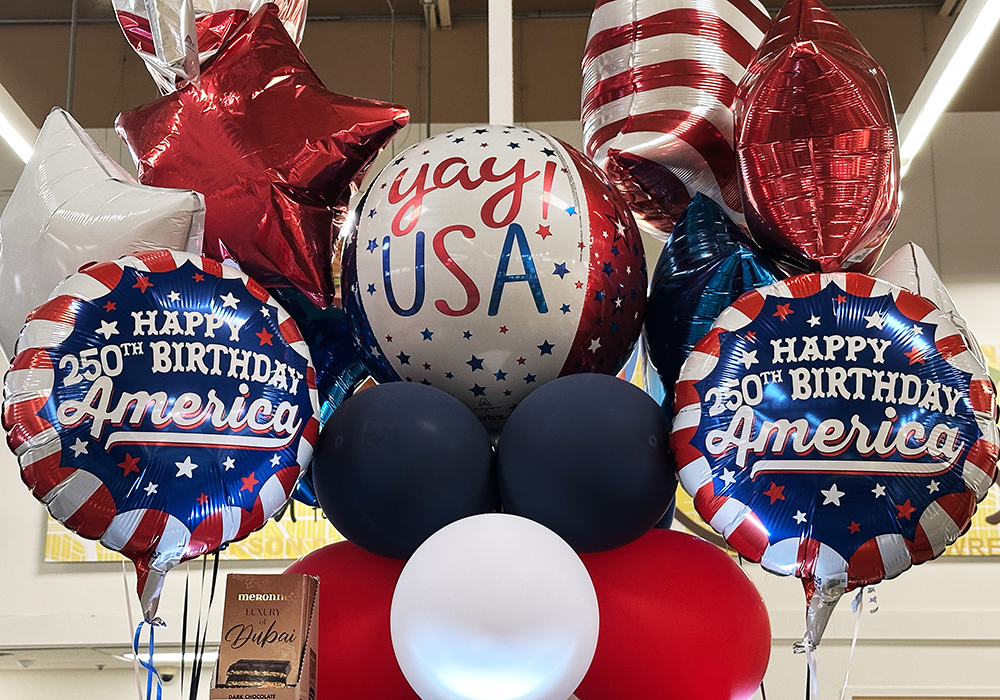
Independence Day balloons are displayed at a grocery store in Chicago, June 25, 2026. (AP photo/Nam Y. Huh)

Join the Conversation
Send your thoughts to Letters to the Editor. Learn more
On April 29, 1962, President John F. Kennedy hosted that year's Nobel laureates at a White House dinner. Kennedy famously told the illustrious audience, "I think this is the most extraordinary collection of talent, of human knowledge, that has ever been gathered together at the White House, with the possible exception of when Thomas Jefferson dined alone."
Jefferson was only one of several extraordinary men who gathered in Philadelphia in the summer of 1776 and who voted to declare American independence. John Adams, Benjamin Franklin, Samuel Huntington, Benjamin Rush, Samuel Adams, Robert Morris, John Hancock — all would be found in our history books even if they had not signed the famous document. How fortunate we Americans were to have such a stunning collection of political minds present to bring the nation to birth.
Jefferson stands out because he wrote the first draft of the declaration. He gave us the words we all learned as children and which still serve as our national creed and challenge us to persevere in living them out: "We hold these truths to be self-evident, that all men are created equal, that they are endowed by their Creator with certain unalienable Rights, that among these are Life, Liberty and the pursuit of Happiness. That to secure these rights, Governments are instituted among Men, deriving their just powers from the consent of the governed."
Those words lit a fire which still inspires freedom-loving people around the world. In the 1980s, when I was in college, it was common to hear arguments that the capitalist West was as bad as the Communist East, that it was all about power, not principle. A whole body of scholarly revisionist history argued that it was the U.S. and its allies that started the Cold War. This view was especially prominent among those well-intentioned people involved with the "nuclear freeze" movement. Many of those who made these arguments were people with whom I agreed on a host of other political subjects.
There was one fact, however, a simple fact, which disproved all this moral equivalency as utter nonsense: No one ever died trying to cross the Berlin Wall into East Berlin. Never in my life has art met politics more poignantly than when the great Leonard Bernstein went to Berlin in 1989 after the wall fell to lead musicians from symphonies in Germany, the U.K., Russia, France and the U.S. in Beethoven's Ninth "Ode to Joy" Symphony.
In the last movement, the chorus did not sing "Freude" or "joy" as in the original score. They switched to "Freiheit" or "freedom." What did those who only a few years prior were arguing for moral equivalence make of the celebrations throughout Eastern Europe when communism fell?
Advertisement
The America the founders knew — mostly English, overwhelmingly Protestant — would be greatly changed within 100 years by waves of immigrants. The nation and especially its founding creed would be tested by a great and terrible Civil War. George Washington was speculating in land beyond the Appalachian Mountains by the time the declaration was signed, but he could not have conceived the great westward migration to the Pacific. The steam engine, the telegraph, railways, photography, the telephone, moving pictures, television, the internet, all these technological innovations transformed the country in complex ways. Through it all, the national creed our founders set forth has emerged, beaten and bruised, never fulfilled, always beckoning, always a dream worth pursuing.
We have since learned that Jefferson fathered illegitimate children with one of his slaves, John Adams was ornery and tempted by the thought of restoring aristocratic sensibilities, and Franklin was an uncaring husband and unforgiving father. Each of the marks of progress in our national story came with an often terrible cost: A revolution that did not extend freedom to the enslaved; the native peoples who had their land, and often their lives, stolen; the hundreds of thousands of casualties in our wars; laborers put out of work by each technological advance. In 1776, we declared ourselves free of allegiance to Great Britain. We did not leave behind the human race with its capacity for sin as well as greatness, generosity as well as moral blindness.
Next week, let us turn to the task of rescuing our Republic from its current endangered state. This will require more than defeating President Donald Trump and Trumpism. How do we break the cycle of throwing the bums out of office every four years, seeing as no important policy changes can be enacted and come to fruition in so short a time? How do we rise above the race to the bottom in gerrymandering? How do we end the chokehold of the superrich over our political system? How do we learn to listen to each other patiently and with an open mind in an age of internet memes that reward outrage and idiocy? All of these amount to greater threats to democracy than the meager tyrannies of King George III.
This week, however, let us celebrate Jefferson the visionary writer and Adams the persistent politician and Franklin the persuasive diplomat. Let us think of the good the Revolution accomplished, not its failure to accomplish more. And let us be grateful for the still remarkable inspiration throughout the world of the ideals set forth in that document officially adopted 250 years ago.
You are reading a selection from Michael Sean Winters' weekly newsletter. To get the full edition — including the "In the News" link roundup — delivered 24 hours before it appears online, sign up here!