A rainbow flag is seen near the spires of the Cologne Cathedral on July 9, 2023. (OSV News/Reuters/Jana Rodenbusch)
Pope Leo XIV's recent in-flight answer to a question about blessing same-sex couples exhibited a preference for not exacerbating divisions within the church over pushing the limits on polarizing issues.
His answer, however, did not occur in isolation, not on the plane and certainly not in the context of other pronouncements over the first year of his pontificate. In the broader view, it might be said that Leo is conducting an ongoing seminar on two significant themes: how change in the church occurs and that matters of morality include far more than a few issues involving sexuality.
On that latter point, Leo said: "First of all, I think it's very important that the unity or division of the church should not revolve around sexual matters. We tend to think that when the church is talking about morality that the only issue of morality is sexual. And in reality, I believe there are greater and more important issues such as justice, equality, freedom of men and women, freedom of religion that would all take priority before that particular issue."
Intentional or not, Leo's response poses a major challenge to a segment of U.S. Catholicism that uses sexual issues — opposition to abortion and to LGBTQ+ initiatives, to name two — as proof of Catholic bona fides. That leaves "justice, equality, freedom of men and women, freedom of religion," not to mention mass deportations, wars of choice, economic disparities and other issues of human need to be dealt with as matters of prudential judgment. In other words, one is free to consider those justice issues as a separate category not demanding the same urgency as matters of sex.
We have made the point before, but it is worth visiting again.
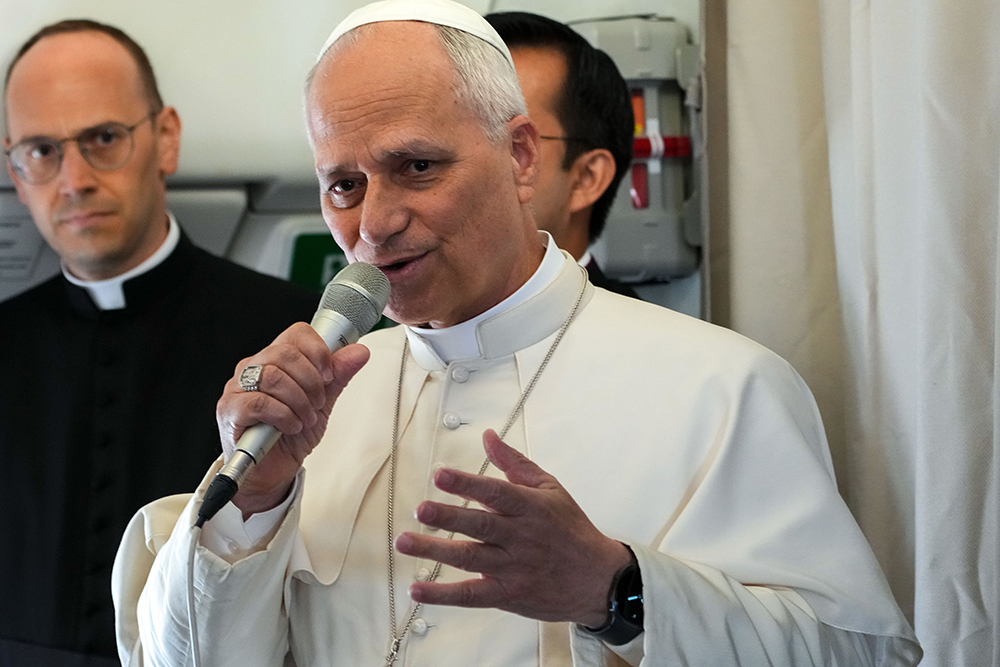
Pope Leo XIV answers questions from journalists during a news conference aboard the plane flying back to Rome after leaving Equatorial Guinea, April 23, 2026. (CNS/Lola Gomez)
While previous popes have raised issues of war, economic disparity and other justice issues often and in strongly critical language, Leo's comments carry a greater resonance and authority here because he speaks in heartland-accented English with firsthand knowledge of his home country's highest aspirations and deepest flaws.
His remarks land, too, with a sense of unusual urgency because current conditions in the United States — mass deportation, murders by masked agents of U.S. citizens, reckless invasions of sovereign countries, wars of choice and threats to annihilate a civilization — are breathtakingly extreme and constitute a threat to both domestic and global stability.
Being Christian and Catholic in the United States has taken on new meaning in this turbulent era. Leo has made it clear in his condemnations of war and the cruel treatment of vulnerable refugees and immigrants that such matters are not tangential to the work of the church. They pose essential responsibilities for all who call themselves followers of Christ.
Leo is challenging Catholics across the spectrum of liberal to conservative to take what might be a discomfiting step of engaging the fullness of the Gospel.
While he responded in the negative to a question about whether he would endorse formal blessings for same-sex couples, a possibility advanced by German bishops, he upheld the informal blessings approved by his predecessor, Pope Francis.
Small consolation, perhaps, to those who have been patiently waiting for the church to reflect on its current interpretation of Scripture, which says scant little about such issues, but also its understanding of human sciences, which have a great deal to say about our brothers and sisters whose sexuality, through no design of their own, does not conform to the majority. Galileo and his struggle to convince church officials of a heliocentric universe comes to mind. Our hope is that, in the current case, it doesn't take another 500 years to acknowledge the realities of the LGBTQ+ community.
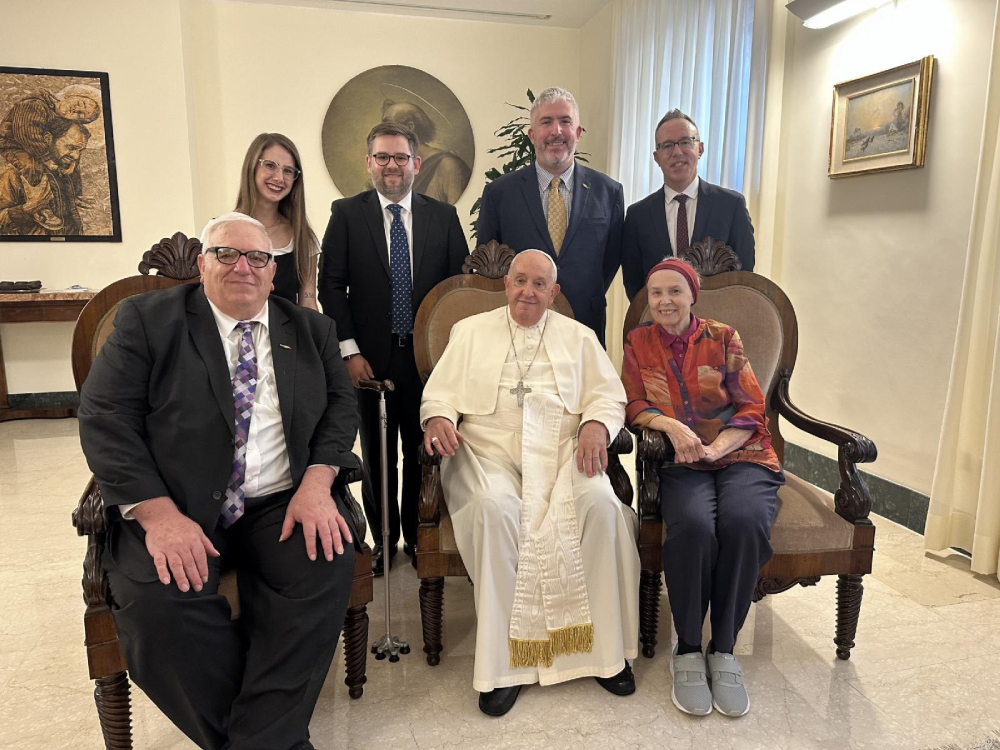
Pope Francis poses for a photo with a delegation from New Ways Ministry, including transgender and intersex Catholics, during a meeting at his residence at the Vatican Oct. 12, 2024. Pictured from left are Francis DeBernardo, Bernadette Donlon, Robert Shine, Matthew Myers, Brian Flanagan and Loretto Sister Jeannine Gramick.(CNS/New Ways Ministry)
A shorter wait may be in store.
The day before the report was published about Leo's comments on the plane returning from Africa, a column by Francis DeBernardo, executive director of New Ways Ministry, detailed a series of private gatherings that included bishops, LGBTQ+ Catholics, scientific experts and other scholars and theologians.
What had become clear in the ministry's decades of work advocating for LGBTQ+ Catholics, wrote DeBernardo, was that bishops had little knowledge of those members of the Catholic community.
"Almost every document about LGBTQ+ people issued from the Vatican, the U.S. Conference of Catholic Bishops, and a number of individual U.S. bishops reflects incomplete knowledge about the lives of sexual and gender minorities," DeBernardo wrote. "Absent is an awareness of developments in science about gender and sexuality. Also absent are related discussions from the theological community."
New Ways held three such gatherings in different parts of the country beginning in 2023. Bishops, 17 in all, heard the voices of LGBTQ+ Catholics, learned from the experts, from theologians, from pastoral workers.
Archbishop John Wester of Santa Fe, New Mexico, said, "The honest exchanges gave me a deeper insight into the issues facing LGBTQ members of the Catholic Church. The atmosphere was collegial and respectful, living up to the ideals of synodality."
Bishop Joseph Kopacz of Jackson, Mississippi, described one of the meetings as "an authentic expression of what the Spirit is saying to the church in the worldwide synod."
Leo is challenging Catholics across the spectrum of liberal to conservative to take what might be a discomfiting step of engaging the fullness of the Gospel.
We've come a long way from the not-so-long ago description of homosexuality as "objectively disordered," and homosexual acts as "intrinsically disordered" — phrases that, despite efforts by some Catholics to remove them from church teaching, stubbornly remain in the Catechism of the Catholic Church.
Who could have imagined then that a pope would answer a question about gay seminarians with "Who am I to judge?" Francis later gave his blessing to Jesuit Fr. James Martin's ongoing ministry to the LGBTQ+ community, as did Leo.
Perhaps most exemplary of the possibility of change was the cordial and encouraging personal visit Sr. Jeannine Gramick, founder of New Ways Ministry, had with Pope Francis. That moment signaled a sea change in attitude from the decades of harassment and punitive action she underwent at the hands of church officials.
It is not inconsequential in discussing change — whether speaking of American Catholics in general or church rules governing LGBTQ+ persons — to take note that in another interview discussing the possibility, Leo said it was necessary to "change attitudes before we ever change doctrine."
Advertisement
Recently on the plane, in explaining that he would not endorse the plan from German bishops about offering formalized blessings to same-sex couples, Leo referenced broader blessings and said that "to go beyond that today" could cause disunity. But tomorrow? Leo may be leaving that an open question.
Can U.S. Catholics change attitudes enough to confront the obscene obsession we have with militarism? Can we, as People of God, square up with the hideous toll of death and destruction we've been complicit in from Vietnam to Iraq to Afghanistan, through Central America, and now in Iran — to mention only some of the most obvious.
Can the example of a handful of bishops in the U.S., together with a softening of attitudes at the highest levels of the church, begin to confer full humanity to sexual and gender minorities?
The Catholic Church is not a static entity fully and perfectly formed. Time and again what was immutable bends and transforms. Leo may be showing us the way.