(Dreamstime/221308678)
In an interview early in his pontificate, Pope Leo XIV commented that it was "highly unlikely" that Catholic teaching about sexuality and marriage would change very soon. He also said that "we have to change attitudes" as a prelude to any future doctrinal change. That statement is accurate not only for doctrinal change, but also for change in pastoral practice.
Pastoral changes have been happening at varying rates among reform-minded Catholics in the U.S. and around the world. Turn on the television, read a newspaper, listen to a podcast, visit a local school, go to a political debate — in every aspect of modern cultural and civic life, LGBTQ+ issues are being widely discussed and better understood. Except for some Catholic church leaders who have roundly condemned LGBTQ+ issues, the majority seem to ignore the topic, brush it aside or give it the smallest amount of lip service.
Almost every document about LGBTQ+ people issued from the Vatican, the U.S. Conference of Catholic Bishops, and a number of individual U.S. bishops reflects incomplete knowledge about the lives of sexual and gender minorities. Absent is an awareness of developments in science about gender and sexuality. Also absent are related discussions from the theological community. It is painfully obvious that most official statements and documents were produced without conversing with LGBTQ+ people — an easily completed preliminary step.
In more than 30 years as executive director of New Ways Ministry, a national Catholic ministry of justice, dialogue and reconciliation for LGBTQ+ people and the wider church, I've witnessed repeatedly the impact of poor information and lack of understanding on the church's handling of LGBTQ+ issues. To address the need for knowledge about LGBTQ+ people, to promote good pastoral care by our bishops, and to walk forward in synodality, New Ways has been sponsoring a series of two-day meetings, in which bishops interact with theologians, scientific professionals, other scholars, pastoral ministers and, most importantly, LGBTQ+ people themselves.
Advertisement
Since 2023, New Ways Ministry has hosted three such gatherings at Georgetown University, St. Louis University, and the Siena Retreat Center in Racine, Wisconsin. Seventeen bishops attended these programs, many attending more than one conference.
These meetings were private to allow for honest and frank dialogue. They produced rich conversations, education and exposure to LGBTQ+ topics for bishops who are disposed to creating a more welcoming church. Even bishops who already had good information on LGBTQ+ issues said they saw the need for such programs.
As Archbishop Jeffrey Grob of Milwaukee reflected after one meeting, "Dialogue and listening are constitutive to learning and understanding. Once they cease, so does the hope for growth and movement."
The seminars were held under the Chatham House Rule, which allows the sharing of information and topics from the meeting; however, names of the attendees are confidential, unless a participant gives explicit permission to share their participation or comments.
What happened at these meetings? Lots of talk in all sorts of configurations. Short presentations by panelists, interaction at small group tables, and dialogue with panelists were the three main forms of discourse, but conversations over meals and coffee breaks often provided some of the most powerful encounters.
The meetings covered a variety of topics: pastoral ministry, moral theology, health care, psychological understandings of gender, employment issues, school policies, and, perhaps most importantly, the positive and negative encounters that lesbian, gay, transgender, nonbinary and intersex people have had with the institutional church.
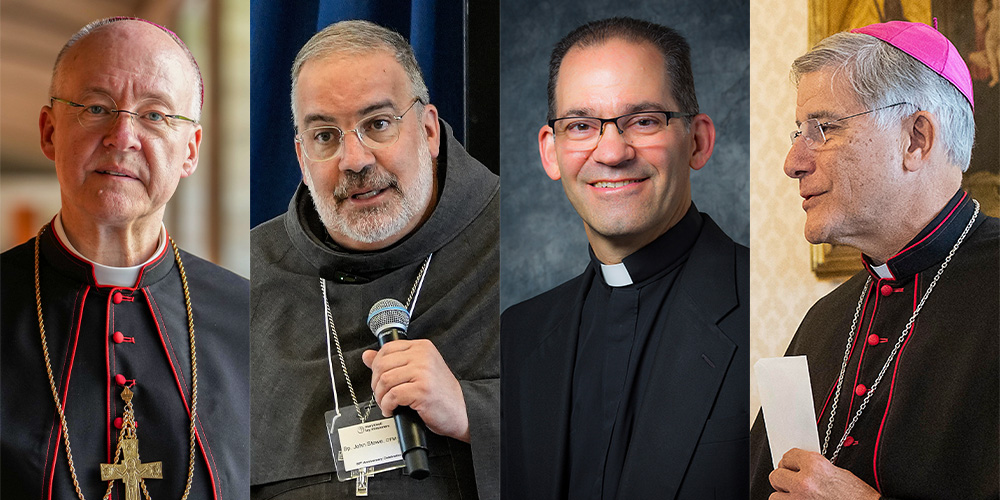
From left: Archbishop Jeffrey Grob of Milwaukee (CNS/Lola Gomez); Bishop John Stowe of Lexington, Ky. (OSV News/Gregory A. Shemitz); Auxiliary Bishop Michael Saporito of Newark, N.J. (CNS/Courtesy of Newark Archdiocese); Bishop Joseph Kopacz of Jackson, Miss. (CNS/Vatican Media)
Bishops listened with deep attention to personal stories from gay priests and lesbian nuns who shared how it felt to serve the church while receiving negative messages about their very being. Bishop John Stowe of Lexington, Kentucky, highlighted how important personal testimony is for church leaders to hear: "It is one thing to consider an issue; it is quite another to encounter a person whose life is affected by that issue."
Theologians explained rationales for greater acceptance of LGBTQ+ people through the application of traditional Catholic concepts. Cristina Traina, the Avery Cardinal Dulles, SJ Chair in Catholic Theology at Fordham University, said at one meeting that even someone as revered as St. Thomas Aquinas broke forth with ideas considered revolutionary in his time, simply by bringing together Catholic principles and what was then the newest secular knowledge.
The bishops heard from Dr. Cynthia Herrick, a practicing endocrinologist and former co-director at an academic adult transgender center. She spoke about the latest scientific understandings of gender development. Gender identity is not based on a new theory or ideology, she said, and it is not a contagion. How we understand our gender is determined by specialized areas within the brain.
They also heard about what pastoral ministers are doing in schools, parishes, and dioceses. Yunuen Trujillo, a Catholic LGBTQ+ woman, lay minister and author, spoke about the challenges of doing LGBTQ+ ministry in the Hispanic community. "The need is especially urgent" at this time, she said, "when many Latinos are being targeted for harassment and discrimination by their own government. The church must be a safe and welcoming space for all."
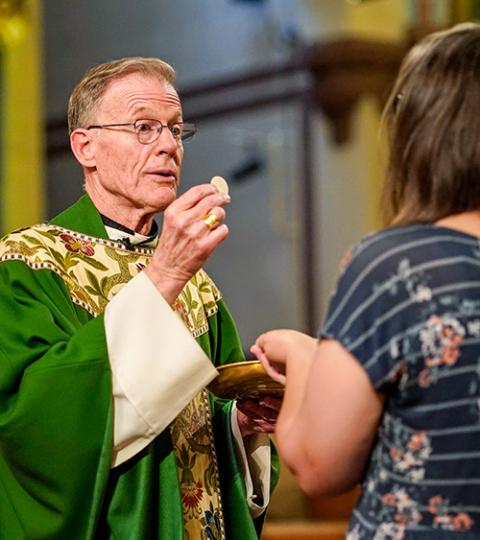
Archbishop John Wester of Santa Fe, N.M., distributes Communion during the closing Mass for the Outreach LGBTQ Catholic Ministry Conference at the Church of St. Paul the Apostle in New York City June 18, 2023. (OSV News/Gregory A. Shemitz)
What have all these meetings accomplished? Most importantly, they have broken the ice of chilly silence that, even after Pope Francis' warm approach, still stifles progress on LGBTQ+ issues. These meetings are opening up the conversation.
At the conclusion of one meeting, one bishop was in tears when he expressed how little he had known about the realities of transgender people, and regretted how he may have unintentionally added to their pain. Auxiliary Bishop Michael Saporito of Newark, New Jersey, said, "I certainly felt enriched by the exchange of personal stories and information that was offered. I had many questions answered and still need time to learn more."
Maxwell Kuzma, a Catholic transgender man and writer who shared his personal journey at the meeting, offered another kind of accomplishment. "This was Catholicism at its best: rigorous intellectual discussion among experts, with plenty of genuine fraternal interest to go around," he said.
The bishops weren't the only beneficiaries. Kuzma pointed out that by "listening to the bishops' perspectives, I saw the pressures and challenges facing the American church outlined clearly and the urgent need for outspoken moral clarity in times such as these."
At the conclusion of the 2026 meeting, Archbishop John Wester of Santa Fe, New Mexico, was "very grateful to New Ways Ministry for facilitating this conference. The honest exchanges gave me a deeper insight into the issues facing LGBTQ members of the Catholic Church. The atmosphere was collegial and respectful, living up to the ideals of synodality."
Bishop Joseph Kopacz of Jackson, Mississippi, echoed these sentiments about synodality when he said, "Further such meetings are needed. It was an authentic expression of what the Spirit is saying to the church in the worldwide synod."
It is now more important than ever that the church learn new ways of accompanying and dialoguing with its LGBTQ+ members. As Leo said, progress depends on changing attitudes. My time spent with the bishops, experts and LGBTQ+ Catholics at these meetings has convinced me that genuine, bold encounter in a synodal spirit is the key to such change.