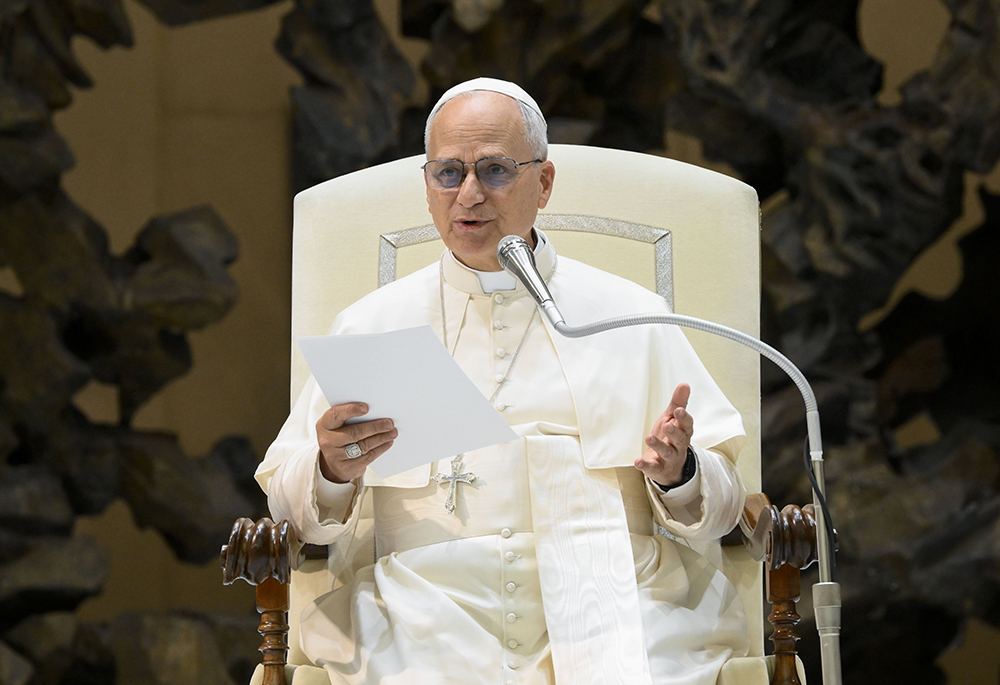
Pope Leo XIV speaks to religious leaders and people involved in interreligious dialogue during an event at the Vatican Oct. 28, 2025, marking the 60th anniversary of the Second Vatican Council declaration Nostra Aetate on the church's relations with other religions. (CNS/Vatican Media)
The growing list of destructive consequences of President Trump's foolish war on Iran include some that will never be considered in the Situation Room or during congressional debates. But the corrosive effect the war is having on relations between Christians and Jews could prove as consequential as any of the geopolitical results.
Engagement with Israel in an all-out war of choice against Iran, which posed no imminent threat to the United States, places those Christian voices who strongly criticize the war — this publication among them — under special scrutiny.
Is disagreement with the government of Israel policies necessarily antisemitic? If not, how does one separate the two, given that Judaism and its history are inextricably linked to the modern state?
In this era of growing antisemitism that feeds on ancient memes, online tropes and internet influencers whose fevered and hateful imaginations lie beyond accountability, the threads are not easily separated. Legitimate critique of Israeli geopolitics becomes fuel for baseless antisemitism.
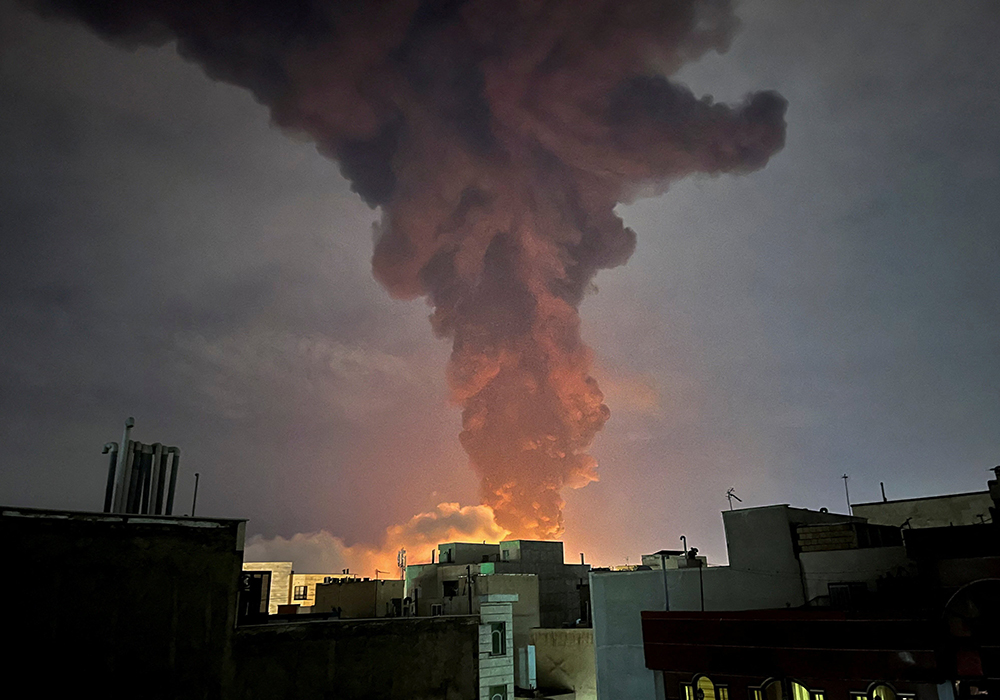
Smoke rises in Tehran, Iran, March 7, 2026, following an explosion amid the U.S.-Israeli conflict with Iran. (OSV News photo/Majid Asgaripour, West Asia News Agency via Reuters)
Guidance through that thicket of tensions is available thanks to the long work of civil authority, in the Catholic Church's singular document, Nostra Aetate, and in efforts by the Vatican and Jewish leaders elevating the roots of our shared faith.
On March 18, in anticipation of this year's Holy Week, Archbishop Alexander K. Sample of Portland, Oregon, recited portions of the text of Nostra Aetate to emphasize the church's close connection to and obligations toward Judaism.
"The Jewish community is attacked at a far higher rate than any other religious group in the United States," he said. "If we Catholics, in truly living out the Gospel, are to defend religious freedom with integrity, we must clearly speak out against antisemitism."
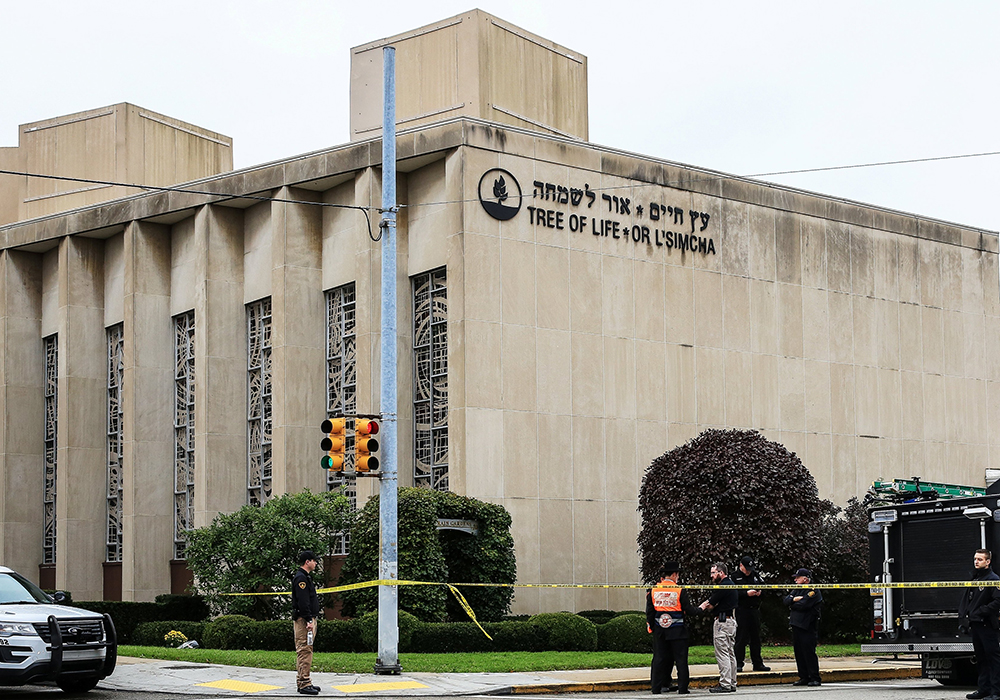
Police officers are seen after a gunman killed at least eleven people Oct. 27, 2018, at the Tree of Life Synagogue in Pittsburgh. (CNS/Reuters/John Altdorfer)
Sample grounded his statement in Nostra Aetate and its expansive embrace not only of Judaism but of all religions. The document, a product of the Second Vatican Council in the mid-1960s, is especially relevant today.
The document's wisdom is anchored in humanity's common pursuit of God and higher purpose. It said:
The Church therefore, exhorts her sons, that through dialogue and collaboration with the followers of other religions, carried out with prudence and love and in witness in the Christian faith and life, they recognize, preserve and promote the good things, spiritual and moral, as well as the socio-cultural values found among these men.
It also declared: "The Church reproves, as foreign to the mind of Christ, any discrimination against men or harassment of them because of their race, color, condition of life, or religion."
Advertisement
Nowhere in the document is it even hinted that such a wide embrace of others requires agreement with the activity of any nation-state. It does not require one to choose sides among competing Muslim factions or the ambitions of one or another Hindu sect. Nor does it ascribe God's favor to any nation-state, political movement or ideological preference.
In the secular sphere, the International Holocaust Remembrance Alliance, a 31-state committee of which the United States is a member, met with other interested parties in Bucharest in 2016 and adopted a non-legally binding definition of antisemitism that is used by the U.S. State Department.
"Antisemitism is a certain perception of Jews, which may be expressed as hatred toward Jews," the definition states. "Rhetorical and physical manifestations of antisemitism are directed toward Jewish or non-Jewish individuals and/or their property, toward Jewish community institutions and religious facilities."
The alliance provides examples of antisemitism, among them wishing the disappearance of the Jewish state. But the examples go beyond the political. "Antisemitism frequently charges Jews with conspiring to harm humanity, and it is often used to blame Jews for 'why things go wrong.' It is expressed in speech, writing, visual forms and action, and employs sinister stereotypes and negative character traits."

This screenshot of aerial footage from KMOV 4 News shows graffiti reading "Death to the IDF" and a burnt car on a street in Clayton, Missouri, Aug. 6, 2025. In a statement released Aug. 7, 2025, St. Louis Archbishop Mitchell T. Rozanski said, "Antisemitism and hatred have no place in our community," following an attack in front of an Israel Defense Forces soldier's home in Clayton. (OSV News screenshot/YouTube)
At the same time, the alliance made clear that "criticism of Israel similar to that leveled against any other country cannot be regarded as antisemitic."
No straight or wide path exists in sorting the way through Catholic-Jewish tensions when Israel's resort to violence raises objections in so many quarters, including the Vatican. The destruction of Gaza, Israel's response to the slaughter of some 1,200 people by Hamas on Oct. 7, 2023, was a relentless, disproportionate destruction of Palestinian territory that left 67,075 dead, many women and children among them, and more than 169,000 injured.
The current war in Iran, which raises difficult issues of resistance for U.S. Catholics, has quickly become a regional conflict that has clear global implications and seemingly is without any resolution in the near term. It was not difficult to oppose the war simply on the basis of the recent and very costly failures of U.S. wars in the Middle East. In this case, objections to the war came from Pope Leo XIV, who pleaded for a ceasefire and in one presentation posed a searing question to those responsible for war. "One might well ask: Do those Christians who bear grave responsibility in armed conflicts have the humility and courage to make a serious examination of conscience and to go to confession?"
The condemnation of the war also came from high-ranking U.S. hierarchy. Cardinal Robert McElroy, Archbishop of Washington, a highly regarded voice among the bishops, said in an interview that the decision to go to war was "not morally legitimate" because it failed to meet numerous requirements of traditional Catholic just war teaching. Another U.S. bishop, Cardinal Blase Cupich of Chicago, condemned White House propaganda that made light of the war's casualties.
So where do Catholics go from here?
What appears to be an impasse may also present an opportunity.
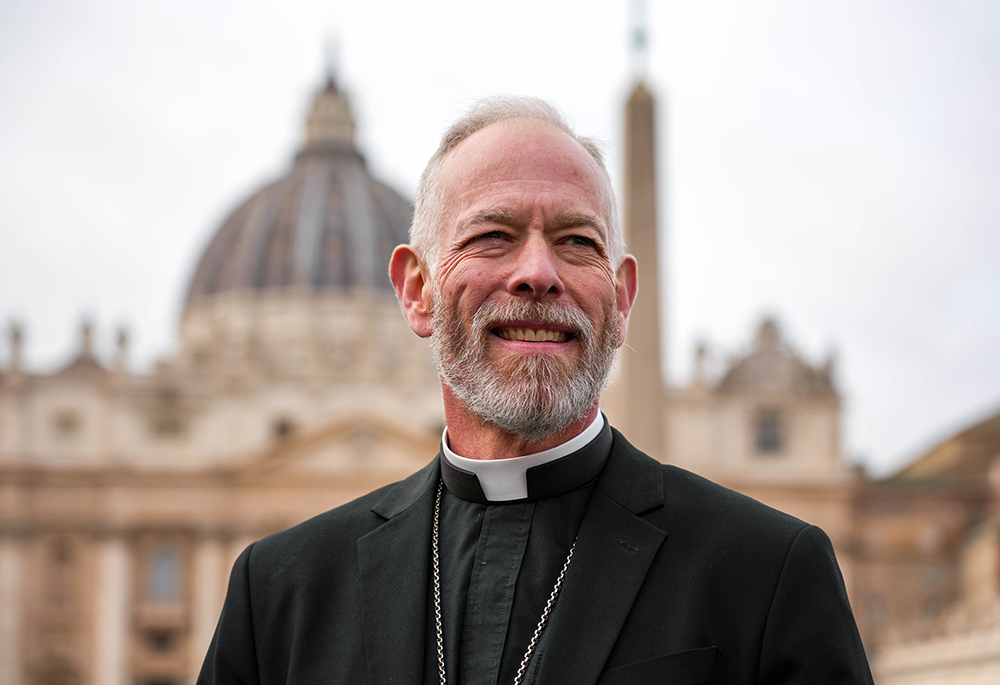
U.S. Archbishop Alexander K. Sample of Portland, Oregon, poses for a photo at the Vatican Feb. 11, 2026. (CNS/Lola Gomez)
Sample provided a good start. Go to the heart of our church's teachings on our relationship with Jews and other religions.
Perhaps as an extension of the Easter season, more bishops might teach about Nostra Aetate and parishes might develop programs around the teaching to combat the rise in antisemitism in the culture.
We, who still have the freedom to move beyond the comforts of our own religious tradition, should consider approaching others in solidarity. We might seek opportunities to meet with our Jewish, Muslim and other brothers and sisters in faith, not to discuss international politics but — perhaps following the example of St. Pope John Paul II in Assisi — to pray together. As Nostra Aetate states: "We cannot truly call on God, the Father of all, if we refuse to treat in a brotherly way any man, created as he is in the image of God."
Perhaps it is time, in the face of war and increasing displays of hatred at home, that we attempt to show the world examples of love, human to human, that overcome fear and division.