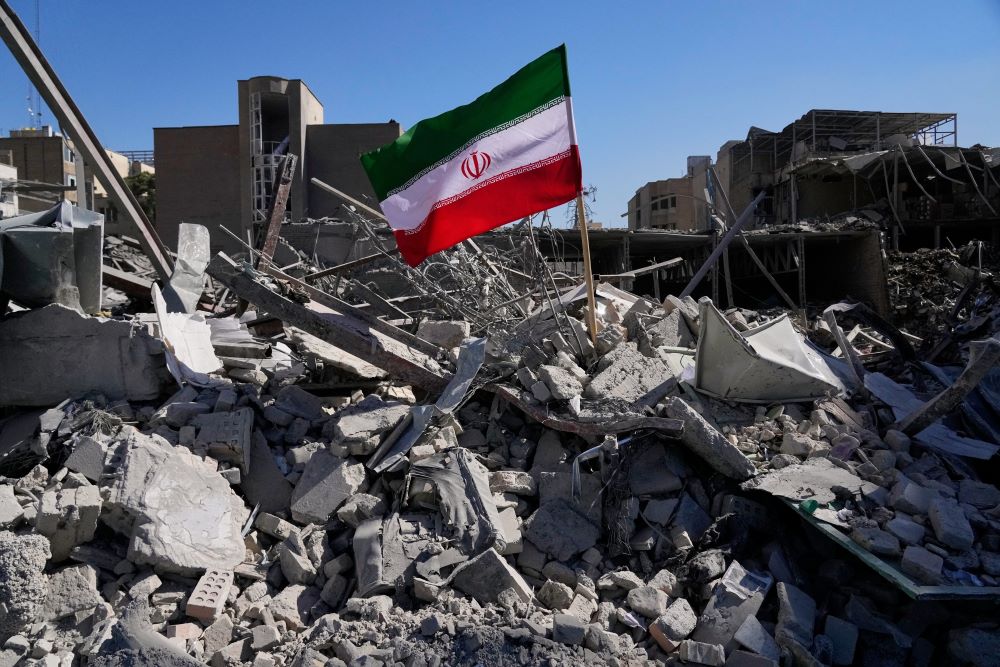
An Iranian flag is placed among the ruins of a police station struck March 2 during the U.S.-Israeli military campaign in Tehran, Iran, March 3. (AP/Vahid Salemi)
President Donald Trump, who when newly elected in 2016, said, "We will stop racing to topple foreign regimes that we know nothing about, that we shouldn't be involved with," has plunged into the dangerously unknown.
His war on Iran, undertaken without Congressional approval, without consultation with the United Nations, and lacking the support of allies, most of whom have been alienated, is a reckless venture. The massive assault began Feb. 28. Just days later, things are beginning to unravel in ways far beyond his control.
Once again U.S. troops are asked to sacrifice on behalf of a project that is, at best, questionable, and the world is once again on edge at the prospect of violence spreading out of control.
Already, three U.S. jets have been downed, six Americans have been killed and Iranian missile attacks have spread to U.S. bases in surrounding countries, including Lebanon. Iranian missiles have killed at least 11 and injured hundreds in Israel, and Israel is expanding its war in Lebanon. In Iran, nearly 800 people have been killed and hundreds injured.
In addition to the loss of human life, at least two U.S. embassies have been closed, oil prices are rising and markets are jittery.
Yesterday (March 2), Trump was predicting the fighting could extend five weeks or more, and additional U.S. troops were heading to the Middle East as the fighting spread.
We have gone to war on the bluster and wish of a president for whom reality and facts are transactions amenable to his needs of a given moment.
The developments heightened the significance of Pope Leo XIV's plea that all countries involved in the conflict "assume the moral responsibility of stopping the spiral of violence before it becomes an irreparable abyss."
What Trump appeared to understand in 2016, at least in terms of avoiding danger, remains true. The U.S. is good at blowing things up and upending regimes, but really awful at what follows.
The file on U.S. regime-change attempts, conducted by presidents of both parties, is thick with relevant warnings. Vietnam, Afghanistan, Iraq, Libya — to name just a few — do not inspire confidence or national pride. They are examples of embarrassing failures that cost incalculable amounts in human life and misery, in destruction of cultures, and trillions in national treasury.
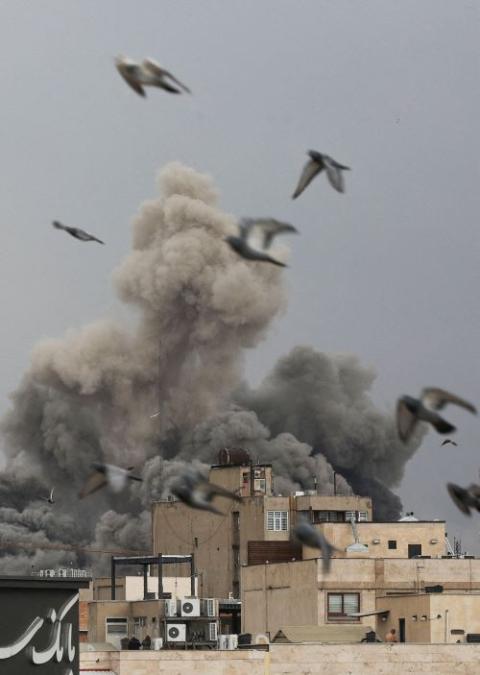
Birds fly as smoke rises following an explosion, after Israel and the U.S. launched strikes on Iran, amid the U.S.-Israel war with Iran, in Tehran, Iran, March 2. (OSV News/West Asia News Agency via Reuters/Majid Asgaripour)
It is no small irony that among the most relevant of those ventures today was the overthrow in 1953 of Iran's duly elected Prime Minister, Mohammad Mosaddegh, who was replaced with Mohammad Reza Pahlavi, shah of Iran. It was a coup engineered by the U.S. on behalf of British oil interests. That regime change seeded the Iranian revolution of 1979, the results of which we are now attempting to remedy with a violent regime change.
It is telling — as well as chilling — to realize that our campaigns against foreign rulers and disliked governments failed even when they were the work of thoughtful presidents who listened to military and international affairs experts, sought congressional approval, and were conducted with wide support of allies. They failed whether the goal was high-minded — to free an oppressed people — or, more commonly, to smooth the way for U.S. business interests or to gain access to another country's natural resources.
The reality of this moment is stark. We have gone to war on the bluster and wish of a president for whom reality and facts are transactions amenable to his needs of a given moment. The original rationale for military action against Iran, to defeat an imminent threat to the United States, was simply false.
The war is being led by a secretary of defense, Pete Hegseth, who is disturbingly enamored of military violence. He has demonstrated a cavalier approach to the use of force and has acted beyond the rules of civil and military law in killing scores of unidentified people on boats in Caribbean and Pacific waters that he asserts, without providing any evidence, were running drugs and were thus threats to the United States.
Our sole ally in the war on Iran is Israel, whose leader, Prime Minister Benjamin Netenyahu, stands to benefit far more than the U.S. from the destruction of Iranian leadership and the chaos that is certain to follow.
Netenyahu, who played Trump successfully eight months ago in convincing him to deliver bunker buster bombs to sites where Iran was developing nuclear weapons, has been convincing Trump of the need for further military intervention despite diplomatic talks that were underway.
The celebration in many quarters of the Middle East over the death of Iran's supreme leader, Ayatollah Ali Khamenei, is understandable. His rule was beyond brutal, a murderous regime that kept inhuman control of a people and destroyed the vibrancy of an ancient culture. His death, however, is, given other possibilities of the effects of war in the Middle East, of limited consolation.
No one knows what will follow, and Trump's demand of Iranians that they set up a new government was, at best, specious.
Advertisement
New York Times columnist Thomas Friedman has an expansive and incisive take on the war and the complexities inherent in one of the world's most volatile regions.
One point he makes, however, is especially pertinent to the domestic situations in the United States and Israel:
[W]e we must not let this war to bring democracy and the rule of law to Iran distract us from the threats to democracy and the rule of law posed by Trump in America and by Prime Minister Benjamin Netanyahu in Israel. Trump wants to promote those ideals in Tehran, even as his ICE agents operated for two months with limited regard for legal restraints in my home state of Minnesota and as he floats ideas about restricting who can vote in our next election. If the war in Iran enables Netanyahu to win the Israeli elections planned for this year, it will be a major propellant to his efforts to annex the West Bank, cripple the Israeli Supreme Court and make Israel an apartheid state, which would be a major blow to American interests in the region beyond Iran.
Perhaps it is not coincidental that Trump's change of heart from critic of intervention to international warrior occurred against the backdrop of tanking poll numbers, the threat of Republican congressional defeat in November, an increasingly creaky economy in large part due to his tariff policy, and the persistent threat of yet-to-be-investigated connections to the Jeffrey Epstein scandal.
At home, Trump is able to read the public mood and reverse his course — removing ICE from Minneapolis and National Guard troops from other cities — or spin endless fiction as he did during the State of the Union. But all-out war is another matter altogether. He won't be able to simply end it and spin a more congenial tale if it begins to go wrong.
"Let diplomacy silence the weapons," Leo said following the U.S. strikes in Iran in June. "Let nations chart their future with works of peace, not with violence and bloody conflicts!"
In this moment, Pope Leo's plea for diplomacy and request that we pray for peace is not empty rhetoric. It is informed by costly disasters of the past.
History tells us this latest venture does not yield to a president's wishes.