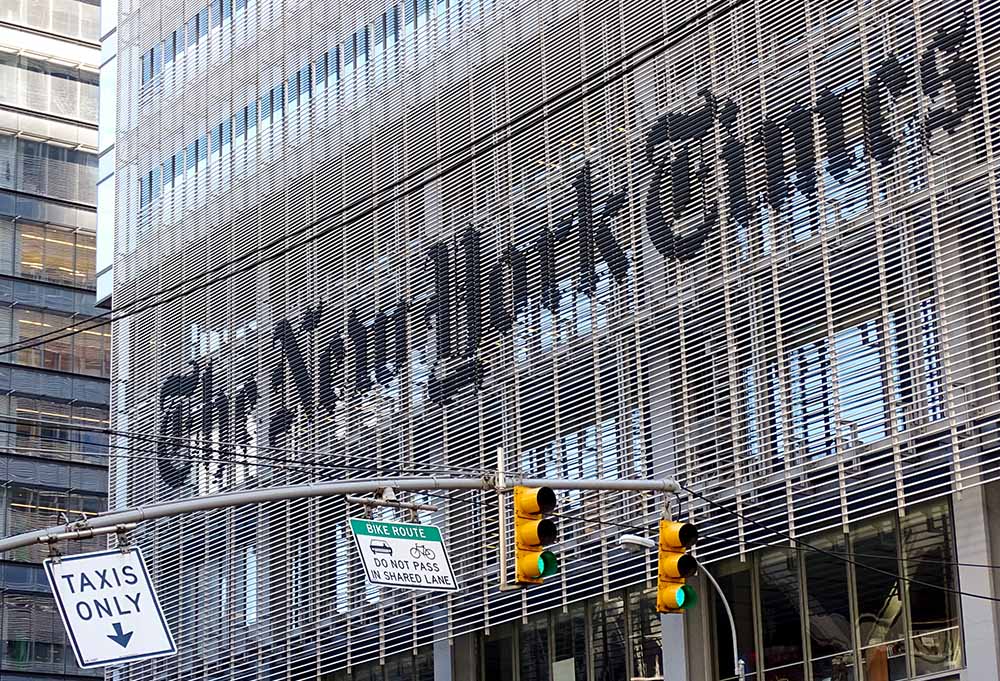
The New York Times Building in Manhattan, New York City (Wikimedia Commons/Adam Jones)
It is becoming clear that one of the primary civic responsibilities of the Trump era is to determine, amid the tsunami of threats to democracy, what to ignore for the moment and where to take a stand against the destructive forces.
Among the latter are the recent threats to The New York Times, carried out in hand-delivered subpoenas to reporters and a bizarre all-night "investigative" session in the White House led by FBI Director Kash Patel.
The Times has lots of enemies, and that's not surprising, given its prominence, resources and significance in the development of U.S. journalism The Times isn't perfect, but it is arguably the most important symbol and practitioner of a foundational right that applies not just in the arena of civil government but in every area of human conduct.
Catholics in the United States have a special responsibility to support press freedoms and, luckily, we have a great thinker who made the case many decades ago.
"The freedom of the press to inform is nothing really but the other side of the rights of the people to be informed," Jesuit theologian John Courtney Murray said in a 1963 speech to the Catholic press. "I think within the Church, as within civil society, the need of the people to know is in principle unlimited."
We have a right to know. And that requires a press with the freedom to report.
We have often referred to that speech by Murray because it was appropriated by NCR's founders as a statement of purpose for this publication. In establishing the significance of the First Amendment, he also expanded the importance of the people's right to know, viewing it as a fundamental right of humans gathered not only in political bodies but also in other settings, including churches.
Advertisement
The Trump administration's attack on the Times for reporting on the security deficiencies in the president's newest vanity project, a luxurious Qatari-donated Air Force One, is but the latest in a steady campaign against news organizations. The Times, in this case, is different. It isn't willing, as were ABC and CBS, to pay the equivalent of a bribe. Unlike Washington Post owner Jeff Bezos, the Times' owners seem unwilling to grovel before the throne.
This is neither a partisan matter nor just another in the endless string of Donald Trump's self-indulgent tantrums. Leaders of either party would be only too glad to employ national security concerns, endlessly construed to apply to almost any government activity, to stifle robust coverage of those conducting the affairs of state.
The Murray talk, long and complex, should be required reading for U.S. Catholics in this era when journalism done in compliance with the most rigorous demands of the craft — not the latest online influencer or purveyor of conspiracy theories — is in such jeopardy.
For the moment, a core tenet of the presentation suffices. Said Murray: "The freedom of the press knows only one limitation, and that is the people's right to know."
What to do?
Begin with two of the simplest activities. Look up your members of Congress and call them. Tell them you are deeply opposed to the administration's assault on freedom of the press. Do the same with the White House. The number is 202-456-1111. You can leave a message or wait to talk to a human.
We have a right to know. Regarding that right, there is no reasonable compromise.