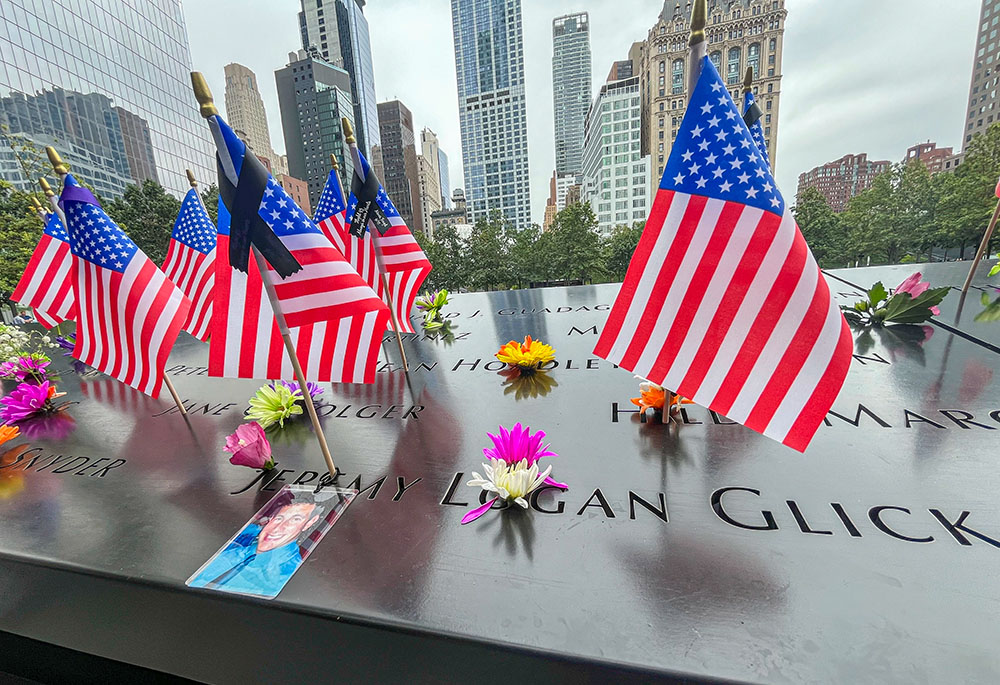
Flags and flowers are placed in the inscribed names at the National September 11 Memorial in New York on Sept. 10, 2025. (AP/Donald King)
The 9/11 attacks delivered a one-two punch to our nation. The horrific deaths of nearly 3,000 people on U.S. soil were closely followed by U.S. government-led acts of retaliatory revenge, plunging our nation into a war on terror that continues.
But in that gap — right after the four hijacked planes hit the twin towers of the World Trade Center, the Pentagon and crashed in a remote field in Shanksville, Pennsylvania, but just before many took up the rallying cries of "Never again!" — there was a period of silence: a shocked calm, not unlike the eye of a hurricane, taking in what just happened before the next wave took hold.
As a nation, we were not just taking a moment of silence; this was days of relative quiet as Americans held their collective breath and grieved. For at least two days, there were no civilian or commercial flights and major news networks dropped regular programing and commercials to unpack what had just happened. We felt unified, sharing this tragedy by gathering in places or worship or parks, and volunteering or cheering on first responders.
For the rest of September and into October, religious fervor soared. People flocked to churches in large numbers, seeking answers, comfort or maybe a spiritual perspective and connection amid the chaos and the new place of shaken security.
But in the days, and now decades, that followed, we picked ourselves back up. Days after the attacks, air travel resumed, but far differently and it has remained that way. TV shows and commercials were back on within the week, and within a few months, the short-term spike of church attendance returned to previous levels.
In many ways, the country was changed by that day, even as it also moved on from it. An entire generation of young adults knows about 9/11 only through history books rather than personal memory, and this upcoming anniversary has morphed into another culture war battle. But each year, the names of those who died are read aloud at memorial services and we pause and reflect.
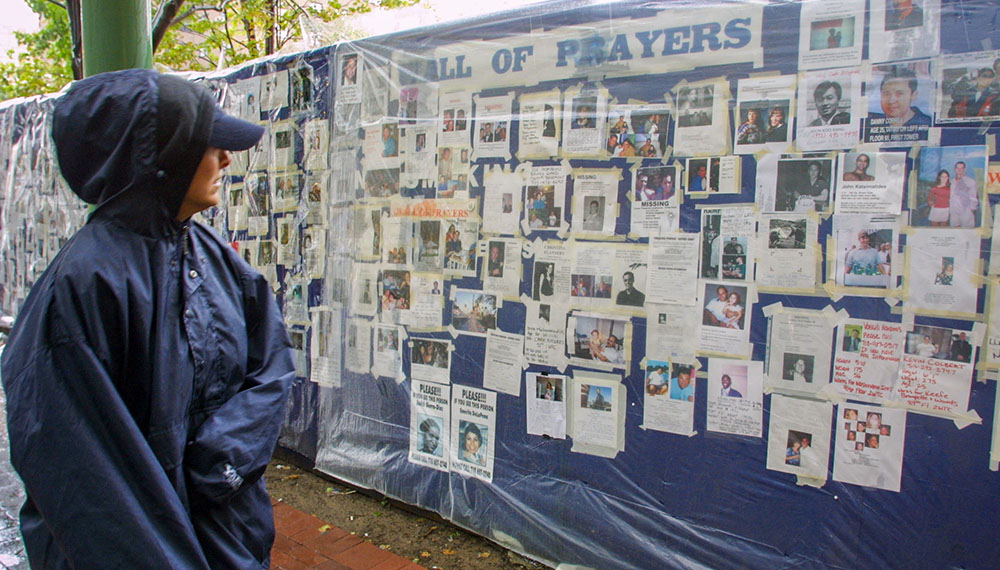
A woman looks at missing person posters of victims of the Sept. 11 terrorist attacks on the World Trade Center in New York City on Sept. 14, 2001. (AP/Robert Spencer)
Still, 25 years later, we are left wondering what we, as people of faith, are to make of what happened and are called to grapple with its aftermath.
For starters, we do what everyone does on big anniversaries: We remember. For those who were alive, which is now less than two-thirds of the U.S. population, we remember what happened and solemnly recall those who died on the hijacked planes, or were at work in Washington and New York on that Tuesday pre-fall morning. We remember the resilience of first responders, the firefighters who rushed into the burning buildings in lower Manhattan. We can see in our minds' eyes the images of thousands fleeing New York City by walking across major bridges or getting on ferries. We can picture the hundreds upon hundreds of homemade missing person fliers posted around hospitals and near ground zero that became the very first makeshift memorials of that day. We also now remember the thousands of first responders who died from the fumes of toxic dust around ground zero.
We all have different and likely very specific memories of 9/11, akin to the previous generations' remembering where they were when Pearl Harbor was attacked or when President John F. Kennedy was shot. Even among our staff here at NCR, the memories vary from those who were kids and didn't understand what was going on to those who had to explain what had happened to their children and also report on it.
One staff writer was in New York City for college at the time, living in an apartment in Brooklyn. His cousin, just one day shy of her 25th birthday, was working with a consulting agency at an office on the 96th floor of the World Trade Center and was among those who died that day.
Advertisement
Another, who had just graduated from high school four months before Sept. 11, said several classmates had joined the military after high school. After the attacks, they were sent to Iraq to fight the war on terror and a few of them never came home.
For us all, the memory of what happened that day also blurs into what happened in the post-9/11 frenzy including the uptick in anti-Muslim hate crimes; the passage of the Patriot Act allowing increased government surveillance and access to records; the opening of a prison at the Navy base in Guantánamo Bay, Cuba, for suspected terrorists; and the start of the Department of Homeland Security and the Transportation Security Administration or TSA.
On Sept. 20, 2001, President George W. Bush addressed Congress and the nation, announcing, "Our war on terror begins with al Qaeda, but it does not end there. It will not end until every terrorist group of global reach has been found, stopped and defeated." A few weeks later, the U.S. began its war against Afghanistan with airstrikes on the region. And about a year and half later, we invaded Iraq. The Iraq War lasted nine years and killed 4,492 U.S. service members and more than 200,000 Iraqi citizens.
That's a lot to remember and make sense of, but our Catholic faith places special emphasis on remembering. The focal point of our liturgy is the words of Christ: "Do this in memory of me." And a core Jesuit spiritual principle, contemplation in action, refers to how our thoughts and prayers should guide what we do and how we move forward in our world.
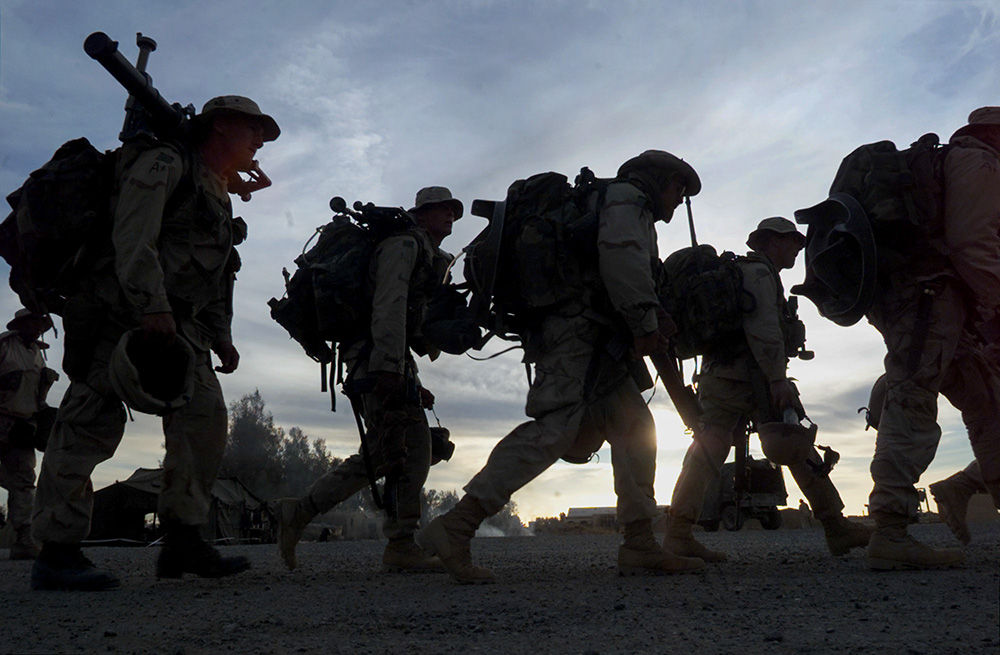
American Marines with full battle gear prepare to board transport helicopters at the U.S. military compound at Kandahar airport for a mission to an undisclosed location in Afghanistan Dec. 31, 2001. (AP/John Moore)
So for this milestone anniversary, some quiet contemplation in our ever-noisy world seems essential to continue processing the attacks and their aftermath, but also as a starting point to consider how we can advocate for peace in our world.
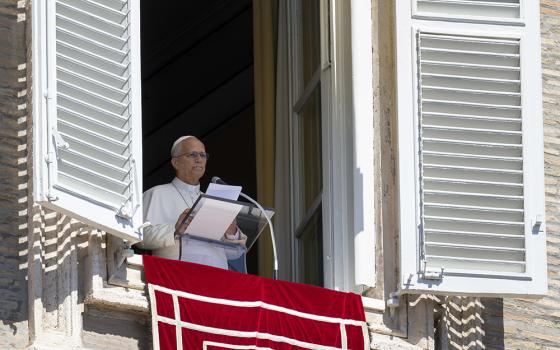
The anniversary falls during the year when the church celebrates a special Jubilee commemorating the 800th anniversary of the death of St. Francis of Assisi, described by Pope Leo XIV in his proclamation of the year as "a model of holiness of life and a constant witness of peace."
Leo has often highlighted the need for peace, speaking about it more than 400 times, in the first year of his papacy.
In a Jan. 10 letter to the ministers general of the Conference of the Franciscan Family, Leo said St. Francis' message of peace was needed now more than ever. "In this age, marked by so many seemingly interminable wars, by internal and social divisions that create mistrust and fear, he continues to speak. Not because he offers technical solutions, but because his life points to the authentic source of peace," the pope wrote.
We can also take our cues from Pope Francis' 2015 visit to ground zero. That visit, unlike any of his other U.S. stops, was essentially silent. The pope prayed with religious leaders inside the memorial's museum and silently prayed next to a candle by one of the memorial's reflecting pools. He then personally greeted family members while the gathered crowd could only hear the rushing water from the deep pools where the Twin Towers once stood.
The memorial at ground zero and the other two sites where people lost their lives that day do not bombard visitors with the devastation and tragedy of 9/11 as much as they invite contemplation with their empty spaces, water, benches and chimes.
For many of us, maybe we can't physically visit these memorials, but we can get to what they evoke by finding a quiet space this Sept. 11 to reflect on what has happened and think about how we can more powerfully commit ourselves to peace.