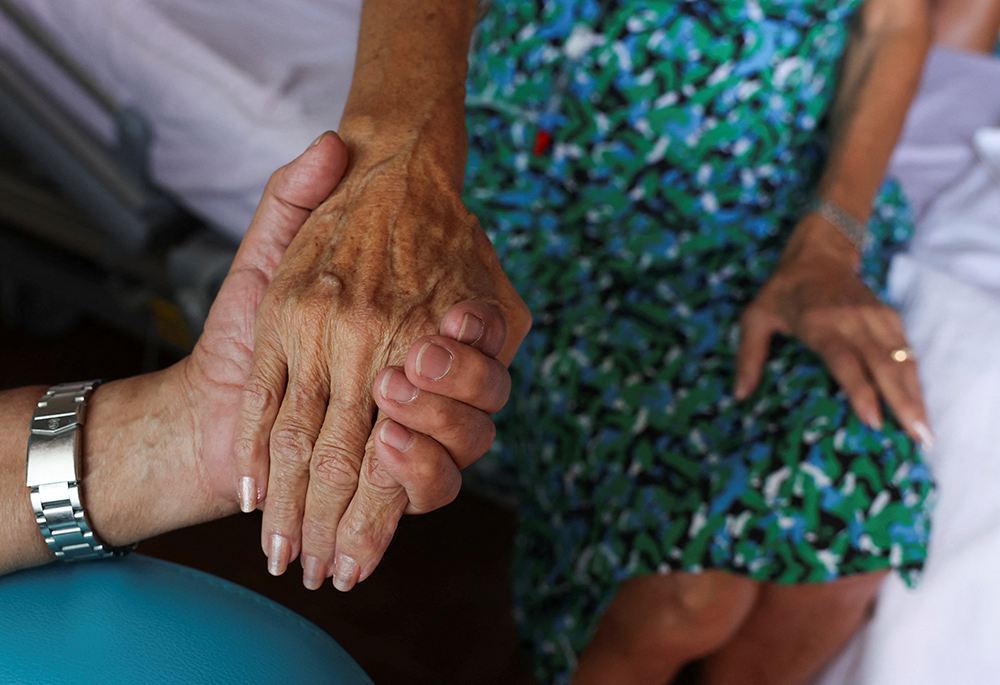
A nurse touches the hand of a patient at the palliative care unit of the Clinic St.-Elisabeth in Marseille, France, May 31, 2024. (OSV News/Reuters/Manon Cruz)

by Sr. Mary Haddad
Join the Conversation
Send your thoughts to Letters to the Editor. Learn more
In just the past few months, the movement to legalize physician-assisted suicide has gained alarming momentum across the country. New York Gov. Kathy Hochul signed the Medical Aid in Dying Act into law in February 2026. Illinois Gov. J.B. Pritzker signed similar legislation in December 2025. Additional states — including Massachusetts, Minnesota, Pennsylvania, and others — have considered similar proposals. More than a dozen U.S. jurisdictions have now legalized the practice. This rapid expansion is cause for deep concern and urgent action.
The advancement of assisted suicide across the country touches upon some of the most profound and important questions we face as a country and as a people. It asks us to consider what true love and compassion are when we face the fear and uncertainty of a terminal illness. But it also asks what our role is when we see our neighbor, friend or family member confront the fear and uncertainty of illness. Is it to walk away and let people fend for themselves, or are we, as Pope Leo states, "called to fix [our] gaze on those who suffer: on the pain of the lonely, on those who for various reasons are marginalized and considered 'outcasts' "?
For Catholic health care, the answer is not to walk away, but rather to walk alongside patients, families, and caregivers in the hardest moments of life. Catholic providers understand what it means to feel desperate for relief. But they also know, from that same long experience, that the answer to suffering is not to hasten death, but to provide better care.
When we look honestly at what drives requests for assisted suicide, the data tell an important story. In states where the practice is legal, the most commonly cited reasons are not uncontrolled pain — they include loss of autonomy, diminished ability to engage in activities that bring enjoyment, and a sense of being a burden on others. These are profoundly human concerns that deserve a compassionate response. They are not reasons to legalize the hastening of death – or conflate it as medicine. They are reasons to provide a better type of care for people at the end of life.
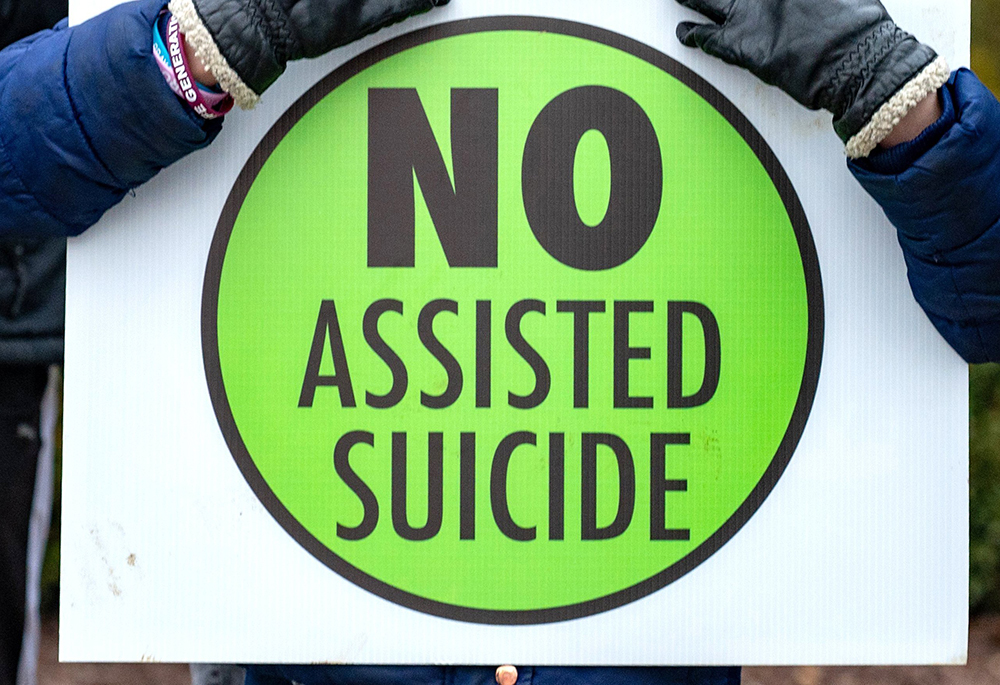
A person is pictured in a file photo holding a sign against physician-assisted suicide. (OSV News/Catholic Review/Kevin J. Parks)
Palliative care offers an alternative to assisted suicide. It is team-based, whole-person care — treating the physical, emotional, social and spiritual dimensions of serious illness simultaneously. It brings expert pain management to people who are suffering. It helps patients and loved ones figure out complicated decisions. It supports caregivers who are exhausted and afraid. It provides chaplaincy for those wrestling with questions of meaning and faith. And it can be delivered alongside curative treatment — from the moment of a serious diagnosis, not only at the very end of life.
Yet despite decades of evidence of its effectiveness, it remains one of the most underutilized resources in American health care. Research shows that nearly 60% of patients who would benefit from palliative care never receive it. A 2024 national scorecard found that no state has achieved the highest rating for palliative care capacity. Millions of Americans living with serious illness face the final chapter of their lives without adequate access to the symptom management, emotional support and spiritual accompaniment that palliative care can provide.
Catholic health ministries across the country have long championed this model of care and are among the nation's leaders in palliative and hospice services — not because it is required of us, but because it flows from our deepest convictions about the sacredness and dignity of human life and our obligation to accompany the sick and dying. We believe that every person, regardless of illness or disability, deserves to be seen, heard and cared for — not pressured or abandoned.
We believe that every person, regardless of illness or disability, deserves to be seen, heard and cared for — not pressured or abandoned.
And pressure is a real risk. When assisted suicide becomes a legal option woven into the health care system, it subtly reshapes the choices available to vulnerable people. Studies from states where it is legal consistently show that fear of being a burden — on family members, on a health care system — is a leading driver of requests. A society that is serious about dignity and autonomy must ask itself: Are we offering a genuine choice, or merely showing the exit to those who feel they have no other way? The answer to that question depends entirely on whether we have invested in the alternative.
We have not invested nearly enough in palliative care. The United States faces a serious shortage of trained palliative care professionals. Access is uneven, with people in rural communities, communities of color and lower-income households far less likely to receive guideline-level care. Coverage policies remain fragmented. And public awareness is startlingly low — the majority of Americans have never heard the term "palliative care." These gaps are not inevitable. They are the result of policy choices, funding priorities, and a cultural reluctance to talk honestly about serious illness and death. We can change them.
Advertisement
Legalizing physician-assisted suicide does not solve the problem of inadequate end-of-life care. It avoids it. It draws doctors, nurses, and pharmacists into the act of ending life, breaking the covenant of care and trust that has defined medicine across centuries. And it risks normalizing the idea that some lives — lives marked by illness, dependency, or diminishing ability — are less worth living.
Cardinal Joseph Bernardin, in his 1995 pastoral letter "A Sign of Hope," wrote of a care that gives suffering people reasons to keep living — not by denying death, but by surrounding them with love and humane, competent attention. That is the vision that should guide us. Not laws that offer death as a solution to problems that better care could address, but a genuine commitment to ensuring that every person, at every stage of illness, has access to the care they need and the presence they deserve.
The measure of a just and compassionate society is how it treats those who are most vulnerable. As states across the country weigh these laws, we urge lawmakers, health care leaders, and voters to demand a better way. Reject assisted suicide. Give people a choice by expanding palliative care. Tell every person facing the end of life: You are not a burden. You are valued.