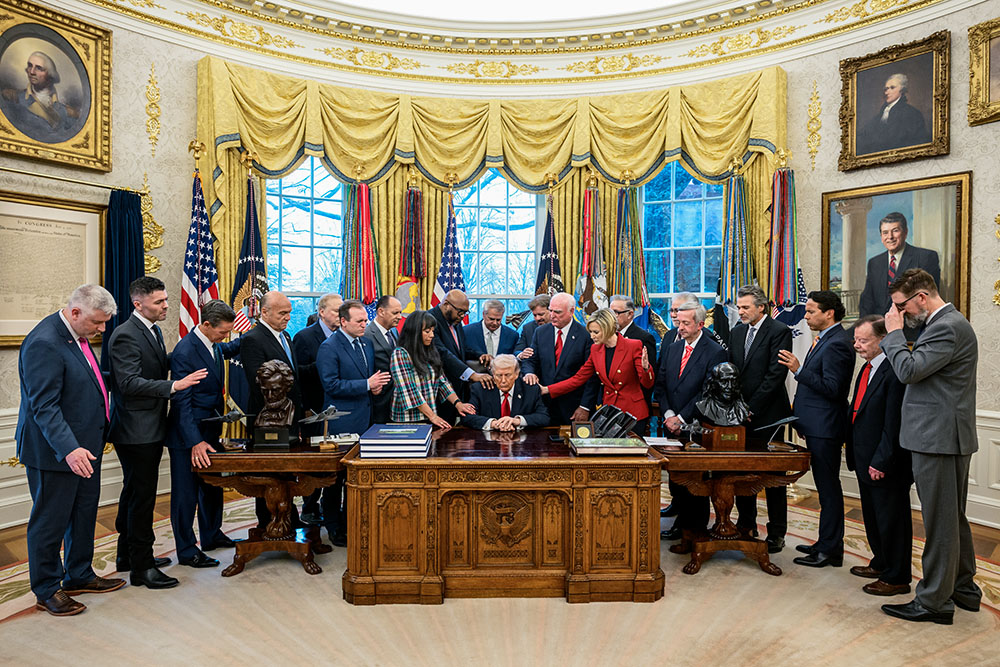
President Donald Trump meets with members of the White House Faith Office in the Oval Office in Washington, D.C., March 5, 2026. (Wikimedia Commons/Official White House Photo/Molly Riley)

by Enzo Del Brocco
Join the Conversation
Send your thoughts to Letters to the Editor. Learn more
Images of Christian leaders praying over the president in the Oval Office recently circulated widely online. For many believers, they raised an old question: What is the proper relationship between Christian faith and political power?
Prayer for political leaders is both legitimate and encouraged within the Christian tradition. The First Letter to Timothy urges believers to pray "for kings and all who are in high positions" (1 Timothy 2:2). In fact, this intention is regularly included in the prayer of the faithful during Sunday liturgies. The church prays for rulers so that they may govern with wisdom, justice, and a commitment to peace, not to suggest that God endorses particular political agendas.
Whenever prayer appears to sacralize political authority or imply divine endorsement of a particular political project, it raises serious concerns within Catholic theology, especially in light of the ecclesiological vision articulated by the 1962-65 Second Vatican Council. The danger arises when prayer, rather than speaking prophetically to power, comes to serve it.
This concern becomes particularly acute in contexts shaped by forms of Christian nationalism, where religious identity becomes intertwined with national identity, political ideology or geopolitical conflict. From the perspective of Catholic teaching after Vatican II, such a fusion risks distorting the Gospel itself.
In Gaudium et Spes, the council teaches that the church "is not identified in any way with the political community nor bound to any political system." Christianity cannot be reduced to a national identity, nor can the Gospel become the spiritual possession of a single nation.
The word catholic itself means universal. The church transcends cultures, borders and political orders. For this reason, Catholic theology remains wary of forms of Christian nationalism in which faith becomes a marker of political identity distinguishing insiders from outsiders.
Advertisement
The New Testament itself warns against precisely this temptation. The Gospels present Jesus repeatedly refusing political messianism. In the Temptation narrative, he rejects the offer of worldly dominion (Matthew 4:8-10). After the multiplication of the loaves, when the crowd seeks to make him king, he withdraws (John 6:15).
Later, when he is arrested, he refuses violence and reminds his disciples that his mission does not rely on earthly power: "Do you think that I cannot appeal to my Father, and he will at once send me more than 12 legions of angels?" (Matthew 26:53). Likewise, before Pilate he declares, "My kingdom is not of this world" (John 18:36).
The Christian revelation of God does not occur through domination or imperial authority but through the vulnerability of the cross. When religious language is used to sanctify political power, Christianity risks contradicting its own central symbol.
At the same time, Catholic tradition does not call Christians to withdraw from public life. On the contrary, the church has long affirmed that political engagement can be a genuine form of charity insofar as it seeks the common good of society. However, the biblical tradition also warns of a recurring temptation: the attempt to bend God's will to human ambitions. Instead of conforming political life to the will of God, communities may seek to enlist God in support of their own projects.
For this reason, while individual Christians may legitimately hold different political positions, the church itself cannot consecrate any political program as the embodiment of the Gospel. Its mission is not to endorse political power but to illuminate public life with the moral demands of the Gospel.
Christian prayer is meant to cultivate humility and discernment rather than serve as a tool for legitimizing power or bending God's authority to human purposes.
Another temptation appears when believers divide themselves into opposing political camps, each claiming to defend certain "values of God" against others. In such cases, faith risks becoming a marker of partisan identity rather than a call to conversion that challenges every political position. When moral concerns are selectively emphasized according to political allegiance, the coherence of the Gospel's vision of human dignity risks being lost.
Christian prayer begins from a different posture: not asking God to fulfill our plans, but asking that we might conform ourselves to God's will. The central prayer of Christianity, the Lord's Prayer, expresses this orientation clearly: "Your kingdom come, your will be done" (Matthew 6:10). The prayer of Jesus in Gethsemane deepens the same logic when he says, "Not my will, but yours be done" (Luke 22:42).
Jesus' own teaching about the kingdom makes clear that it cannot be identified with earthly political power. Before Pilate he declares, "My kingdom is not of this world" (John 18:36). Likewise, after the Resurrection, when the apostles ask, "Lord, is this the time when you will restore the kingdom to Israel?", he answers, "It is not for you to know the times or seasons that the Father has set by his own authority" (Acts 1:6-7). The kingdom of God does not arrive through political triumph or historical calculation.
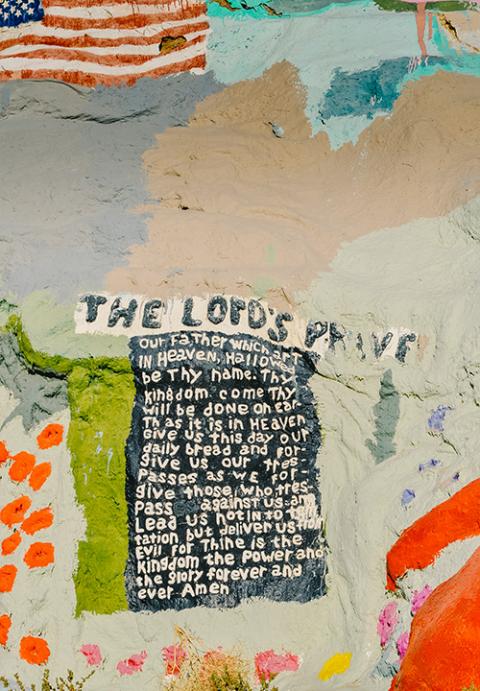
"Your kingdom come, your will be done": The Lord's Prayer is seen painted on Salvation Mountain in California. (Dreamstime/Kelsietaylor)
Christian prayer is meant to cultivate humility and discernment rather than serve as a tool for legitimizing power or bending God's authority to human purposes. The temptation to enlist faith in the service of political power is not new. From the early centuries of the Christian empire onward, believers have wrestled with the risk of using power to secure the faith — or using faith to secure power. Again and again, Christianity has had to confront the danger that the Gospel might be overshadowed or even suffocated by political ambition.
Christian prayer therefore begins not by asking God to endorse our plans, but by asking that our own desires be transformed in light of God's will.
Another troubling dimension of contemporary political religion is the use of apocalyptic language to interpret geopolitical conflicts. In some Christian circles, tensions in the Middle East are read through the lens of the "Armageddon," as if wars were part of a divine script leading to the end of history.
Catholic theology rejects such interpretations. The Book of Revelation is not a geopolitical road map but a symbolic and theological vision whose purpose is to reveal God's ultimate victory over evil, not to predict military conflicts between modern states. Interpreting contemporary wars as steps toward a divinely ordained final battle risks turning human violence into sacred destiny.
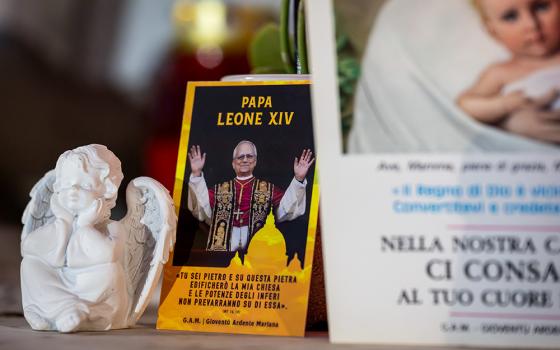
The Gospel calls Christians not to hasten apocalyptic conflict but to be "peacemakers" (Matthew 5:9). Within Catholic social teaching, as Pope Leo XIV reminded us, war is never holy. It remains a tragedy and a sign of human failure, not the unfolding of God's plan.
Ultimately, the church's role in relation to political power is neither withdrawal nor sacralization, but witness. Christians may pray for leaders, engage in public life, and work for justice and for the coming of God's kingdom. Nevertheless, they must remember that no political authority can claim to own or fully represent it. As the Apostle Paul reminds believers, "The kingdom of God is not food and drink but righteousness and peace and joy in the Holy Spirit" (Romans 14:17).