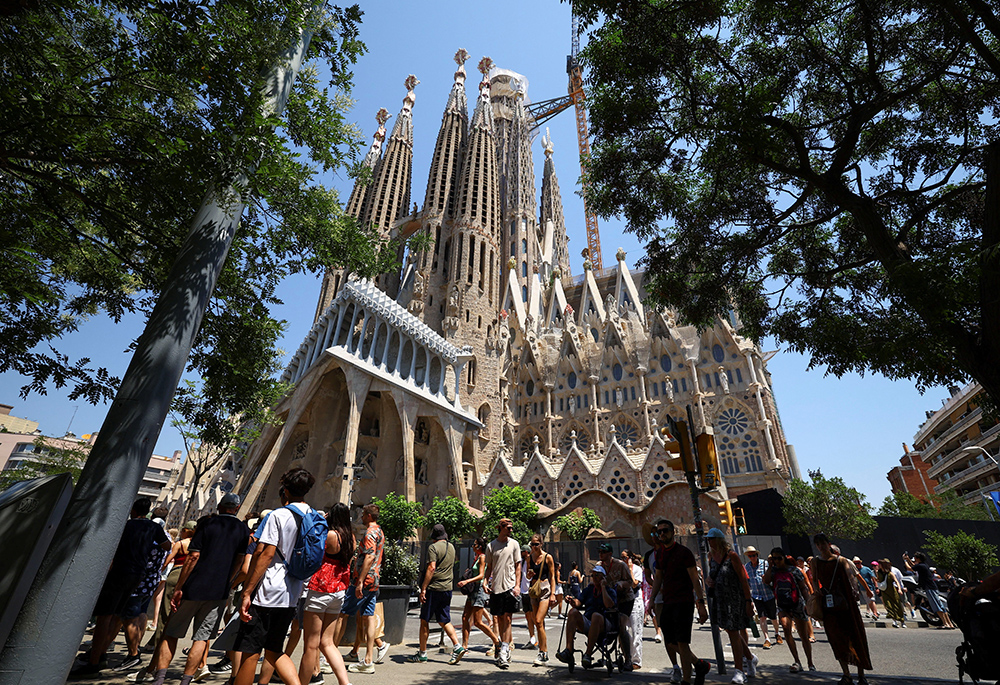
Groups of tourists walk around the Basilica of the Holy Family, known in Spanish as Sagrada Familia, in Barcelona, Spain, June 30, 2025. (OSV News/Reuters/Albert Gea)

by Vanessa R. Corcoran
Join the Conversation
Send your thoughts to Letters to the Editor. Learn more
As part of his apostolic trip to Spain and the Canary Islands, Pope Leo XIV arrives to the Catalan city of Barcelona today. Although much of his busy 6-day itinerary is focused on issues tied to the polarized political climate in Spain, his arrival to Barcelona allows for a spiritual reprieve. Tomorrow (June 10) Leo will visit the Sagrada Família (Holy Family) basilica, to inaugurate the newly finished Tower of Jesus Christ: the part of the basilica that officially makes it the tallest Catholic Church in the world (566 feet).
The visit is timed in recognition of the centenary of the famed Catalan architect Antoni Gaudí, who spearheaded the construction of Sagrada Família for 43 years, until his untimely death in 1926. The Catalan architect and designer was one of the major contributors of Catalan modernisme movement, and his numerous religious projects led to his nickname, "God's architect." Gaudí's complex vision for the famed basilica, as well as his other artistic contributions, reveals why Leo has opted to pay a special visit to one of the most iconic structures in Barcelona.
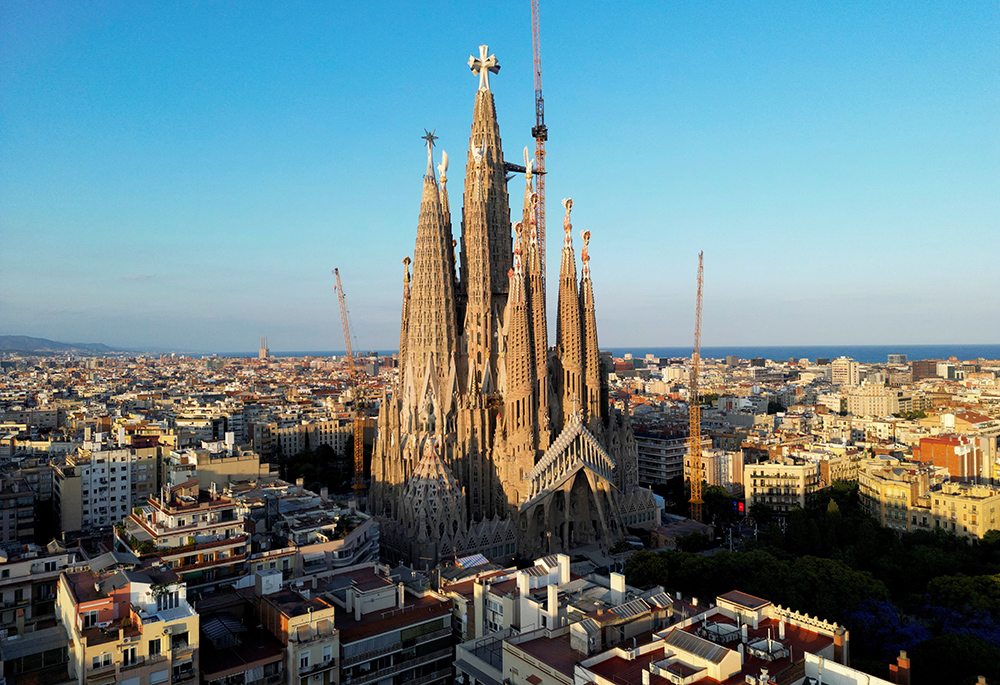
A drone shows the Basilica of the Holy Family, or Sagrada Família, in Barcelona, Spain, June 2, 2026, designed by Catalan architect Antoni Gaudi, ahead of Pope Leo XIV's June 6-12 apostolic visit to Spain. (OSV News/Reuters/Guillermo Martinez)
This trip comes on the heels of the release of Magnifica Humanitas, Leo's first encyclical, which largely focuses on preserving human dignity in the age of artificial intelligence. The teaching document is also a call to safeguard human creativity in the digital age. Writing about how we can "improve and beautify the world," Leo calls us all to consider how we can best be communal human collaborators, instead of yielding to automation.
Visiting Sagrada Familia provides Leo with the perfect opportunity to expand on his first major teaching document. In fact, the basilica is a physical demonstration of Leo's essential message: that creativity and collaboration requires multigenerational thinking and represents the embodiment of what makes us human.
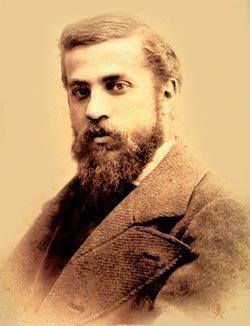
Antoni Gaudí (1852-1926) is pictured in an undated portrait. (OSV News/Wikimedia Commons/Pau Audouard Deglaire)
The long process of building Sagrada Família
Construction of Sagrada Família began in 1882, but Gaudí, who had already found widespread acclaim in Barcelona, took over as master architect in 1883. His design was ambitious in scope: calling for the construction of 18 different towers: representing the twelve Apostles, the four Evangelists, the Virgin Mary and Jesus. Facing critics who recognized the magnitude of the project and anticipated timeline of completion, Gaudí joked his "client" (God) was in no hurry. Gaudí abandoned all other projects besides the basilica in 1915. Gaudí was comfortable with the notion that he would not live to see its completion, noting, "There is no reason to regret that I cannot finish the church. I will grow old but others will come after me."
His vision of a multigenerational project was reminiscent of medieval builders, who laid the foundation of cathedrals knowing they'd never live to see their dream fully realized. Sadly, on June 7, 1926, Gaudí was hit by a tram and died 3 days later on June 10. Sagrada Família was only about a quarter complete at the time of Gaudí's death.
Advertisement
Although the Spanish Civil War temporarily halted construction, Sagrada Família continued to rise higher into the Barcelona skyline throughout the 20th century. In his designs for the church, Gaudí capped the height of the yet-to-be-created towers, so that they would never eclipse the nearby mountain Montjuïc, which he said was God's creation, not a human one. Sagrada Família became known as "the Bible in stone," as the different towers, carvings, stained glass windows and other decorative features work in harmony to tell biblical stories to the millions of visitors who travel to the basilica each year.
Jordi Faulí is the ninth and current architect of Sagrada Família, now in its 144th year of construction. Faulí has taken the basilica into the modern era, using 3D software to design and cut mosaic tiles. While his work stands on the shoulders of Gaudí, Faulí also said, "We're not his disciples, because that's not possible. But we are his successors, without doubt. Most of all, we're his collaborators." Though the completion of the Tower of Jesus Christ in February 2026 makes it now the tallest church in the world, it is still years away from its expected completion.
Papal interest in Gaudí
Pope John Paul II visited Barcelona in 1982 (the first pope to ever to do so). In visiting Sagrada Família, he noted, "The Sagrada Família commemorates another construction made with living stones: the Christian family." This phrase is now etched in stone on the Nativity façade. The cause for canonization was opened in 2003 during his pontificate. Pope Benedict XVI visited Sagrada Família on Nov. 7, 2010, and consecrated it as a minor basilica. During his homily, Benedict praised Gaudí as "a creative architect and a practicing Christian who kept the torch of his faith alight to the end of his life, a life lived in dignity and absolute austerity."
Though Pope Francis never made a visit to Spain during his 12-year pontificate, he did appear via video for the 2021 inauguration of the Tower of the Virgin Mary. In this address, Francis asked that his prayers, like everyone's, "are represented at Mary's feet on this beautiful Basilica." Just days before his passing, Francis declared Gaudí "venerable" on April 14, 2025.
Disarming the new Tower of Babel, praising Gaudí's human innovation
While we have yet to hear Leo's remarks when he blesses the Tower of Jesus Christ, it is possible that his comments on human beauty and creation within his first papal encyclical, Magnifica Humanitas, can offer a framework for how the new pope appreciates human innovators like Gaudí. While much of the news cycle focused on Leo's call to "disarm" artificial intelligence, the document is also a call to preserve human-generated creativity.
"Leo places humanity at a critical juncture, whether to build a new Tower of Babel or 'build the city in which God and humanity dwell together.' Gaudí's vision for Sagrada Família is the latter, in praise of God but a product of human labor and creativity."
—Vanessa R. Corcoran
In the opening paragraphs, Leo discusses the Tower of Babel as a collective human failure. He then exhorts us to abandon such desires so that "humanity will never lose its beauty, and the world once again will come to recognize the human heart as the place where God desires to dwell." While condemning "Babel syndrome" in the era of artificial intelligence, Leo urges readers to follow Nehemiah and build a "new Jerusalem." When the pope arrives in Barcelona on June 10 to bless the Tower of Jesus Christ, he is shedding light on a prime example of generations of human creativity and collaboration.
When Gaudí was asked about his legacy, he observed, "What must always be conserved is the spirit of the work, but its life has to depend on the generations it is handed down to and with whom it lives and is incarnated." It's fair to think that he would embrace Leo's stance on human creativity within Magnifica Humanitas. Leo places humanity at a critical juncture, whether to build a new Tower of Babel or "build the city in which God and humanity dwell together." Gaudí's vision for Sagrada Família is the latter, in praise of God but a product of human labor and creativity.