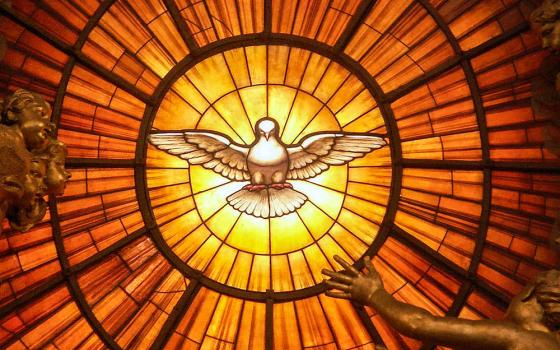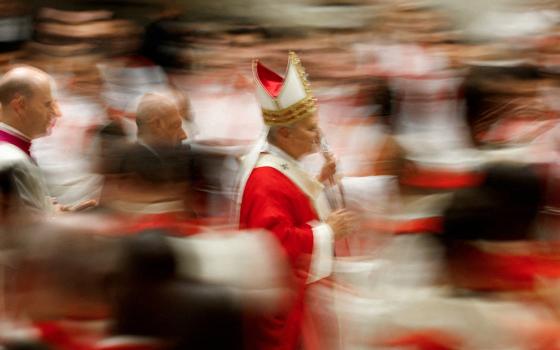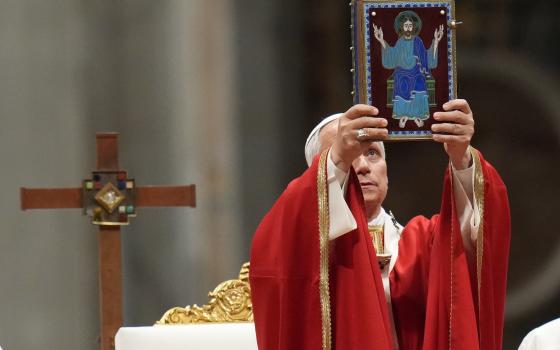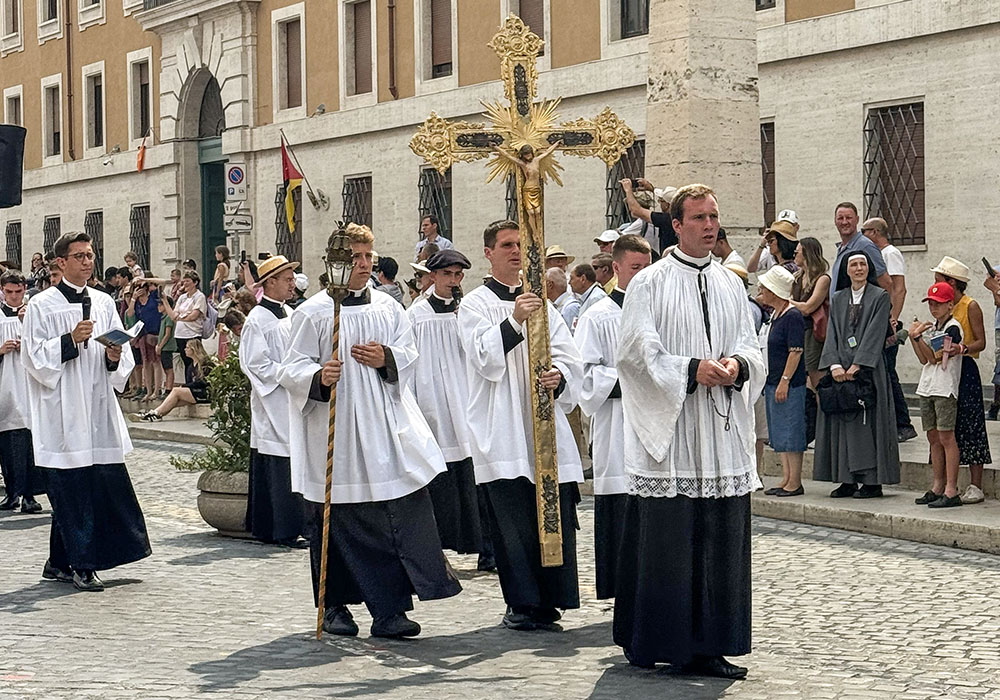
Seminarians and priests walk in procession to the Holy Door of St. Peter's Basilica at the Vatican Aug. 21, 2025. The men were among about 8,000 people who joined a pilgrimage sponsored by the traditionalist Society of St. Pius X. (CNS/Cindy Wooden)

by James Gordon Reid Haveloch-Jones
Join the Conversation
Send your thoughts to Letters to the Editor. Learn more
The traditionalist Society of St. Pius X has taken its decades-long feud with the Roman Catholic Church to a new breaking point. This year, the society announced it would once again consecrate new bishops without a papal mandate — an action that according to canon law incurs automatic excommunication.
Despite attempts at dialogue, and a last-minute June 30 appeal from Pope Leo XIV, the consecrations are set to occur today, July 1, in Econe Switzerland. The society plans to consecrate four men as bishops: Fr. Pascal Schreiber (Switzerland), Fr. Michael Goldade (United States), and Fr. Michel Poinsinet de Sivry and Fr. Marc Hanappier (both France).
The society, which differs with the Catholic Church on essential matters pertaining to the 1962-65 Second Vatican Council, including liturgical reform, was already excommunicated by Pope John Paul II in 1986 following illicit episcopal consecrations. But the group was partially rehabilitated under subsequent papacies.
However, Leo XIV and the Vatican have made it clear that they will uphold the excommunication automatically incurred by these new consecrations.
Ecclesiology teaches us that communion is never simple. It is tempting to treat the Society of St. Pius X as a group that has placed itself beyond the church's embrace. Yet such instincts sit uneasily beside the example of Jesus, who consistently sought those on the margins. Luke's parables of the lost coin, the lost sheep and the prodigal son remind us that discipleship involves seeking those who have strayed and guiding them home.
Advertisement
Leo reflects this Christ‑like posture, praying for the Holy Spirit to enlighten the society's members, rather than abandon them in their disobedience.
This moment invites a wider reflection on justice and peace within the church itself. Fracture, polarization and exclusion are not only ecclesial problems; they are wounds that affect communities, relationships and the credibility of our witness. The work of reconciliation begins at home. When parts of the body of Christ drift to the margins, the whole body suffers.
Recent ecumenical gestures, such as Leo's April 27 meeting with the archbishop of Canterbury, Sarah Mullally, remind us that his heart remains open to all separated brethren.
Mullally's gift of Lambeth Palace honey recalled Proverbs 24: "Eat honey, for it is good ... wisdom is sweet to your soul." That sweetness may be the recognition that the waters of baptism bind us more deeply than any ecclesiastical division. United in baptism as God's children, we are called to work for the healing of the wounds in the body of Christ.
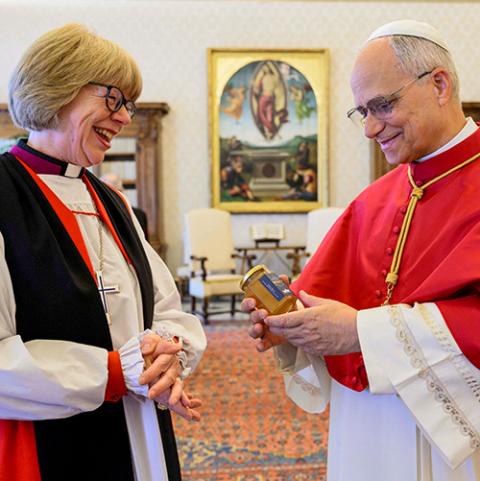
Pope Leo XIV receives a gift of honey from Anglican Archbishop Sarah Mullally of Canterbury during their meeting at the Vatican April 27, 2026. (OSV News/Vatican Media/Simone Risoluti)
Concepts from psychology deepen this insight. Carl Rogers invites us to offer one another, and our communities, the core conditions of unconditional positive regard, empathy and congruence. Without an atmosphere of "unconditional positive regard," or genuine empathy, and a desire to understand "the other," in this case the Society of St. Pius X, we cannot build an environment of trust or a place of discernment where the Holy Spirit can truly move with freedom.
Psychology also reminds us that honesty requires context. Rogers taught that congruence, the willingness to speak truthfully, cannot stand alone. Honesty spoken without unconditional positive regard and empathy breaks the relational trinity of trust. In such moments, what is offered is not truth in its fullest sense but mere fact deployed as a tool to shock, alarm, or distance. Only when unconditional positive regard, empathy, and congruence are held together can communities be genuinely heard, understood and accompanied.
The magisterium after Vatican II reinforces this call to deep listening. Pope Paul VI's Ecclesiam Suam placed dialogue at the heart of the church's mission, and the Vatican II document Gaudium et Spes insisted that authentic encounter begins with attentive listening to the joys and hopes, griefs and anxieties of others. The council taught that the church both speaks and learns, and that respect for conscience and the dignity of the other is essential for discernment.
This magisterial vision aligns closely with Rogers' insight. Only in an atmosphere of empathy, respect and honest presence can genuine understanding and the movement of the Holy Spirit take root.
The Society of St. Pius X situation is therefore not simply a canonical irregularity. It is a reminder of the human cost of division: the faithful caught between communities, the confusion about belonging, the deepening of wounds when dialogue breaks down. Justice, peace and reconciliation are not abstract ideals; they are lived realities shaped by how we respond to moments like this.
Pope Francis emphasized and taught the prophetic horizon of listening and the demands of dialogue. His call was not simply to speak, nor to retreat into abstract theological discourse, but to create space for reflection, encounter, disagreement, curiosity, humility and courage — the courage to engage respectfully in difficult conversations, led always by the spirit of truth.
As Francis reminds us: "Dialogue is born from a respectful attitude toward the other person, from a conviction that the other person has something good to say." The waters of baptism run deeper than any division we create. In them, Christ still calls his church to reconciliation.