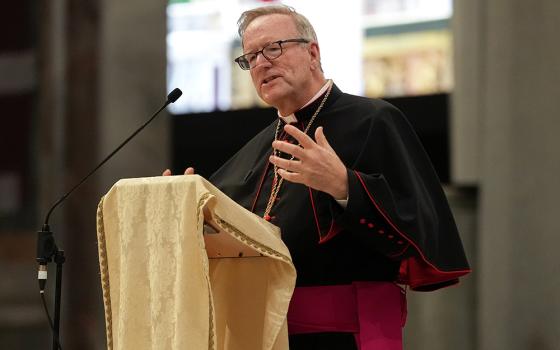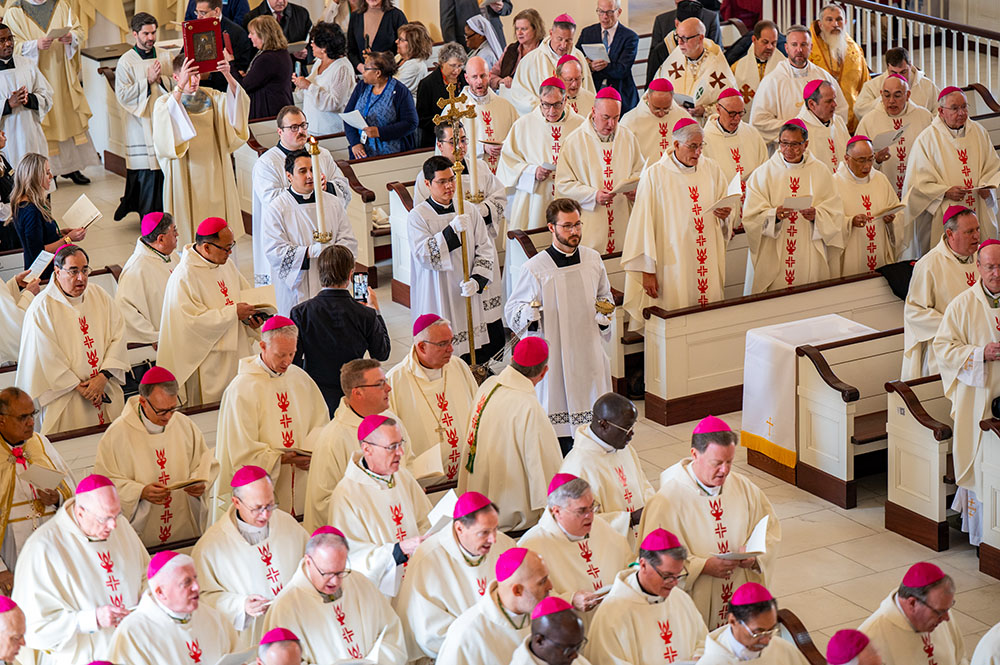
Bishops from around the country gather at the Basilica of the National Shrine of the Assumption of the Blessed Virgin Mary in Baltimore Nov. 10, 2025, for the opening Mass of the U.S. Conference of Catholic Bishops' fall plenary assembly. (OSV News/Catholic Review/Kevin J. Parks)

by Richard Torrenzano
Join the Conversation
Send your thoughts to Letters to the Editor. Learn more
Rebecca Bratten Weiss' critique of U.S. Catholic bishops rests on a premise she fails to establish: that bishops should operate as political actors, judged by how quickly they oppose an administration, in this case, that of President Donald Trump.
That premise does not hold. Without it, the argument collapses.
Catholic bishops are not elected officials. They are not accountable to voters or political cycles.
Their authority is moral and doctrinal, grounded in continuity of teaching. To judge that authority by political timing is to substitute immediacy for principle and alignment for independence.
That is the standard Bratten Weiss imposes. It is also where her argument breaks down.
She presents the bishops' response as a lapse in moral leadership while omitting policy actions that directly intersect with long-standing Catholic priorities.
A claim of inconsistency requires a complete record. A partial record cannot sustain it.
The Trump administration acted consistently in support of churches and religious institutions. The full policy record reflects that:
- Trump became the first sitting U.S. president to address the March for Life in person, and he restricted federal funding for abortion domestically and abroad.
- The administration reinstated the Mexico City Policy, limiting U.S. foreign aid to organizations that perform or promote abortion.
- Trump appointed federal judges and Supreme Court justices widely viewed by many Catholics and other Christians as supportive of pro-life and religious liberty positions.
- The White House Faith and Opportunity Initiative expanded engagement with faith-based organizations, including Catholic institutions.
- The administration directed aid, including to persecuted Christian communities in Iraq and Syria, to rebuild churches, homes and schools after the communities were freed from Islamic State control.
- Trump convened an international meeting on religious freedom, elevating global attention to the persecution of Christians and other religious groups.
- During his term, rules expanded conscience protections for health care workers and religious employers opposed to abortion on religious grounds.
- The administration's policies supported faith-based adoption and foster care agencies operating in accordance with religious beliefs.
- The administration condemned attacks on churches and sanctioned foreign officials responsible for religious persecution.
- His policy changes sought to ensure religious nonprofits could participate in public programs without abandoning their institutional identity.
Advertisement
These are not peripheral matters. They track directly with the church's stated priorities: the sanctity of life, religious liberty, and the protection of vulnerable faith communities.
Without this context, Bratten Weiss' conclusion that U.S. bishops were late in criticizing Trump is effectively predetermined.
Weiss applies an uneven standard. Long-standing church teaching — particularly on life — is treated as politically compromised, while her own policy judgments are framed as morally decisive.
The effect is to recast moral authority as agreement with a particular political critique rather than consistency across issues.
That shift has consequences. If bishops are expected to act as political counterweights — responding in real time to administrations — their authority becomes contingent on immediacy rather than continuity.
They move from independent moral voices to participants in the same arena they are meant to stand apart from.
That is not an expansion of their role. It is a fundamental shift in role.
If the objective is the common good, the measure is not speed of opposition but consistency of principle — whether engagement advances human dignity, protects fundamental freedoms and maintains coherence across issues.
A global institution committed to reconciliation should evaluate such efforts on their merits, not their political associations.
The United States benefits when religious institutions remain independent of partisan expectations. That independence allows them to speak with moral clarity rather than political alignment.
Bratten Weiss' argument would make that independence more conditional, undermining the very moral authority of the bishops that she invokes.